
An antiderivative reverses a derivative, but that reversal cannot recover information that differentiation erased. Because every constant has derivative zero, one rate function usually corresponds to an entire family of original functions. Initial information selects one member from that family. This lesson develops integration rules as reversed differentiation rules rather than as disconnected formulas. Every result is checked by differentiation, interpreted on an interval, and connected to units when the variables represent physical quantities.
Learning objectives and the recovery problem
By the end of this lesson, you will identify and describe antiderivative families. You will derive basic indefinite-integration rules from known derivative rules. You will use algebra and substitution to reveal reverse-derivative structure. You will apply initial conditions with appropriate units and intervals. You will also distinguish an indefinite integral from a definite integral and verify answers by differentiation.
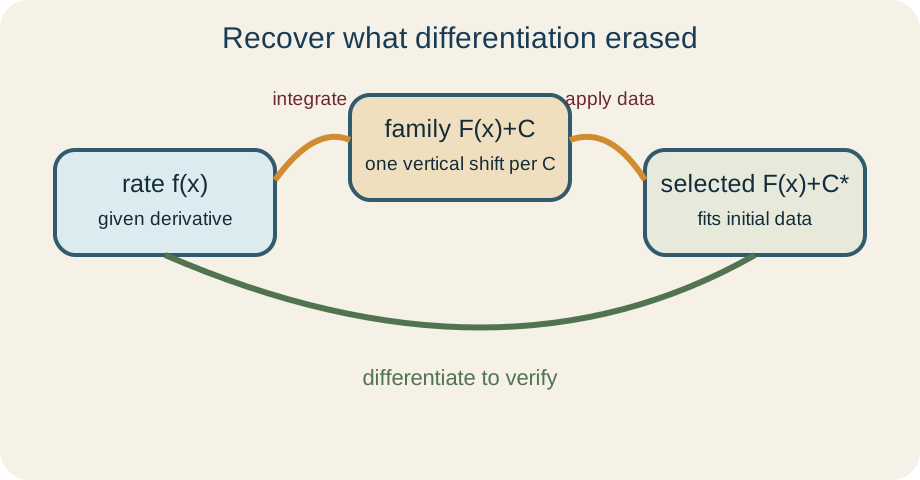
Derivatives turn functions into rates of change. If position is measured in meters and time in seconds, then velocity is measured in meters per second. Recovering position from velocity is an antiderivative problem. The rate tells how positions differ, but it does not reveal the reference position by itself. A separate position measurement supplies that missing vertical location.
The core reasoning loop has three directions. Differentiate a candidate to check the given rate, integrate a rate to produce a family, and apply data to choose one member. These steps should remain conceptually distinct even when an exercise compresses them. The overview below shows where the arbitrary constant enters and where an initial condition removes its freedom. That structure repeats in motion, growth models, and differential equations.
Define antiderivatives and families
A function is an antiderivative of on an interval when at every point of that interval. The prime denotes differentiation with respect to . The statement is local to the stated interval because domains can be disconnected. If and are both antiderivatives there, then . The Mean Value Theorem implies that is constant on that interval.
The indefinite-integral notation is . The elongated symbol signals antiderivative recovery, is the integrand, and identifies as the integration variable. The symbol represents an arbitrary constant. It does not mean one fixed universal number. It means every function obtained by choosing a real constant belongs to the family.
For example, every function has derivative . The graphs are vertical translations of the same parabola. Their tangent slopes match at every common input even though their heights differ. Differentiation collapses this entire family to one derivative function. Integration restores the family but cannot select a height without more information.
Reverse the power and linearity rules
For , the power rule for antiderivatives is . To verify it, differentiate the right side. The derivative of is , and division by cancels that coefficient. The exponent increases by one because differentiation had decreased it by one. The denominator compensates for the new exponent’s derivative coefficient.
The excluded exponent would make the denominator zero. Its integrand is . On any interval that does not cross zero, . The absolute value accommodates both positive and negative inputs. Differentiating gives wherever .
Linearity says constants and sums can be handled term by term. In symbols, . The letters and are constants with respect to . One arbitrary constant at the end represents the full combined family. Writing a different constant after every term is redundant because their sum is another arbitrary constant.
Use algebra before integrating
Integration is easier after the integrand’s structure is visible. Expand products when expansion creates separate powers, split a fraction across numerator terms when valid, and rewrite roots as fractional exponents. These transformations must preserve the domain of the original expression. Algebra is not separate preliminary work; it is part of selecting the reverse derivative pattern. A cleaner integrand reduces both computational and conceptual errors.
For , rewrite . Integrating term by term gives . The horizontal fraction bars make the coefficient division explicit. Differentiating produces . This equals the original integrand on each interval that excludes zero.
Be careful when splitting denominators. The identity is valid, but cannot be split into separate fractions. Likewise, cancel only common factors rather than terms joined by addition. If simplification cancels a factor that was zero at some input, preserve that original restriction. Antiderivative statements must remain tied to the integrand’s true domain.
Recognize standard reverse derivatives
Basic derivative facts generate a table of antiderivatives. Since , it follows that . Since , it follows that . Since , it follows that . Each rule should be verified rather than memorized without its sign.
Scaling inside an exponential changes the needed coefficient. Because , the antiderivative is for nonzero constant . The factor compensates for the chain-rule factor . For example, . Differentiation returns exactly.
Trigonometric antiderivatives also depend on inner scaling. Since the derivative of is , . Similar reasoning applies to many simple compositions. Do not insert a reciprocal factor unless differentiation of the proposed answer confirms it. Reverse-chain reasoning, not superficial appearance, determines the coefficient.
Use substitution as the reverse chain rule
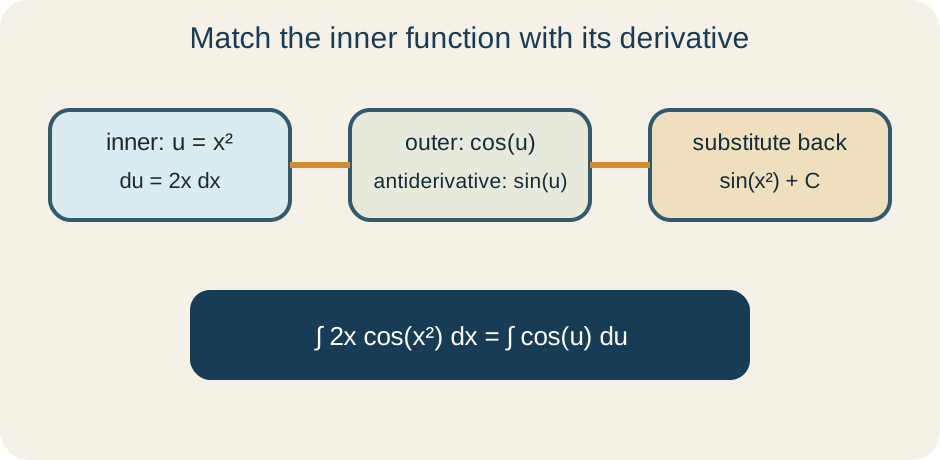
Substitution applies when an integrand contains a composite function together with the derivative of its inner function. If , then . The notation packages the chain-rule relationship into a new integration variable. The goal is to rewrite the entire integral in terms of and . Mixing leftover terms with usually signals an incomplete substitution.
Consider . Choose , so . The integral becomes . Substituting back gives . Differentiation produces and confirms the result.
If the inner derivative differs by a constant factor, compensate algebraically. For , use , so and . The result is . The missing factor of two is a common error. A derivative check exposes it immediately.
Apply initial conditions
An equation such as determines a family . An initial condition selects the member passing through the point . Substitution gives . Solving yields . The final function should satisfy both the differential equation and the initial condition.
Suppose and . Integrating gives . Applying the condition gives . Therefore and . Differentiation returns , while evaluation at two returns seven.
The initial input need not be zero. A condition at is just as usable as one at . In applications, it may mark the time at which an instrument begins recording rather than the process’s true beginning. Keep the time origin and the initial condition distinct. A shifted form can sometimes express the reference more clearly than expanding everything around zero.
Recover motion with units
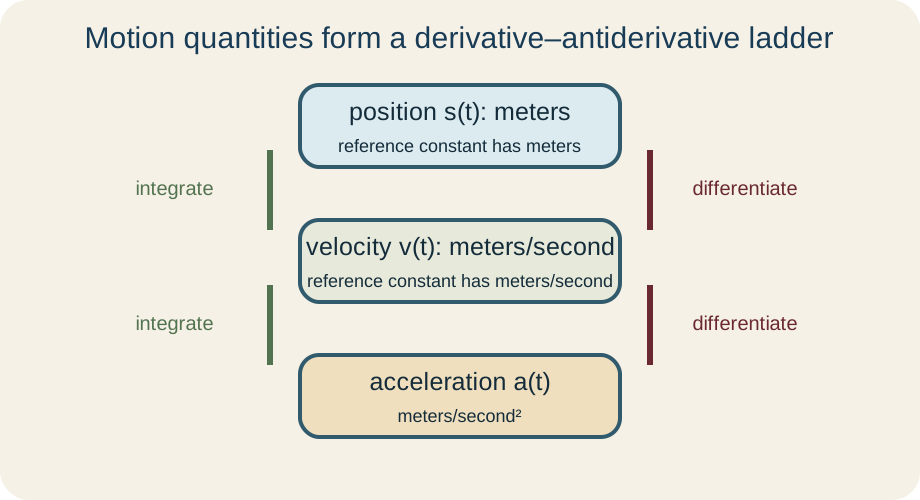
Suppose acceleration is , initial velocity is , and initial position is . Integrating acceleration gives . The constant must have velocity units. The initial condition gives . Thus velocity is fully determined.
Integrating velocity gives . Each displayed term has units of meters when is in seconds. The condition gives . Position requires a new constant because the second differentiation erased another layer of information. Two initial conditions are expected for a second-order recovery problem.
Units diagnose structural mistakes. Integrating acceleration over time must produce velocity units, and integrating velocity over time must produce position units. A constant added to velocity cannot have position units. If the powers of time fail to cancel unit denominators correctly, revisit the coefficient. Dimensional consistency does not prove an answer, but inconsistency proves that something is wrong.
Respect intervals and disconnected domains
The statement that two antiderivatives differ by one constant requires a connected interval. For , the domain is split into and . No path within the domain crosses zero. An antiderivative may use one constant on the negative interval and another on the positive interval. A single written applies only after an interval has been selected.
The expression differentiates correctly on either interval. It does not create a continuous antiderivative across zero because neither the integrand nor the logarithm is defined there. One could define for and for . The constants and are independent. Differentiation cannot relate values across the missing point.
Domain restrictions can also arise from roots, denominators, and inverse trigonometric functions. State an interval on which the integrand and proposed antiderivative are defined. If algebra simplifies a removable factor, remember the original excluded point. The derivative check should be made only on the intended interval. This precision prevents a locally valid formula from being overstated globally.
Distinguish indefinite and definite integrals
An indefinite integral denotes a family of functions. It contains an arbitrary constant and leaves the input variable free. A definite integral such as denotes a number obtained from a limit of sums. Its lower and upper limits are and . No arbitrary constant belongs in the final numerical value.
The notations are connected by the Fundamental Theorem of Calculus but should not be conflated. If , then . Any constant in the antiderivative cancels in the subtraction. The definite integral measures signed accumulation over an interval. The indefinite integral answers which functions have derivative .
A reference-state form anticipates this connection. If , then . The symbol is a dummy integration variable, so it does not conflict with the upper limit . This form displays the known reference position and accumulated change separately. It also preserves units because velocity multiplied by a time increment produces displacement.
Verify and diagnose solutions
Differentiate every antiderivative result. The derivative should reproduce the original integrand exactly on the stated interval. If it differs by a constant factor, revisit chain-rule compensation. If a sign differs, inspect trigonometric derivatives. If an extra term appears, check algebra and the handling of constants.
Do not omit from an indefinite integral. Do not add to a definite integral’s numerical result. Do not use the power formula at exponent , where division by zero would occur. Do not treat as decoration while changing variables inconsistently. Each mistake reflects a lost piece of meaning rather than a mere formatting issue.
A disciplined workflow begins with domain and algebra. Identify the reverse derivative pattern, integrate, and include one arbitrary constant for the resulting family. Apply initial data only after the general family is known. Differentiate the final expression and test all supplied conditions. Finish by checking units and contextual restrictions.
Guided practice and synthesis
Find . Apply linearity and the power rule term by term. The result is . Differentiation gives . The derivative check confirms every coefficient and exponent.
Solve with . The antiderivative family is . Substitution gives , so . The selected solution is . It satisfies both the rate equation and the initial value.
For independent synthesis, solve with . Explain the units of the antiderivative coefficient and the dimensionless exponent. Apply the initial condition without dropping units. Differentiate your result to verify the current-like rate. Then describe the long-term value predicted by the model.
Connection forward
Antiderivatives recover functions from their rates but produce families because differentiation erases constants. Integration rules reverse derivative rules, while substitution reverses the chain rule. Initial conditions restore missing reference information. Domain intervals and physical units constrain what a symbolic answer means. Differentiation supplies a direct and decisive verification method.
The deepest habit is to narrate the recovery. Name the quantity being recovered, explain the role of , and connect each coefficient to a derivative rule. If data select one member, show that substitution explicitly. If the domain is disconnected, state the interval. If quantities carry units, preserve them through every integration.
The definite integral introduces accumulation through limits of sums. The Fundamental Theorem then proves that accumulation and antiderivative recovery are inverse aspects of calculus. Differential equations extend the initial-value idea to rates that depend on the unknown function itself. Techniques of integration broaden the reverse-derivative patterns available. The family-and-reference framework developed here remains essential in each topic.