
Special relativity is a theory of measurement before it is a collection of surprising formulas. It asks how observers assign coordinates to events when they move uniformly relative to one another. The theory preserves ordinary cause and effect while replacing universal time with a frame-dependent division of spacetime. Its predictions become conspicuous near the speed of light, yet its logical structure applies at every speed. This lesson develops that structure from definitions, diagrams, calculations, and consistency checks.
Establish the measurement problem
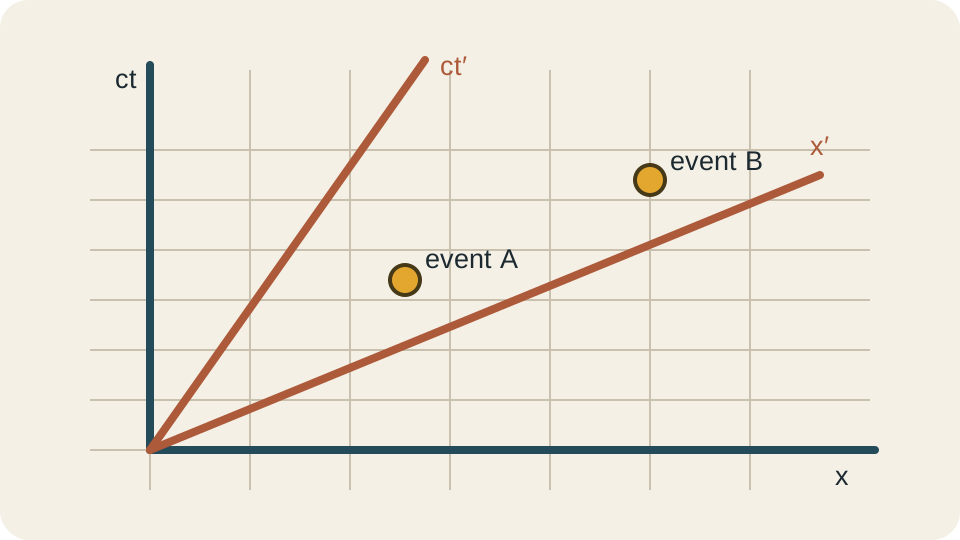
An event is something that occurs at a particular place and time, such as a flash emitted at the center of a train car. An observer in relativity means an entire reference frame equipped with synchronized clocks and position markers, not merely one person looking from one location. A frame assigns coordinates to every event. The symbol denotes spatial position along a chosen axis, and denotes the reading of the synchronized clock at that position. Two frames may assign different coordinates to the same event without disagreeing that the event occurred.
An inertial frame is a frame in which a free object moves with constant velocity. The word free means that the net external force on the object is zero. A train gliding at constant velocity is approximately inertial during a sufficiently short experiment, whereas a train braking sharply is not. Special relativity compares inertial frames and does not initially attempt to model gravity. This restriction lets us isolate the effects of relative motion from the effects of acceleration and curved spacetime.
Operational definitions prevent vague phrases such as “what an observer sees” from causing errors. Light-travel delay can change a visual appearance, but relativistic measurements are defined after those delays are accounted for. A length measurement requires recording the positions of both ends at the same time in the measuring frame. A time interval requires identifying two events and subtracting their assigned time coordinates. Careful attention to the measurement procedure is therefore part of the physics rather than an optional philosophical detail.
Begin with Einstein’s two postulates
The first postulate states that the laws of physics have the same form in every inertial frame. No sealed laboratory moving at constant velocity can determine a privileged state of absolute rest by an internal experiment. Mechanical, electromagnetic, and all other fundamental laws must obey this equivalence. Relative velocity still matters because it relates the measurements made in different frames. What disappears is the idea that one inertial frame is fundamentally more correct than another.
The second postulate states that light in vacuum has the same measured speed in every inertial frame. Numerically, to four significant figures. The symbol is not the speed of a particular lamp or pulse but a universal invariant speed. A moving source does not add its velocity to in the classical manner. Every inertial observer who performs the proper distance-and-time measurement obtains the same value.
These postulates conflict with Galilean coordinate transformations at high speed. Under Galilean reasoning, time is shared universally and velocities simply add, so a light pulse would have different measured speeds in different frames. Experiments instead support invariant light speed and the Lorentz transformations. Space and time measurements must therefore adjust together so that every inertial frame preserves . Time dilation, length contraction, and relativity of simultaneity are connected consequences of that single adjustment.
Use a light clock to predict time dilation
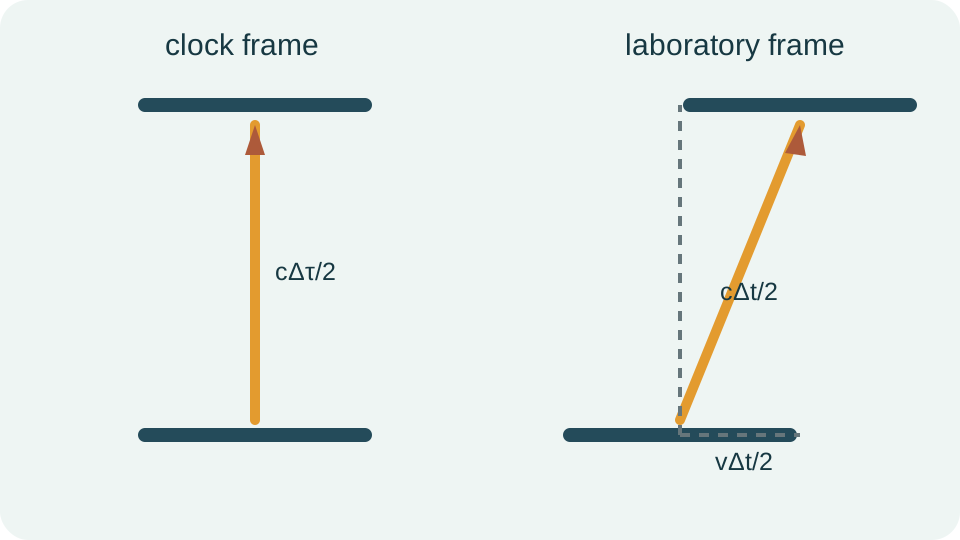
Imagine a clock that counts one tick whenever a light pulse travels from a lower mirror to an upper mirror and back. In the clock’s rest frame, the pulse travels vertically through a fixed distance. Let the time between two selected events on that clock be . The Greek letter tau, , labels proper time, which is the time measured by one clock present at both events. Proper time is attached to a particular path through spacetime rather than to every frame universally.
In a frame where the clock moves horizontally, the same pulse follows a longer diagonal path. The speed of the pulse remains , so the longer path requires a larger coordinate-time interval . Applying the Pythagorean theorem to half of the light-clock journey produces . Here is the relative speed between the clock and the measuring frame. Solving this equation connects geometry directly to the time-dilation formula.
Rearrangement gives , where is the Lorentz factor. Since is never smaller than one, the coordinate interval is at least as large as the proper interval. The phrase “moving clocks run slow” summarizes this comparison but can be misleading if events and frames are not specified. The correct statement is that the proper time along the clock’s path is smaller than the coordinate time between those same events in a frame where the clock moves. This relation is reciprocal between inertial frames because each comparison uses a different pair of spatially separated clocks for the coordinate measurement.
Interpret the Lorentz factor
The Lorentz factor is . The numerator is the dimensionless number one, and the denominator contains the ratio . Because both and have units of speed, their ratio and therefore are dimensionless. Squaring the ratio removes any sign distinction between motion in the positive and negative directions. Only the magnitude of relative velocity controls the factor.
At , the denominator is one and . At speeds much smaller than , the quantity is tiny, so differs imperceptibly from one. At , the factor is . At , it is approximately . As approaches , the denominator approaches zero and grows without bound.
Dimensional and limiting checks should accompany every use of this formula. A Lorentz factor with units signals an algebra or substitution mistake. A calculated value below one is impossible for a real subluminal speed. A low-speed answer should agree closely with classical mechanics. These checks reveal errors before a numerical result is accepted merely because a calculator produced it.
Calculate a dilated lifetime
Suppose an unstable particle has a proper mean lifetime of and moves through a laboratory at . The prefix micro, written , means , so the lifetime is . The particle is present at both its creation and decay events, so a clock moving with the particle would measure the proper time . The laboratory assigns different positions to those events and measures the coordinate interval . Identifying which interval is proper is the conceptual step that determines the equation.
The factor is . Therefore . Units remain microseconds because the Lorentz factor is dimensionless. The laboratory lifetime is longer than the proper lifetime, as the inequality requires. This magnitude check supports the calculation.
During that laboratory interval, the particle travels approximately . Substitution gives to three significant figures. Without time dilation, a classical estimate would give only about . Detecting particles much farther than their proper lifetime would classically allow is direct evidence for relativistic timing. The example connects an abstract clock comparison to a measurable track length.
Define proper length and length contraction
The proper length of an object is measured in the frame where the object is at rest. In that frame, the endpoints remain at fixed coordinates, so their positions need not be recorded simultaneously with special care. A frame in which the object moves measures a contracted length parallel to the motion. The measured relation is . The subscript zero marks a rest-frame quantity rather than a value that is universally preferred.
Simultaneity is essential because a moving object’s endpoints occupy changing positions. The measuring frame must record both endpoint positions at the same time according to its own synchronized clocks. Another frame generally disagrees that those endpoint measurements occurred simultaneously. The two frames therefore use different pairs of endpoint events when measuring the object. Length contraction is a consequence of this measurement structure, not a physical crushing force acting on the object.
Only the dimension parallel to relative motion contracts. Transverse dimensions do not acquire the same factor because that would make frames disagree about whether two passing marks align. The formula also does not say that an object sees itself contracted in its own frame. Its own frame always measures the proper length . Every use of the equation should name the object, its rest frame, the measuring frame, and the direction of motion.
Solve a contracted-length example
A spacecraft has proper length and passes Earth at . Since , observers in Earth’s inertial frame measure . The unit remains meters because division by a dimensionless factor does not change dimensions. The result is smaller than the proper length, as contraction requires. Stating “Earth measures 96.0 meters” prevents the number from floating free of its frame.
The spacecraft crew measures the ship’s length as . They can also say that Earthbound distances parallel to the motion are contracted in the spacecraft frame. These statements are not contradictory because proper length belongs to whichever object is at rest in the selected frame. Reciprocity does not mean that one object possesses two frame-independent physical sizes. It means that length is a relation between a spatially extended object and a simultaneity convention.
If the ship must fit inside a hangar in Earth’s frame, the Earth-frame lengths suggest that both doors could briefly close. In the ship frame, the contracted hangar is shorter than the ship, but the door-closing events are not simultaneous. The front door can close and reopen before the rear door closes in that frame. No frame predicts a collision if the complete event sequence is transformed correctly. Apparent paradoxes often expose an omitted simultaneity analysis rather than a failure of relativity.
Understand relativity of simultaneity
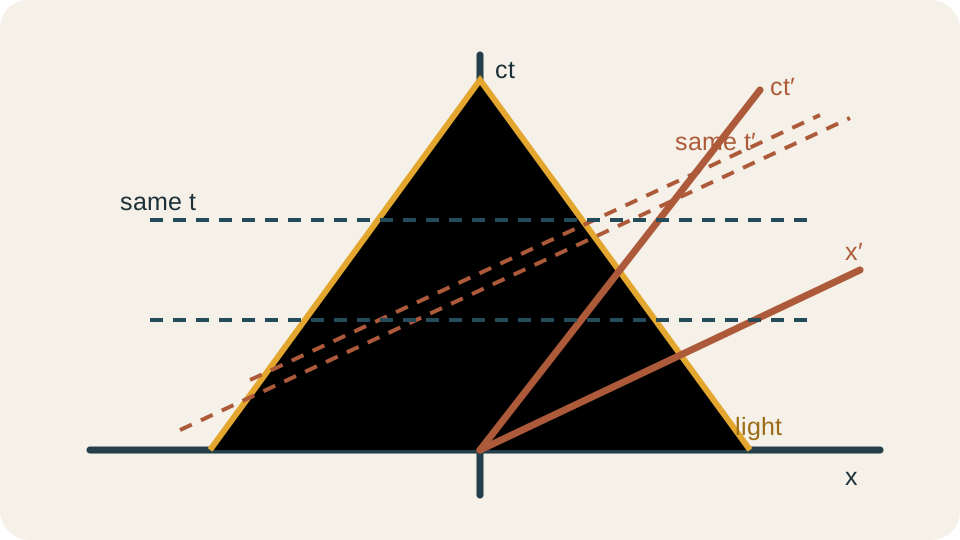
Consider two lightning strikes at opposite ends of a platform. A platform observer midway between them receives both flashes together and, after correcting for equal travel distances, concludes that the strikes were simultaneous. A train observer moving toward one strike and away from the other receives the flashes at different times. Reception time alone is not the final argument, because both observers can correct for light travel. After applying their own synchronized clock network, they still assign different times to the spatially separated events.
The Lorentz time transformation is . The prime labels measurements in a second inertial frame. If two events are simultaneous in the unprimed frame, then , but a nonzero separation generally makes nonzero. The term has units of seconds and quantifies the synchronization shift. Events at the same position, for which , do not acquire this particular simultaneity difference.
Relativity of simultaneity protects the internal consistency of time dilation and length contraction. Without it, reciprocal claims about moving clocks would create genuine contradictions. With it, frames compare different networks of synchronized clocks and different slices of spacetime. Simultaneity becomes frame dependent, while causal order remains invariant for events that can influence one another. This distinction is the bridge from intuitive puzzles to precise spacetime reasoning.
Preserve the spacetime interval
For two events separated in one spatial dimension, define the squared interval as . The symbol means final value minus initial value, so and . Multiplication by converts a time separation into a length scale. Both terms therefore have units of square meters. Different inertial frames disagree about the individual terms but agree about their difference.
If , the separation is timelike and a slower-than-light signal could connect the events. A frame exists in which the events occur at the same position, and the interval can be written . If , the separation is lightlike and only a signal traveling at connects them. If , the separation is spacelike and no causal influence traveling at or below can connect them. The sign class is invariant even though time and distance coordinates vary.
For the moving particle example, the laboratory measurements satisfy . Substituting produces . Dividing by and solving recovers . The interval therefore unifies time dilation with a deeper geometric invariant. It plays a role in spacetime analogous to the squared distance preserved by rotations in ordinary Euclidean geometry.
Use Lorentz coordinate transformations
Let frame move in the positive direction at speed relative to frame . If their origins coincide when both clocks read zero, the transformations are and . The first equation mixes space with time, and the second mixes time with space. This mixing is necessary to preserve invariant light speed. Setting returns and .
A light ray moving in the positive direction satisfies . Substitution gives and . Dividing produces , so the second frame also measures light speed . The same conclusion holds for a ray moving in the negative direction. This check demonstrates how the coordinate rules encode the second postulate.
Signs require a declared frame convention. Reversing which frame moves changes the sign of and gives the inverse transformation. Memorizing an isolated minus sign is less reliable than drawing the axes and describing the motion in words. Units also provide a safeguard because must have units of length and must have units of time. A transformation term with mismatched units cannot represent a physical coordinate.
Recover ordinary mechanics at low speed
A successful new theory must reproduce a well-tested older theory in the older theory’s domain. When is very small, is approximately one. The Lorentz position transformation then approaches . The synchronization term becomes negligible, so . These are the familiar Galilean transformations used in Newtonian mechanics.
For a car moving at , the ratio is about . Its square is about , making extraordinarily small. Ordinary clocks and rulers cannot reveal the corresponding corrections in everyday travel. Newtonian mechanics works so well because it is the low-speed approximation to relativity. Approximate validity is different from fundamental exactness.
The low-speed limit is a powerful diagnostic when deriving or selecting formulas. A proposed relativistic result that fails to approach the classical result as is suspect. The arrow indicates a limiting process, not ordinary equality at a finite speed. Checking limits connects new knowledge to familiar structure and reduces formula memorization. It also shows that relativity extends classical mechanics rather than simply discarding it.
Repair common misconceptions
Relativistic effects are not merely optical illusions. Photographs contain additional light-travel and aberration effects, but corrected coordinate measurements still show time dilation, length contraction, and changed simultaneity. The theory predicts readings on clocks and detector arrays, not only appearances to human eyes. Particle lifetimes and precision clock experiments agree with these predictions. Calling the effects illusions therefore erases the operational evidence.
No material object with nonzero rest mass is accelerated through the light-speed boundary by finite energy. The growth of relativistic energy and momentum becomes unbounded as approaches . This statement does not mean that an object moving near feels its own clock running abnormally. Locally, its proper time proceeds normally and physical laws retain their usual form. Relativity compares measurements across frames rather than assigning a universal slowdown to one traveler.
The slogan “everything is relative” is also inaccurate. The speed of light, spacetime interval, causal structure, and laws of physics are invariant. Frames disagree in precisely constrained ways rather than arbitrarily. A good explanation states both what changes and what remains fixed. Invariants are what make relativistic disagreements mutually consistent and scientifically testable.
Practice a complete reasoning routine
For each problem, first identify the two events and the frames that assign their coordinates. Next decide whether a stated time is proper time or whether a stated length is proper length. Then compute and with units and significant figures under control. Select a relation only after those definitions are fixed. Finally check direction, magnitude, dimensions, and the low-speed limit.
As practice, consider a probe moving at with an onboard elapsed time of . The Lorentz factor is , so Earth measures to three significant figures. The onboard interval is proper because one probe clock is present at both departure and arrival events along the probe’s path. Earth measures the corresponding travel distance as , using the fact that light travels one light-year per year. The probe frame instead measures that Earth-frame distance contracted to approximately .
Explain in words why the two distance-time accounts agree on the encounters. Earth divides by and obtains about . The probe divides the contracted by and obtains . Each calculation uses distance and time measured in the same frame. Mixing Earth’s distance with the probe’s time would create an invalid hybrid calculation.
Consolidate the spacetime framework
Special relativity begins with equivalent inertial frames and invariant light speed. Those commitments require a Lorentz factor, frame-dependent simultaneity, time dilation, and length contraction. The spacetime interval remains invariant while separate space and time components change. Proper time and proper length are defined by specific measurement conditions. Every formula is therefore a statement about events, frames, and procedures rather than a free-standing numerical rule.
The most reliable conceptual sequence is event identification, frame labeling, proper-quantity recognition, equation selection, and physical checking. Diagrams support that sequence by showing paths and simultaneity surfaces. Units expose malformed substitutions, and limits connect relativistic results to ordinary experience. Worked examples become meaningful when every number is attached to a frame and operational definition. This discipline prevents nearly every introductory relativity paradox.
Later work extends this foundation to relativistic momentum, energy, Doppler shifts, and four-vectors. General relativity then treats gravitation through curved spacetime and locally inertial frames. Those developments preserve the central habit learned here: search for invariant structure beneath observer-dependent coordinates. Relativity is not permission for arbitrary perspectives. It is a precise account of how different measurements fit into one coherent physical world.