
Atoms do not exchange internal energy in arbitrary amounts. A bound atom occupies one of a discrete set of quantum states, and each state has a permitted energy. Light can be absorbed or emitted when the atom changes states and the photon energy matches the state-energy difference. This quantization produces sharp spectral lines rather than a continuous rainbow. Those lines provide experimental evidence about atomic structure even though the states themselves cannot be seen directly.
The word “level” can tempt us to imagine a tiny electron sitting on a circular shelf. That picture is useful only within strict limits. Modern quantum mechanics describes a state through a wavefunction and associated probabilities, not a definite planetary path. Energy-level diagrams represent allowed energies and transitions without claiming literal spatial tracks. This lesson uses the diagrams as accounting tools and then distinguishes what the hydrogen model predicts from what it cannot explain.
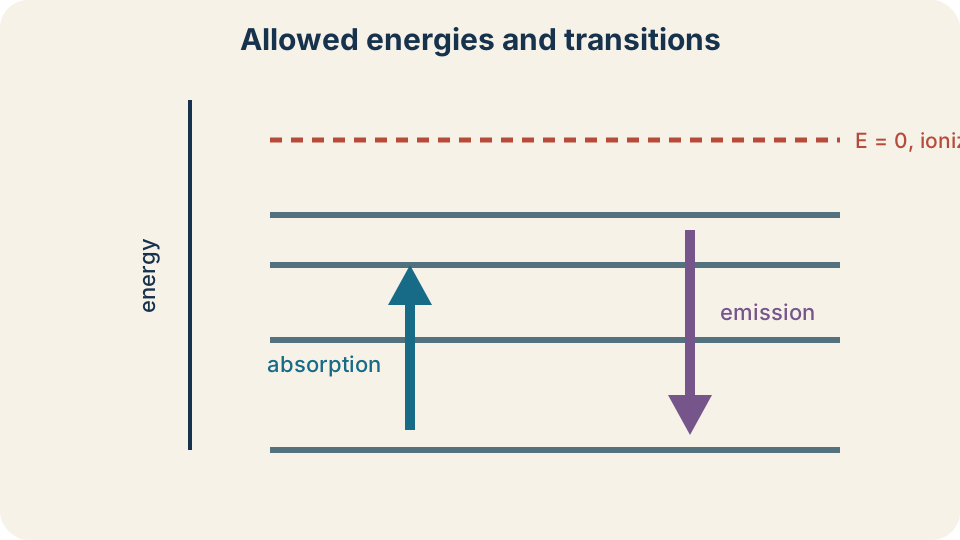
Horizontal lines represent allowed energies rather than physical shelves in space. An upward arrow requires absorbed energy. A downward arrow can release a photon. The arrow’s vertical length represents the magnitude of the energy difference. The continuum begins at the chosen zero-energy ionization threshold.
Read an energy-level diagram
An energy-level diagram places energy on a vertical axis. Each horizontal line represents an allowed stationary-state energy. A line drawn higher on the page represents a state with greater energy under the chosen reference. The spacing between lines matters more than their absolute drawing height. A transition arrow connects an initial state to a final state.
Let denote initial-state energy and denote final-state energy. The change in atomic energy is . If , the change is positive and the atom must gain energy. If , the change is negative and the atom loses internal energy. Energy conservation transfers the opposite amount to or from the radiation field.
Energy diagrams should not be read as orbital-radius diagrams. A higher energy often corresponds to a more spatially extended hydrogen state, but the vertical coordinate itself is energy. Different diagrams can use different reference zeros while preserving all physical differences. The diagram is therefore an abstract bookkeeping representation. Its purpose is to make allowed gaps and transition directions visible.
Connect energy gaps to photons
A photon has energy , where is Planck’s constant and is photon frequency. In SI units, exactly. Because frequency has units , the product has joules. For light in vacuum, , where and is wavelength. Combining the relations gives .
For a one-photon transition, conservation requires . Absolute-value bars ensure that photon energy is reported as a positive magnitude. During absorption, and the atom gains the photon’s energy. During emission, and the photon carries away . A larger energy gap corresponds to higher frequency and shorter wavelength.
The relationship is exact for an ideal isolated transition when recoil and line broadening are neglected. It does not mean an atom absorbs every photon that passes nearby. The photon must match an allowed energy gap and the transition must satisfy quantum selection rules. Interactions and finite lifetimes can broaden a line over a narrow range. The central gap nevertheless determines the characteristic spectral frequency.
Distinguish absorption and emission
Absorption begins with an atom in a lower state and ends in a higher state. The incident photon disappears as its energy is transferred to the atom. A bound-to-bound transition requires a matching discrete photon energy. A photon with insufficient energy cannot bridge the gap. A photon with a nonmatching larger energy is not automatically partly absorbed in an isolated one-photon process.
Emission begins with an atom in an excited state. A downward transition releases energy, often as a photon. Spontaneous emission occurs without an incoming photon, whereas stimulated emission is prompted by radiation of the matching frequency. The emitted photon’s energy equals the state gap. Repeated atoms undergoing the same transition produce the same characteristic spectral line.
An atom in a stationary state does not continuously radiate merely because its electron has charge. That classical prediction contributed to the failure of planetary-orbit models. Quantum stationary states have time-independent observable energy distributions apart from phase evolution. Radiation accompanies a transition or interaction rather than ordinary persistence in a state. This distinction stabilizes atoms within quantum theory.
Establish the hydrogen energy model
For ideal hydrogen, the bound-state energies are for . The integer is the principal quantum number. The electronvolt, abbreviated , is an energy unit defined by . The numerator is hydrogen’s ground-state binding-energy magnitude. The square in the denominator makes higher levels crowd progressively closer together.
The ground state has and energy . The first excited principal level has and . The level has approximately . Increasing raises the energy because the values become less negative. It does not increase the binding magnitude.
The formula applies to the nonrelativistic hydrogen atom under a simplified treatment. Hydrogen-like ions with one electron can use a related expression containing nuclear charge . Multi-electron atoms require electron–electron interactions, shielding, and more quantum numbers. Fine structure, hyperfine structure, and external fields introduce additional splitting. The hydrogen formula is foundational because it reveals quantized energy, not because it is universally exact.
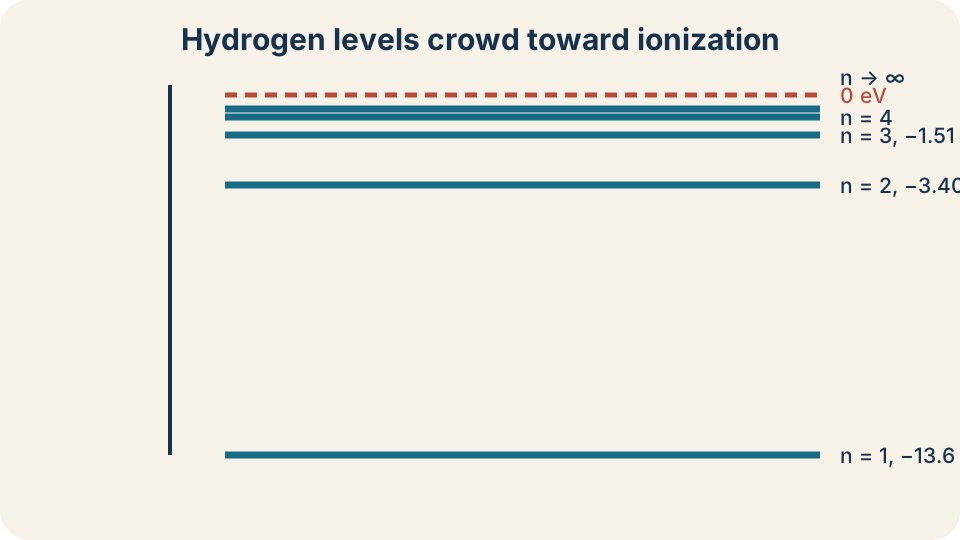
Hydrogen’s level spacing shrinks as increases. The ground state at is most strongly bound. Higher states are less negative and closer to ionization. The limit approaches zero energy. The diagram’s unequal gaps follow the factor . Equal vertical steps would therefore misrepresent the model.
Interpret negative bound-state energy
Energy zero is a reference choice, not the absence of all energy in every sense. For hydrogen, zero is conventionally assigned to an electron and proton infinitely separated and at rest. A bound atom lies below that reference, so its energy is negative. Energy must be supplied to reach zero and separate the particles. The negative sign records binding relative to the chosen reference.
From the ground state, the ionization energy is . From , it is . The excited electron is less tightly bound because it already has more energy. A photon at the threshold can free the electron with nearly zero kinetic energy at great separation. Extra photon energy becomes kinetic energy of the products under conservation.
Changing the reference would add the same constant to every level. Transition differences would remain unchanged because the constant cancels in . Spectral predictions therefore do not depend on the arbitrary zero. Negative energy should not be confused with a negative photon energy. Photons carry positive energy, while the sign of an atomic change identifies gain or loss.
Calculate a hydrogen emission line
Consider hydrogen initially at and ending at . The initial energy is to three significant figures. The final energy is . Atomic change is . The negative sign shows that the atom loses energy.
The emitted photon energy is the positive magnitude . A convenient constant is . Wavelength is . Electronvolts cancel, leaving nanometres. The result lies in the red region of visible light.
Check the direction before trusting arithmetic. A downward transition must emit rather than absorb energy. The to gap is smaller than the to gap, so its photon should have lower energy and longer wavelength. The calculated is consistent with that prediction. Qualitative checks make sign and reciprocal-relation errors easier to catch.
Calculate absorption and ionization thresholds
Suppose ground-state hydrogen absorbs a photon that raises it to . The required energy is . The corresponding wavelength is to three significant figures. This wavelength lies in the ultraviolet. A lower-energy visible photon cannot cause that isolated transition.
Ionization differs from a bound-to-bound transition because the final electron can have a continuum of kinetic energies. From the ground state, any photon with energy at least can ionize hydrogen under appropriate interaction conditions. At exactly the idealized threshold, the separated products have zero excess kinetic energy. If a photon ionizes the atom, approximately remains for kinetic energy after the binding requirement. Momentum conservation distributes energy more precisely between electron and nucleus.
Bound-state absorption therefore produces discrete lines, while photoionization can absorb a continuum above threshold. This distinction explains why atomic spectra can contain both sharp features and continuum edges. The threshold position reveals binding energy. The excess-energy rule resembles the photoelectric effect. In both cases, energy conservation separates a removal requirement from resulting kinetic energy.
Connect transitions to spectral lines
An emission spectrum records wavelengths released by excited atoms. Because only particular state differences occur, the spectrum contains characteristic lines. An absorption spectrum records missing wavelengths after broader light passes through a cooler atomic sample. Matching photons promote atoms upward and are removed from the transmitted beam. Emission and absorption lines for the same species correspond to the same energy gaps.
Hydrogen lines form named series according to their final principal level. Transitions ending at form the Lyman series, primarily in the ultraviolet. Transitions ending at form the Balmer series, several of which are visible. Transitions ending at form the Paschen series in the infrared. Within each series, wavelengths converge as initial levels crowd toward the ionization limit.
Spectral lines act as atomic fingerprints. Astronomers identify elements in stars by comparing observed line patterns with laboratory spectra. Gas-discharge lamps reveal characteristic colors for the same reason. Temperature, motion, pressure, and electromagnetic fields can alter line strengths, widths, or positions. The underlying set of quantum-state differences still anchors interpretation.
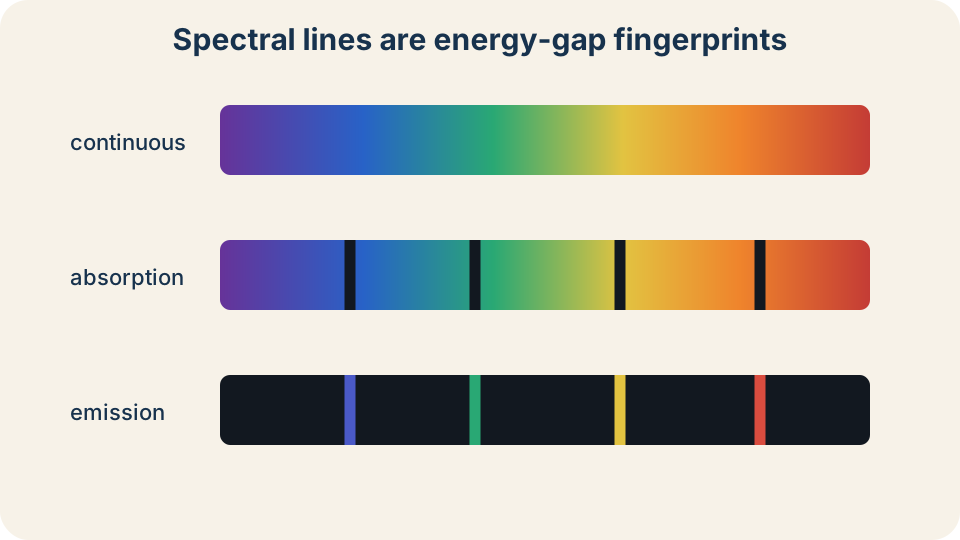
A continuous source contains a broad range of wavelengths. Hydrogen absorption removes selected wavelengths that match upward transitions. Excited hydrogen emits at corresponding allowed wavelengths during downward transitions. The dark and bright lines share positions because they reflect the same energy differences. Line intensity depends on populations and transition probabilities, not only gap size. Line width also carries information about the source and its environment.
Recognize that energy matching is not the only rule
Matching the energy gap is necessary for a bound transition, but it may not be sufficient. Quantum selection rules describe which transitions couple strongly to a given interaction. These rules follow from state symmetries and the mathematical form of the light–matter interaction. Some transitions are allowed and strong, while others are forbidden or much weaker. “Forbidden” usually means strongly suppressed under a particular approximation rather than absolutely impossible under every condition.
Modern atomic states require more labels than principal quantum number . Orbital angular momentum, magnetic orientation, and spin contribute quantum numbers and degeneracies. States that share the same simplified hydrogen energy can split through finer interactions. External magnetic fields cause Zeeman splitting, while electric fields cause Stark splitting. High-resolution spectra therefore reveal structure beyond the basic -level diagram.
At an introductory level, energy conservation remains the first filter. If photon energy does not match an allowed gap within the line width, the bound transition cannot occur. If it does match, selection rules and state populations determine likelihood and intensity. This layered reasoning prevents the false claim that every matching arrow is equally bright. It also prepares the transition from Bohr-style diagrams to quantum states.
Separate the Bohr model from modern quantum mechanics
The Bohr model postulates particular circular orbits and quantized angular momentum. It reproduces the main hydrogen energy formula and offers an intuitive historical bridge. It also predicts a characteristic radius scale and explains why hydrogen emits discrete frequencies. These successes were significant because classical orbiting charges could not account for stable atoms. The model remains useful when its limited target is stated.
The model fails broadly for multi-electron atoms and detailed spectral structure. It does not properly describe orbital shapes, transition intensities, electron spin, or chemical bonding. Its circular paths assign trajectories that modern quantum mechanics does not. Quantum theory instead represents an electron through a wavefunction and observables through operators. Orbitals describe probability structure rather than miniature planetary tracks.
An energy-level diagram can be retained without retaining literal Bohr orbits. Horizontal lines represent eigenvalues of the atomic Hamiltonian, the operator associated with total energy. A stationary state has a definite allowed energy even though position is described probabilistically. Transitions arise from interactions between states and fields. The modern interpretation preserves quantization while replacing classical paths with quantum states.
Account for multi-electron atoms qualitatively
In a multi-electron atom, electrons repel one another as well as interact with the nucleus. Inner electrons shield outer electrons from the full nuclear charge. Different orbitals penetrate toward the nucleus by different amounts. Energies therefore depend on both principal and orbital quantum numbers. The simple hydrogen formula no longer supplies all level positions.
The Pauli exclusion principle restricts how electrons occupy states. Electron spin and orbital occupancy influence the atom’s total energy. Configurations can have many closely spaced terms, producing richer spectra than hydrogen. Correlation means electron motions cannot always be treated as independent. Computational approximations are often required for accurate predictions.
Nevertheless, the transition principle remains. Photons exchanged in atomic transitions still reflect differences between allowed total-energy states. Characteristic spectra persist because each element has a distinctive nuclear charge and electron structure. The lines become more numerous and their labeling more sophisticated. The foundational energy-accounting framework therefore generalizes even when the simple formula does not.
Use a reliable problem-solving workflow
First identify the initial and final states and write their energies with units. Compute the atomic change as . Use its sign to decide whether the atom absorbs or emits. Then use the positive photon magnitude . This separation prevents negative photon energies.
Next choose a consistent unit system. If energies are in electronvolts, conveniently yields nanometres. If energies are in joules, use in joule-seconds and in metres per second. Do not mix electronvolts and joules without conversion. Track numerator and denominator units through the fraction.
Finally check physical direction and scale. Larger energy should correspond to higher frequency and shorter wavelength. A transition ending at a lower energy should emit. An upward bound transition should require an exact gap, while ionization accepts energies above threshold. State the model being used and avoid extending hydrogen’s formula to a many-electron atom.
Repair common misconceptions
An electron does not travel between energy levels by moving vertically on the diagram. The diagram’s vertical coordinate is energy rather than physical height. A transition is a change of quantum state. Asking for a classical path during the change applies an inappropriate model. The measurable outputs are probabilities, energies, momenta, and emitted or absorbed radiation.
A photon does not generally donate only the amount needed for a nonmatching bound transition and keep the remainder while remaining the same photon. In an isolated one-photon bound transition, the photon is absorbed as a whole. Its energy must match the allowed gap within physical broadening. Ionization differs because excess energy can become kinetic energy. Distinguishing discrete final states from a continuum resolves the apparent contradiction.
Negative bound energy does not mean the atom possesses “less than no energy” in an absolute universal sense. It means the bound state lies below a selected separated-particle reference. Only differences affect transition photons. Another error is to use as a negative emitted photon energy. Keep the atomic signed change and photon positive magnitude conceptually separate.
Retrieve and connect forward
Does a bound atom absorb every incident photon frequency? No, because a bound-to-bound transition requires a matching allowed energy difference and suitable coupling. How much energy ionizes hydrogen from ? The level is relative to zero, so must be supplied. Why are bound energies negative? They lie below the separated electron–proton reference.
For a downward transition with a gap, the photon energy is . Its vacuum wavelength is . The wavelength is visible and shorter than that of a lower-energy red photon. The atom’s energy change is . These signed and unsigned statements are compatible.
Atomic energy levels connect experimental spectra to quantum states. The gap determines photon energy, the transition direction determines absorption or emission, and the ionization reference explains negative binding energies. Hydrogen offers an exact-enough foundational model, while multi-electron atoms require modern quantum mechanics. The next studies of wavefunctions, probability amplitudes, and operators will explain why these states exist. Energy-level reasoning remains the accounting framework that links those abstractions to measured light.