
Kinematics describes motion without first asking which forces caused it. That description must begin with a reference frame, because words such as position, direction, and motion have meaning only relative to a chosen origin, axes, and observer. Position reports location, displacement reports the net change between endpoints, and distance reports the total path length traveled. These quantities often share units but answer different questions. This lesson builds each concept through number lines, maps, motion diagrams, and graphs so that formulas remain connected to observable motion.
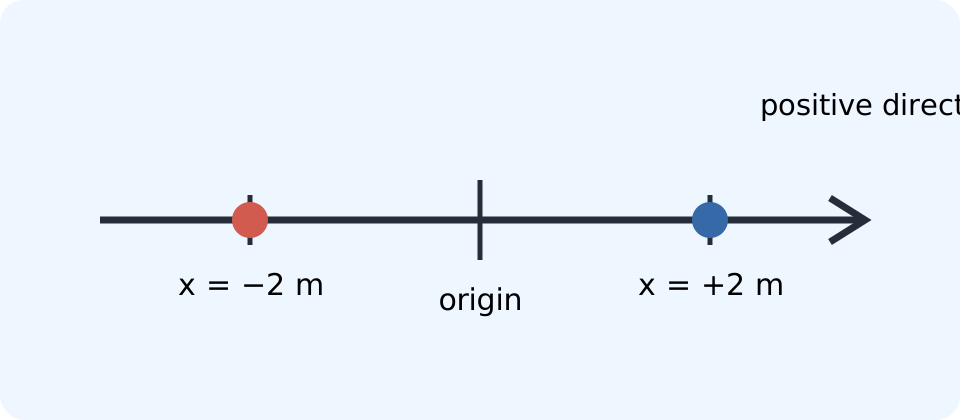
Construct a reference frame
A reference frame supplies an origin, coordinate axes, positive directions, and a clock. In one-dimensional motion, one axis is sufficient and is often labeled . Choosing right as positive makes locations to the right of the origin positive and locations to the left negative. Choosing left as positive would be equally valid if used consistently. Nature does not provide a universally preferred horizontal sign convention.
The origin is the location assigned coordinate zero. If a tree is chosen as , then describes a point on the negative side of the tree. The negative sign identifies direction relative to the chosen axis. It does not mean the object has negative length or has traveled a negative distance. A coordinate is an address, not a record of the path used to arrive there.
A frame also identifies the observer relative to whom motion is described. A passenger can remain at a fixed position within a steadily moving train while changing position relative to the ground. Both descriptions are correct within their frames. Stating “the object is moving” without identifying a reference can therefore be incomplete. Introductory problems often imply a ground-fixed frame, but rigorous work names it when ambiguity matters.
Represent position in one and several dimensions
Position in one dimension can be written , meaning the coordinate as a function of time . Parentheses indicate that the value may change as time changes. A specific statement such as locates the object at time . The metre is the SI unit of position. A table, equation, graph, or motion diagram can represent the same function.
In two or three dimensions, position is a vector written . In Cartesian coordinates, . The unit vectors , , and point along the positive coordinate axes and each has magnitude one. The scalar components , , and state how far to move along those directions from the origin. Bold type and the unit-vector expansion communicate that position has both magnitude and direction.
Changing the origin changes position coordinates but not the physical separation between two fixed events. If every one-dimensional coordinate is shifted by a constant , the new coordinate is . Both initial and final coordinates shift by the same amount. Their difference remains unchanged because . This invariance is why displacement between fixed endpoints does not depend on where zero was placed.
Define displacement as endpoint change
Displacement is the change in position from an initial event to a final event. In vector notation, . The capital Greek letter delta means “final value minus initial value,” not simply “a small amount.” The subscripts and label initial and final states. The order of subtraction is fixed by that definition. Displacement depends only on the endpoints chosen for the interval.
In one dimension, the equation becomes . If an object moves from to , then . The positive sign means the net change points in the positive direction. Subtracting a negative coordinate correctly becomes addition. Writing the symbolic relation before inserting values helps preserve the order final minus initial.
If the same object moves from to , its displacement is . The magnitude is , while the sign reports negative direction. Absolute-value bars remove direction and retain size in this one-dimensional case. Reversing the endpoints reverses displacement. This directional behavior distinguishes displacement from a nonnegative path-length measure.
Define distance as accumulated path length
Distance traveled is the total length of the actual path followed during an interval. It is a scalar, so it has magnitude but no direction. Distance is nonnegative and usually denoted or described in words to avoid confusion with displacement magnitude. It depends on every segment of the route, not merely the endpoints. Two travelers can share initial and final positions while accumulating different distances.
For piecewise one-dimensional motion, add the absolute position change over each segment: . The index labels a segment between reversals or other selected waypoints. Absolute-value bars make each segment length nonnegative. If direction never reverses, the segment lengths combine to the magnitude of total displacement. When reversals occur, distance becomes larger than displacement magnitude.
For every motion, . Equality holds when the path follows the straight endpoint-to-endpoint direction without reversal or detour. A closed trip returns to its starting point and therefore has zero displacement, yet its distance can be large. The inequality is a geometric fact, not a special kinematics rule. It gives an immediate check on calculated results.
Analyze a reversal step by step
Suppose a cart begins at , moves to , and then returns to . Displacement uses only endpoints: . The intermediate turn at does not enter this calculation. The positive result means the final point lies in the positive direction from the starting point. It does not say the cart traveled only .
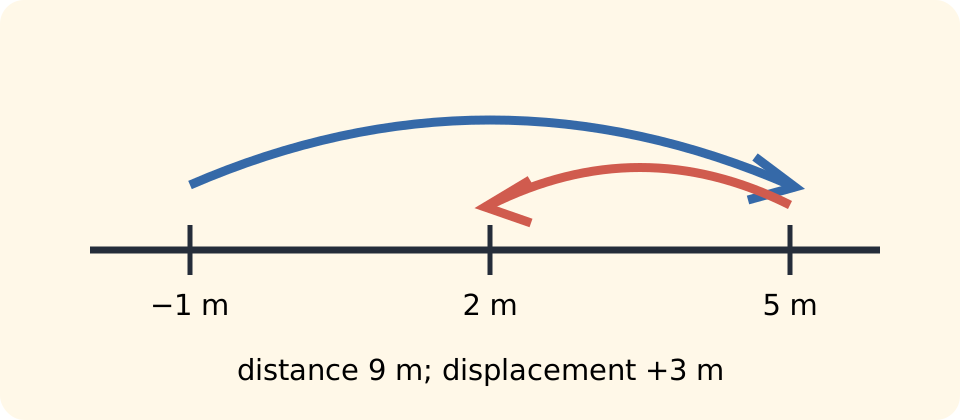
The outward segment has length . The return segment has length . Adding gives . The units remain metres because lengths, not squared quantities, are being added. The check is satisfied.
The example shows why adding signed displacements segment by segment produces net displacement rather than distance. The segment displacements are and , whose sum is . Taking each segment’s magnitude before adding produces . The timing of the turn is irrelevant to these two totals, although it will matter when calculating speed and velocity. A solution should state which accumulation is being performed.
Extend the distinction to two dimensions
In two dimensions, displacement connects initial and final points with a vector independent of route. If and , then . Its magnitude is . The square root follows from the Pythagorean theorem for perpendicular coordinate components. A direction angle can be found from components with quadrant-aware trigonometry.
Suppose a hiker walks east and then north. Distance is . Displacement is with magnitude . Its direction is north of east. The path length and endpoint separation are different even though both use kilometres.
A curved path reinforces the same distinction. Distance follows the curve and can be found by segment addition, geometry, measurement, or integration. Displacement remains the straight vector from beginning to end. For one complete lap of a circular track, distance is the circumference , while displacement is zero. The path has not vanished merely because the endpoints coincide.
Read motion diagrams
A motion diagram marks an object’s position at a sequence of equally spaced times. Each dot is an event with both location and time, even when the clock values are not written. Spacing between successive dots indicates how much distance is covered during each equal interval. Wider spacing suggests greater average speed over that interval. The sequence order and axis arrows communicate direction.
Displacement over the entire diagram is the vector from the first dot to the final dot. Distance requires following the ordered chain and adding every interval length. If dots reverse direction, the path doubles back even though the endpoint vector may be small. Drawing a separate straight displacement arrow prevents the path and net change from being conflated. Color or numbering can clarify overlapping positions visited at different times.
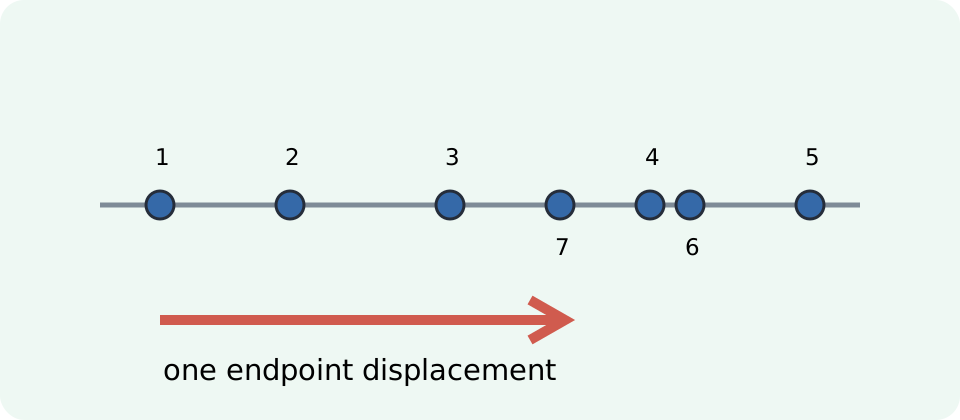
Motion diagrams also prepare the ideas of average velocity and average speed. Average velocity uses displacement divided by elapsed time, whereas average speed uses distance divided by elapsed time. A round trip can therefore have zero average velocity and nonzero average speed. The denominator can be identical while the numerators differ. This distinction grows directly from the definitions established here.
Interpret position–time graphs
A position–time graph places time on the horizontal axis and position coordinate on the vertical axis. A plotted curve does not ordinarily show the object’s physical path through space. Moving upward on the graph means position is becoming more positive, while moving downward means it is becoming less positive. A horizontal segment means position remains constant. The graph is a record of coordinate versus time.
Displacement between times and is the vertical change . If the graph begins at and ends at , displacement is regardless of intermediate bends. Distance requires dividing the interval at every reversal, where the graph changes between increasing and decreasing. Add the absolute vertical changes across those monotonic pieces. Horizontal time length is not itself a traveled distance.
The slope of a position–time graph will later define velocity. Positive slope indicates positive velocity, negative slope indicates negative velocity, and zero slope indicates rest. A reversal occurs where slope changes sign, often at a local maximum or minimum. Distance accumulates without decreasing even when position does. Reading graph shape through definitions prepares a coherent transition to velocity rather than relying on visual slogans.
Distinguish coordinate sign from physical magnitude
A negative position locates an object on the negative side of the origin. A negative displacement indicates a net change in the negative coordinate direction. Neither statement makes distance negative. The same numerical sign can therefore play a different semantic role depending on the quantity. Always name the variable before interpreting its sign.
Magnitude is written with absolute-value bars in one dimension or vector-magnitude bars in several dimensions. If , then . Distance might equal this magnitude or exceed it depending on the route. Removing the sign is not a universal way to turn displacement into distance. It works only for motion without additional reversals or detours over the chosen interval.
Zero also needs interpretation. Position zero means the object is at the chosen origin. Displacement zero means initial and final positions coincide. Distance zero means no path length accumulated, which requires no motion during the interval. A runner completing a lap demonstrates that zero displacement does not imply zero distance.
Change origins and positive directions
Changing the origin relabels every position by the same coordinate shift. If the original origin is moved to the right, an old coordinate becomes . Initial and final coordinates both change. Their difference does not, so displacement represents the same physical endpoint separation. Distance also remains unchanged because the physical route has not changed.
Reversing the positive axis changes the signs of positions and displacement components. An eastward displacement that was becomes if west is chosen positive. Its magnitude remains . Distance remains because it has no coordinate direction. A correct answer may therefore have a different sign under a different declared axis.
Comparing work from two coordinate systems requires translating signs rather than declaring one wrong. Physical predictions such as meeting points, separations, and elapsed path lengths must agree after translation. This coordinate independence is a powerful error check. If changing the origin changes a calculated displacement, the subtraction was likely set up incorrectly. If reversing the axis changes a reported distance, a scalar was likely given an inappropriate sign.
Handle measurement and significant figures
Positions are measured relative to landmarks with instruments of finite resolution. A coordinate such as implies a precision different from . Displacement subtracts two measured positions, so its uncertainty depends on both measurements. Reporting many calculator digits does not create additional physical precision. Preserve guard digits during work and round the final value according to the measurement context.
Distance measured along a path may carry additional uncertainty from route approximation. Replacing a curve with straight segments underestimates its length unless segments are sufficiently fine. GPS positions, maps, odometers, and video tracking operationalize different versions of location and path measurement. Their resolution and coordinate assumptions should be stated when evidence matters. Definitions remain exact while measured estimates carry uncertainty.
Units must accompany every position, displacement, and distance value. Adding to is meaningless because the quantities have different dimensions. Converting to before combining it with metre measurements prevents hidden scale errors. Coordinate components must use compatible length units. Dimensional consistency is the first layer of verification.
Repair common misconceptions
A common misconception is that a negative position means an object moved backward. Position alone contains no history, so it cannot reveal how the object arrived. An object at might be stationary, moving positive, moving negative, or reversing. At least two time-labeled positions are needed to determine a change. Do not infer motion from a single coordinate.
Another misconception is that displacement magnitude always equals distance. Equality requires a path without reversal or detour between endpoints. A round trip provides the clearest counterexample because displacement is zero while distance is positive. Segment the path and calculate both quantities separately. The inequality should hold afterward.
A third mistake is treating a position–time curve as a map of the physical route. Its vertical direction represents coordinate value, and its horizontal direction represents time. A curved graph does not imply a curved road. Identify the axes before interpreting any shape. Graph literacy begins by asking what each coordinate measures.
Practice with explanation
A runner completes one lap and returns to the starting line. Distance is because that is the path length around the track. Displacement is because final and initial positions coincide. Average speed over a positive elapsed time would be nonzero, while average velocity would be zero. Explain why the runner’s substantial motion is not contradicted by zero displacement.
An object moves from to without reversal. Its displacement is . Its distance is . The sign communicates motion in the negative direction, while distance is nonnegative. Redraw the axis with the positive direction reversed and translate both results.
A robot moves east, west, and east. Its distance is . Taking east positive, displacement is . The endpoint method gives the same result if the robot starts at zero and finishes at . Identify the two reversals and explain why they increase distance without changing the endpoint rule.
Consolidate the framework
Position locates an object relative to a reference frame. Displacement is final position minus initial position, . Distance is the nonnegative length accumulated along the actual route. Position and displacement are coordinate-dependent vectors, while distance is a scalar path property. Their shared length unit does not make them interchangeable.
The reliable workflow is to draw the frame, label initial and final positions, mark turns or waypoints, and decide whether the question asks for an endpoint vector or accumulated path. Use signed subtraction for displacement and absolute segment lengths for one-dimensional distance. In several dimensions, subtract position-vector components and use geometry for magnitude. Check that distance is at least as large as displacement magnitude. State directions and units with every final result.
These ideas lead directly to velocity and speed. Average velocity is displacement per elapsed time, while average speed is distance per elapsed time. Instantaneous velocity becomes the rate of change of position, and speed becomes its magnitude. Position–time graphs then acquire a slope interpretation grounded in definitions already established. A careful beginning makes every later kinematics equation more intelligible.