
Integers extend whole numbers in two directions from zero. They describe elevation above or below sea level, temperature above or below a reference, money credited or owed, and motion in opposite directions. The sign carries relational information rather than decorating a numeral. A positive and a negative number can have the same magnitude while representing opposite states. The number line makes these ideas visible.
Signed arithmetic should not begin as a list of rules to memorize. Addition describes a combined displacement, subtraction compares or reverses a displacement, and absolute value measures distance. Multiplication patterns and the distributive property justify product signs. Each operation answers a different question. Understanding those questions makes later algebra less fragile.
This lesson connects language, diagrams, symbols, and contexts. You will predict an answer’s location and sign before calculating. Every subtraction will preserve the difference between an operation sign and a number’s sign. Worked examples will include degrees Celsius, metres, and dollars when units belong to the quantity. The goal is a durable mental model for all later signed quantities.
Learning goals and a reference-point thought experiment
You should locate, order, and compare integers. You should distinguish sign, magnitude, opposite, and absolute value. You should explain addition and subtraction as directed movement or change. You should justify multiplication and division sign patterns. You should model real situations without confusing a reference value with nothingness.
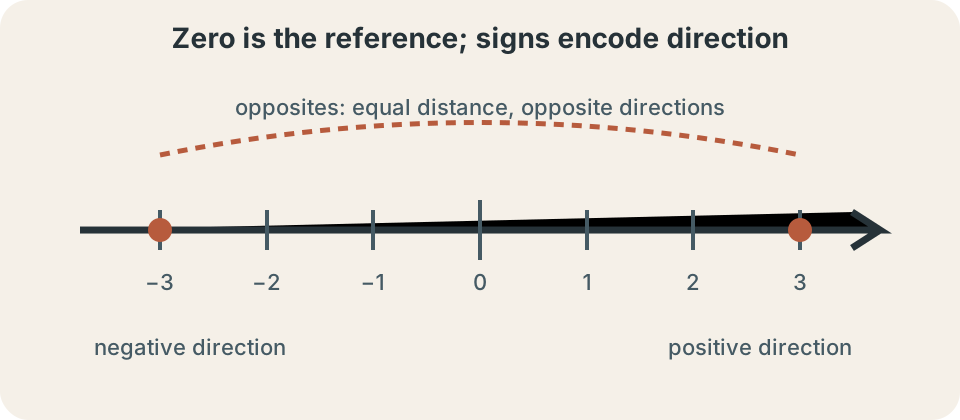
Imagine standing on floor zero in a building with underground parking. Floor is three levels above the reference. Floor is three levels below it. Both locations are the same distance from floor zero. Their directions relative to the reference are opposite.
Predict which location is greater on a vertical scale. Higher positions correspond to greater numbers, so . The comparison does not ask which numeral contains the larger digit because both contain . It asks which signed location lies farther in the increasing direction. A chosen orientation gives the sign its meaning.
The integer set extends counting numbers
The integers are . The ellipses mean the pattern continues without end in both directions. Positive integers lie on one side of zero, and negative integers lie on the other. Zero is neither positive nor negative. All whole-number counting values are included.
The symbol names the set of integers. One historical explanation connects the letter to the German word Zahlen, meaning numbers. Set notation says negative two is an element of the integers. In contrast, says one half is not an integer. The horizontal fraction still represents a number, but not a member of this set.
Integers are discrete. Between consecutive integers such as and , no other integer exists. Other real numbers do exist between them. This distinction matters when a context counts indivisible objects. A count of students may use integers even though a measured length can vary continuously.
The origin supplies a reference
Zero is the origin on a number line. It provides the reference from which signed positions are measured. On a horizontal line, the conventional positive direction points right. On a vertical line, the conventional positive direction often points upward. A different choice is allowed if it is stated and used consistently.
Zero does not always mean the absence of a physical quantity. A temperature of is a reference point on the Celsius scale, not an absence of thermal energy. An elevation of may mean mean sea level. A bank balance of \0$ does represent neither credit nor debt in that account. Context determines what the origin represents.
Adding zero leaves a number unchanged: . This property makes zero the additive identity. The letter can represent any number. Identity means the operation returns the original input. Zero’s role as reference and its role as additive identity are related but distinct.
Order means position from left to right
On a conventional horizontal number line, values increase toward the right. Therefore . The symbol means “is less than.” The symbol means “is greater than.” Each symbol opens toward the greater value. Reading left to right gives an immediate order check. The position model decides the comparison.
Among negative integers, the value closer to zero is greater. Thus because negative two lies to the right of negative seven. The digit has greater magnitude, but the signed number has lesser value. Magnitude and order answer different questions. A number-line sketch separates them.
To order several integers, locate their approximate positions and read from left to right. For , the order is . Avoid sorting only the visible digits. Attach each sign to its numeral throughout the comparison. The final inequality should match the drawn positions.
Opposites express equal distance in reverse directions
The opposite of is . Opposites occupy equal distances from zero in different directions. Their sum is zero: . This makes the additive inverse of . The word inverse refers to undoing addition.
The expression is not necessarily a negative number. If , then . If , then . The first minus sign instructs us to take the opposite of the entire value. Its result depends on the value represented by .
Zero is its own opposite because . No other integer has that property. Double opposition returns the original number: . A number-line reflection across zero illustrates both facts. Opposite and reciprocal should not be confused.
Absolute value measures distance
Absolute value is the distance from to zero. Distance is nonnegative. Therefore , , and . The vertical bars are operation symbols. They do not mean parentheses.
A piecewise definition makes the rule precise: when , while when . The phrase “when” states the condition for each output rule. The first rule keeps a nonnegative input unchanged. The second takes the opposite of a negative input. Together the cases include every real input.
Absolute value does not simply mean “erase a minus sign.” For , subtraction must be evaluated first, giving . For , absolute value gives and the outside negative produces . Operation order and grouping matter. Distance language remains more reliable than a visual trick. This interpretation also works when the input is an expression.
Distance between two positions
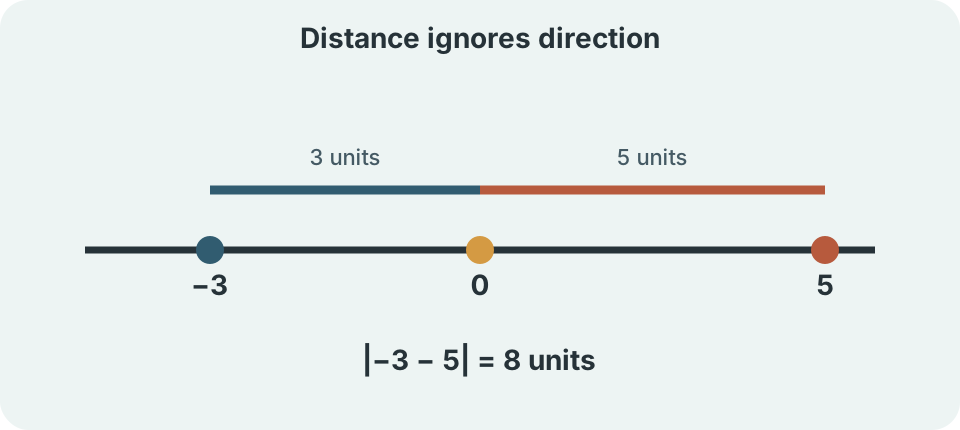
The distance between coordinates and is . Subtraction finds the directed difference. Absolute value removes its direction and keeps magnitude. Reversing the order gives , which has the same result. Distance is symmetric.
The distance between and is . It can also be computed as . On the line, travel from to covers three units and from to covers five more. The total is eight units. Both subtraction orders therefore agree after absolute value.
Units belong to the coordinate context. If the points are elevations and , their vertical separation is . If they are temperatures, the temperature difference has unit degrees Celsius in this elementary context. A bare would omit what was measured. The absolute value supplies magnitude, not a unit.
Addition combines directed displacements
Interpret the first addend as a starting position and the second as a directed movement. Adding a positive number moves in the positive direction. Adding a negative number moves in the negative direction. The result is the ending position. This model gives meaning to the sign rules.
For , start at and move seven units right. Four units reach zero, and three more reach . Therefore . The positive movement has greater magnitude than the negative starting position. The result takes the positive direction.
For , start at and move eight units left. Five units reach zero, and three more reach . Therefore . The two signed quantities partly cancel. The larger magnitude determines the remaining direction.
Same-sign and different-sign addition
When two addends have the same sign, their directed effects reinforce. Add their magnitudes and retain the shared direction. Thus and . The negative example represents two leftward displacements. Its magnitude is nine and its direction is negative.
When signs differ, the directed effects oppose. Subtract the smaller magnitude from the larger magnitude. Give the result the sign of the addend with greater magnitude. For , magnitudes differ by five and the negative magnitude is larger. Therefore the result is .
This procedure follows the displacement model rather than replacing it. Equal opposite magnitudes cancel completely, as in . A quick estimate should identify whether the answer lies left or right of zero. The algorithm then supplies its exact distance from zero. Prediction and calculation should tell the same story.
Addition properties support rearrangement
Integer addition is commutative: . Changing addend order does not change the final combined displacement. For example, . Number-line paths differ in their intermediate positions. Their endpoints agree.
Addition is associative: . Parentheses change which pair is combined first but not the final sum. This allows useful grouping of opposites. In , group . The result is then .
Commutativity and associativity apply to addition, not to subtraction in the same way. Usually . Also, need not equal . Rewriting subtraction as addition of opposites lets valid addition properties be used. Operation names determine which properties apply.
Subtraction means adding an opposite
The definition converts subtraction into addition of the opposite. The first minus sign in is an operation. The minus sign in creates the opposite of . If is already negative, its opposite is positive. Keeping those roles separate explains the familiar double-negative result.
For , subtracting negative four means adding its opposite. Thus . On a number line, the displacement represented by negative four points left. Subtracting that displacement reverses it to the right. The answer is greater than seven.
For , rewrite as . Both directed effects point left. For , rewrite as . These expressions look similar but describe opposite second displacements. Parentheses keep the signed subtrahend visible.
Change is final minus initial
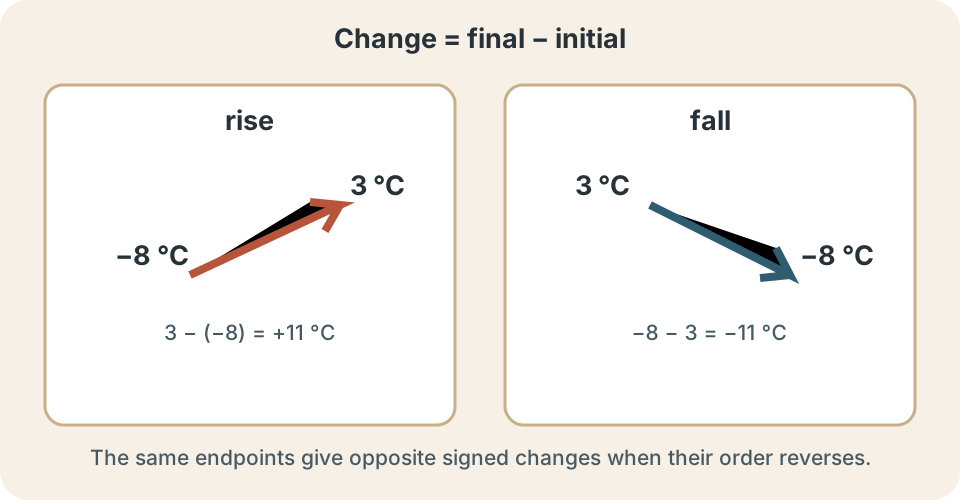
A change in a quantity is . Capital Greek delta, , means a finite change. Subscript marks the final value, and subscript marks the initial value. The order is final minus initial. Reversing it changes the sign.
A temperature rises from to . Its change is . The positive change agrees with a rise. The first subtraction mark separates final from initial. The negative sign inside parentheses belongs to the initial temperature.
The two negative signs therefore have different jobs. Units remain degrees Celsius throughout the subtraction. The result describes an interval difference. It is not a ratio of absolute thermodynamic temperatures. The signed answer agrees with the observed direction.
If temperature falls from to , the change is . Its magnitude is , but its signed change is negative. “How much did it change?” may ask for magnitude, while “what is the change?” often preserves direction. Read the language carefully. Report both when ambiguity matters.
Multiplication as repeated signed addition
Multiplication by a positive integer repeats an addend. The expression means three copies of negative four. Thus . The result points negative because every repeated displacement does. Its magnitude is .
The product of two positive integers is positive by ordinary repeated addition. A positive times a negative is negative. Commutativity then gives a negative times a positive as negative. The remaining case is a negative times a negative. A pattern or distributive argument determines it.
Consider products , , , and . Decreasing the first factor by one increases each product by two. Continuing the pattern gives . The product of two negative factors is positive. The pattern preserves constant differences.
The distributive property justifies product signs
The distributive property says . It must remain true for integers. Because , multiply by to get . Distributing gives . The first product is .
Therefore . The second product must be to be the additive inverse of . Hence . The positive result is forced by previously established properties. It is not an arbitrary classroom rule.
The sign pattern can be summarized after it is understood. Same-sign factors produce a positive product. Different-sign factors produce a negative product. Magnitudes multiply normally. Zero times any integer is zero.
Division reverses multiplication
Division asks for a missing factor. The statement is true because . The horizontal fraction bar groups the entire numerator and denominator. It also signals division. Units, if present, divide in the same way.
Same-sign division produces a positive quotient because a positive missing factor gives a same-sign product. Different-sign division produces a negative quotient. Thus and . These rules follow from multiplication. They need not be memorized separately.
Division by zero is undefined. No integer can satisfy , so has no value. The expression is valid because . Numerator and denominator roles are not interchangeable. A fraction bar should make their grouping clear.
Powers and the importance of parentheses
Exponent notation represents repeated multiplication. The expression means . Parentheses include the negative sign in the base. The expression follows operation order and means . These are different expressions.
An even positive integer exponent applied to a negative base gives a positive result. Negative factors pair to make positive products. An odd exponent leaves one unpaired negative factor, so the result is negative. Therefore and . The parity of the exponent controls the sign.
Do not say that “squaring makes everything positive” without respecting grouping. Squaring a real number does produce a nonnegative value. In , however, the negative operation occurs after the square unless parentheses say otherwise. Symbol structure controls operation order. Careful notation prevents a false shortcut.
Contexts require defined sign conventions
In finance, a positive balance may represent money available and a negative balance debt. A change from -\15$22$22-(-$15)=$37$37$. Currency symbols and signs serve different roles. Parentheses preserve the signed initial amount.
In elevation, positive may mean above sea level and negative below it. Moving from to changes elevation by . The traveled path could be longer than this vertical change. Coordinate change and travel distance are different. State which one is requested.
Not every context uses the same positive direction. A physics problem may choose downward as positive to simplify falling motion. A computer display may count vertical pixels downward. The mathematics remains consistent when the convention is declared. Signs encode the chosen orientation rather than an inherent moral quality.
Common misconceptions and repairs
One misconception says a greater magnitude always means a greater number. This fails for negative values. Negative seven has greater magnitude than negative two but lesser value. Draw both on a number line. Compare position for order and distance for magnitude.
Another misconception says absolute value changes every result to positive. Absolute value returns a nonnegative distance, but an outside operation can change that value. For example, . Evaluate from the inside outward. Translate the bars as distance before simplifying.
A third misconception changes subtraction to addition without changing the subtracted number. Correct rewriting is . Both the operation and the second value change form together. Write the intermediate step. This habit becomes essential with algebraic expressions.
A reliable problem-solving routine
Identify the reference point and positive direction. Translate each contextual quantity into a signed integer with units where appropriate. Predict whether the result lies left or right of zero. Name the operation’s meaning. Then calculate.
For addition, combine directed displacements. For subtraction, add the opposite or calculate final minus initial. For absolute value, interpret distance. For multiplication and division, determine magnitude and sign separately. Use parentheses around negative substituted values.
Check the result in the original context. An increase should have a positive signed change under the usual convention. A distance should not be negative. A quotient multiplied by its divisor should recover the dividend. Explain the answer in a sentence rather than leaving a bare numeral.
Practice and connection forward
Order from least to greatest. Their number-line order is . Next evaluate . Subtraction of a negative becomes addition of its opposite. The positive magnitude exceeds the negative magnitude by five.
Find the distance between and . Compute . A bank balance changes from -\15$22$22-(-$15)=$37$. Both examples separate distance or change from endpoint values.
Without looking back, define integer, opposite, magnitude, absolute value, and additive identity. Explain why and why a negative times a negative is positive. Draw an addition and a subtraction on a number line. Fractions and ratios will extend signed-number reasoning beyond discrete steps. Variables will then let these properties operate on unknown quantities.