
A fraction is not merely two whole numbers stacked vertically. It can name a number, record a division, compare quantities, or describe a scaling operation. Ratios and proportions extend the same multiplicative reasoning into rates, percent, similarity, probability, and scientific measurement. The central idea is that a relationship can remain constant even while both quantities change. This lesson builds that idea visually, numerically, algebraically, and through units.
Establish the learning goals
By the end of this lesson, you should be able to explain what the numerator and denominator mean in several contexts. You will generate and justify equivalent fractions rather than relying on an unexplained rule. You will add, subtract, multiply, and divide fractions with attention to the quantities represented. You will distinguish ratios, rates, and unit rates. You will also solve proportional relationships and check them using units and reasonableness.
Fraction work is often taught as a list of procedures, but procedures become durable when attached to meaning. A common denominator matters because addition requires pieces of a common size. Multiplication composes two scaling actions. Dividing by a fraction asks how many copies of that fractional quantity fit. Each rule can therefore be reconstructed from an interpretation.
Throughout the lesson, use horizontal fraction bars in mathematical notation. A horizontal bar groups the complete numerator and complete denominator, reducing ambiguity on narrow screens and in complex expressions. Keep physical units attached to measured values and write compound units as fractions, such as . Estimate the expected size of each answer before calculating. These habits make both the notation and reasoning easier to verify.
Interpret one fraction in several ways
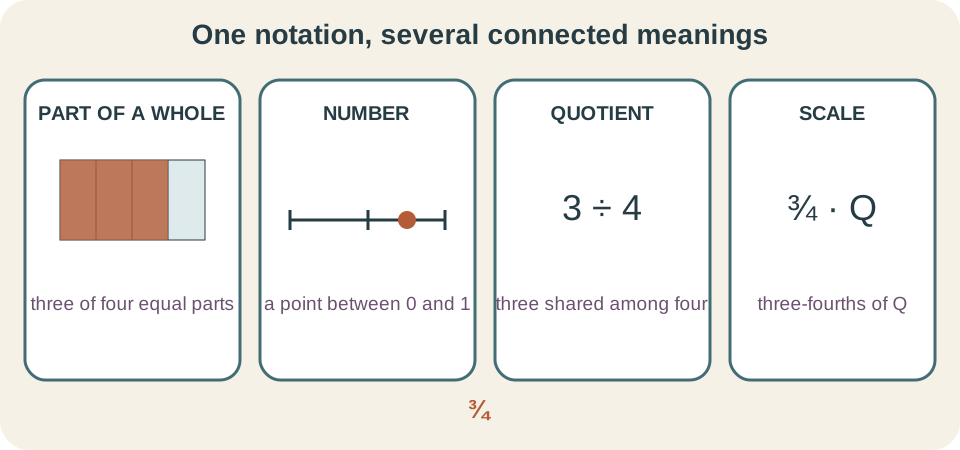
For numbers and with , the fraction can represent equal parts when a whole is partitioned into equal parts. The number above the bar is the numerator, and the number below it is the denominator. In , the denominator names fourths and the numerator counts three of them. Equal parts are essential because unequal pieces do not define one consistent fractional unit. The whole being partitioned must also be identified.
The same notation represents the quotient . Thus is the number obtained by sharing three units equally among four groups. It is also the point three fourths of one unit from zero on the number line. This number-line view shows that fractions are numbers, not merely pieces of objects. Improper fractions such as lie beyond one and are ordinary numbers as well.
A fraction can also act as an operator. Multiplying a quantity by means divide the quantity into four equal shares and select three shares. For example, . The numerical factor is dimensionless, so the product retains meters. This scaling interpretation becomes especially important in proportions and percent change.
Explain why the denominator cannot be zero
The expression asks for a number that multiplied by gives . When , this description determines one quotient. If and , no number multiplied by zero can produce . If both are zero, every number multiplied by zero gives zero, so no unique quotient is selected. Division by zero is therefore undefined.
This restriction is a domain condition, not a technical annoyance. In , the denominator becomes zero at . The expression is undefined at that input even if it is meaningful elsewhere. Algebraic transformations must preserve this excluded value. Recording restrictions prevents a simplification from accidentally enlarging the domain.
Calculators may display an error, infinity symbol, or special machine value for division by zero, but none turns it into an ordinary real-number quotient. A limit can describe behavior as a denominator approaches zero without assigning a value at zero. That later calculus idea does not change the arithmetic definition. For present purposes, always identify values that make a denominator zero. Never cancel or substitute before checking the restriction.
Build equivalent fractions by scaling
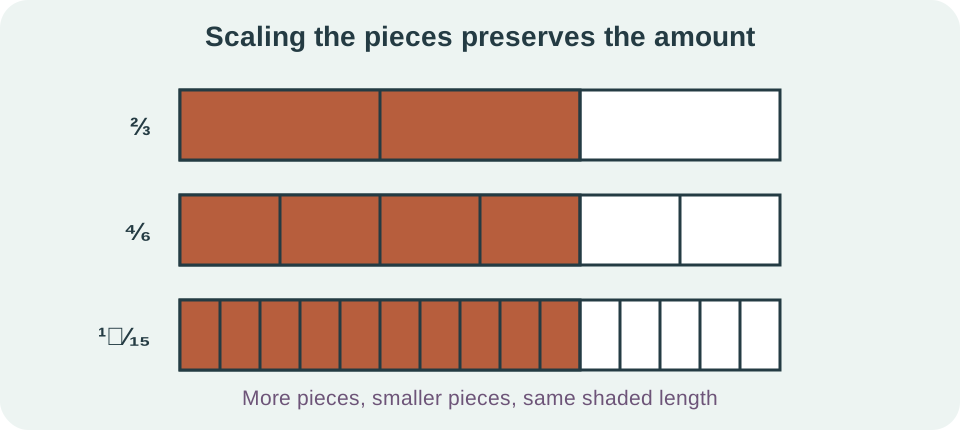
Multiplying a fraction’s numerator and denominator by the same nonzero number preserves its value. Algebraically, , and when . Multiplication by one does not change a number. Therefore . The counted pieces change size and number together while the total amount remains fixed.
Simplifying a fraction reverses this scaling process. If numerator and denominator share a nonzero factor, divide both by that factor. For example, . The fraction is in lowest terms because three and four have no common factor greater than one. Simplification changes representation, not value.
Cancellation applies to factors, not to terms separated by addition or subtraction. For , . However, cannot lose the two occurrences of because the numerator is a sum, not a product with common factor . Rewriting as makes the structure visible. Structural reading prevents invalid cancellation.
Compare and order fractions
Fractions with a common denominator can be compared by their numerators because they count equal-sized pieces. Thus because five eighths contain two more eighths than three eighths. Fractions with a common positive numerator reverse the denominator intuition: because fifths are larger than eighths. A picture or number line makes both statements visible. Comparison is about numerical value, not which written integers look larger.
One general method creates a common denominator. To compare and , rewrite them as and . Therefore . Cross-products provide the same comparison when denominators are positive because and . The common-denominator reasoning explains why the cross-product shortcut works.
Benchmarks can make comparison faster. Both and are slightly greater than , so a finer comparison is needed. Their cross-products are and , making larger. Estimating against zero, one half, and one also catches implausible decimal conversions. Exact methods and benchmarks should support one another.
Add and subtract fractional quantities
Addition combines quantities expressed in the same unit. The fraction counts fourths, while counts sixths, so the pieces must first be renamed with a common size. The least common denominator of four and six is twelve. Thus . The denominator remains twelve because the result counts twelfths.
Adding denominators would change the unit and has no general justification. The incorrect expression is less than one, although both original fractions together exceed one. A quick estimate exposes the mistake. Correct fraction addition resembles adding rather than adding the word or unit itself. The common denominator is the shared fractional unit.
Subtraction follows the same principle. For , a common denominator is twenty, giving . Because is approximately and , a result near is reasonable. The exact fraction equals . Estimation verifies the direction and approximate magnitude.
Multiply fractions as composed scaling
Multiplication of fractions composes scaling operations. Taking of means applying a two-thirds scale to a five-sevenths quantity. The product is . Numerators multiply because selected parts are counted in both directions of an area model. Denominators multiply because the whole is partitioned into equal subregions.
Unlike addition, multiplication does not require common denominators. The operands are scaling factors rather than counts of pieces being combined. Factors may be simplified before multiplication when a numerator and denominator share a factor. For example, . This cross-cancellation is valid because the entire numerator and denominator are products.
Fraction multiplication can increase or decrease a positive quantity depending on the factor. Multiplication by a positive proper fraction less than one makes the quantity smaller. Multiplication by an improper fraction greater than one makes it larger. Multiplication by a negative fraction also reverses sign. Predicting these effects before computation helps detect inverted or misplaced factors.
Divide by a fraction using reciprocal scaling
Division asks how many copies of one quantity fit into another. The expression asks how many two-fifths units fit in three fourths. Multiplying both quantities by five halves changes each two-fifths unit into one whole. Therefore . Multiplication by the reciprocal undoes the divisor’s scaling.
The reciprocal of a nonzero fraction is . Their product is one because when both and are nonzero. Only the divisor is inverted in fraction division. Inverting the dividend or both fractions produces a different operation. Writing the original question in words can keep the roles clear.
Units show the same reciprocal logic. Dividing by gives . Dividing distance by time creates distance per unit time. Dividing time by distance would instead produce . The order of division determines both value and unit.
Distinguish ratios, rates, and unit rates
A ratio compares two quantities through division. The ratio of six red tiles to four blue tiles can be written . Order matters because reversing the comparison gives a reciprocal ratio. A ratio may compare quantities with the same unit or with different units. The labels identify what each number counts.
A rate compares quantities having different units. If a cyclist travels in , the average rate is . A unit rate has one unit of the denominator quantity. The number fourteen alone is incomplete because it does not name the compared quantities. Compound units are part of the measured result.
Rates can be interpreted in either direction, but the two directions answer different questions. Fuel efficiency might be measured in , describing distance per amount of fuel. Fuel consumption might be measured in , describing fuel per fixed distance. One rate is not simply “better” notation than the other. The useful orientation depends on the question and convention.
Recognize proportional relationships
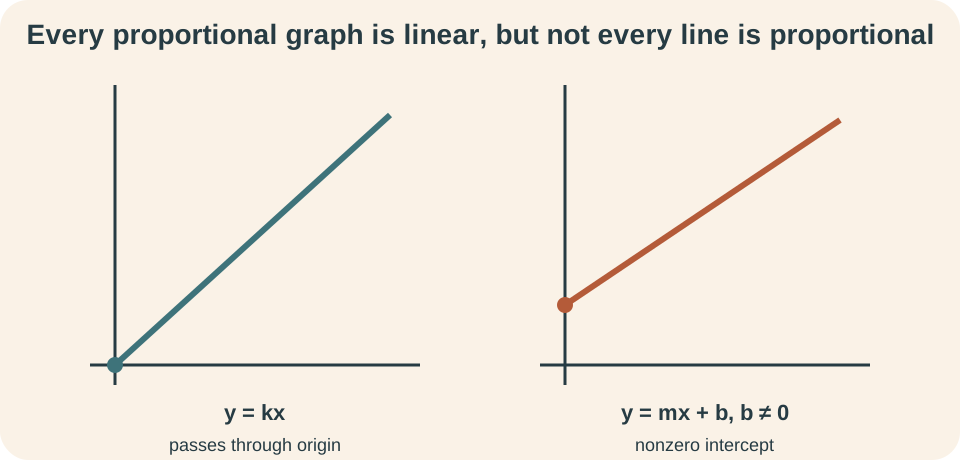
Two quantities are proportional when one is a constant multiple of the other. The equation expresses direct proportionality, where is the constant of proportionality. For , the ratio remains constant. The graph is a straight line through the origin. A nonzero intercept signals that the relationship is linear but not directly proportional.
Tables can reveal proportionality by comparing ratios. If values are , , and , then each ratio equals three. The model is . Differences in are not constant unless differences in are also controlled. Proportional reasoning focuses on multiplicative rather than merely additive change.
Context determines the unit and meaning of . If is hours and is dollars earned, then has units . If is a drawing length and is actual length, then is a scale factor after compatible units are used. The constant connects every pair in the same model. Identifying it turns a pattern into a usable relationship.
Solve proportions by preserving equality
A proportion is an equation stating that two ratios are equal, such as . When and are nonzero, multiplying both sides by yields . The familiar phrase “cross multiply” abbreviates this multiplication of both sides by the denominators. It is not an independent law. Showing the equality-preserving step explains why it works.
Suppose three cups of flour make eight servings. If is the flour required for twenty servings, preserve the order as . Multiplying both sides by gives . Serving units cancel and cups remain. Because twenty servings exceed eight, an answer greater than three cups is reasonable.
The same problem can be solved through a scale factor. The serving count is multiplied by , so the flour amount must also be multiplied by . Then . This method emphasizes coordinated scaling rather than an equation algorithm. Both approaches express the same invariant ratio.
Connect fractions with decimals and percent
A decimal is another representation of a fraction whose denominator is a power of ten, or of an equivalent quotient expressed in base ten. For example, because . A percent means “per one hundred,” so . These are three names for the same number. Choosing among them depends on the task.
To find percent of a quantity , multiply by . Thus of is . The percent factor is dimensionless, so dollars remain. The word “of” signals multiplication in this setting. An estimate using twenty percent gives fifty dollars, supporting the result.
Percent change compares a change with the original value. The formula is . Increasing from to gives . Gram units cancel because percent change is a relative comparison. Reversing original and new values answers a different question and produces a different percentage.
Use scale and dimensional analysis
A map scale is a proportional relationship between drawing distance and actual distance. If represents , then represents . Centimeter units cancel because one appears in the numerator and one in the denominator. The remaining kilometers identify the requested quantity. A scale factor should be oriented so unwanted units cancel.
This method is called dimensional analysis or the factor-label method. A conversion factor is a ratio equal to one because numerator and denominator name equivalent quantities. For example, equals one as a conversion relationship. Multiplying by it changes the numerical representation without changing the physical length. Units function like algebraic factors and provide a built-in check.
Multiple factors can form a conversion chain. To convert to meters per second, compute . Kilometers and hours cancel, leaving the desired fractional unit. If the units do not cancel correctly, a factor has been inverted or omitted. Unit structure guides the arithmetic.
Diagnose common misconceptions
Adding denominators during fraction addition is perhaps the most familiar error. It ignores the need for a common piece size. Invalid cancellation across addition is another structural error, as in trying to reduce . Cancellation requires a common multiplicative factor in the entire numerator and denominator. Testing a simple value can expose the changed result.
Proportions fail when quantity order changes between ratios. If the first ratio is cups per serving, the second must also be cups per serving. Writing servings per cup on one side creates reciprocal quantities. Units make this mismatch visible even when the numbers look plausible. Labeling every value before forming the equation prevents the problem.
Students may also drop units, invert the wrong fraction during division, or treat every straight-line relationship as proportional. A graph of is linear but not proportional because it does not pass through the origin. A quotient with zero denominator is undefined even when cancellation seems tempting. Each mistake can be addressed by returning to meaning. Procedures are safest when their underlying quantities remain visible.
Practice and explain the reasoning
Compute and identify the common fractional unit. Compute and explain why the divisor’s reciprocal appears. Compare with without first converting to decimals. State one estimate for each answer. Show factors before canceling.
A map uses the scale . Find the actual distance represented by . Then convert to meters per second with a unit-factor chain. Explain why each conversion fraction equals one. Verify that only the requested units remain.
A price rises from to . Calculate the fractional increase and percent increase. Then determine whether the relationship is proportional. Identify its slope, intercept, and ratio at two positive values. Explain which evidence settles the proportionality question.
Solutions and reasoning
The least common denominator of twelve and eighteen is thirty-six. Therefore . Division gives . For comparison, and , so . Estimates near , a little above three, and near support the results.
The map distance is . The speed conversion is . Each conversion factor compares equivalent quantities and therefore has value one. Kilometers and hours cancel. The remaining unit is meters per second.
The increase is , and its fraction of the original is . The percent increase is . The line has slope four and intercept five. At , , while at , . The changing ratio and nonzero intercept both prove that the relationship is not proportional.
Carry proportional reasoning forward
Fraction fluency is the ability to reconstruct meaning, not merely execute remembered steps. Identify the whole, the units, and the role of the fraction. Decide whether quantities are being combined additively or compared multiplicatively. Use equivalent forms to create common units or convenient scale factors. Check each answer against an estimate and the original context.
These ideas reappear throughout mathematics. Slope is a rate of vertical change to horizontal change. Similar figures preserve ratios of corresponding lengths. Probability compares favorable outcomes or probability mass with a total. Algebraic rational expressions extend fraction structure to variable quantities.
Science uses proportional reasoning constantly. Density, concentration, speed, pressure, and many other quantities are ratios with compound units. Dimensional analysis chains equivalent ratios to convert representations and test equations. Percent describes relative change, while scale factors connect models with real systems. Understanding fractions as relationships therefore opens far more than a chapter of arithmetic.