
Exponents compress repeated multiplication. Order of operations supplies the grammar that makes a symbolic expression unambiguous.
Learning objectives
You will interpret bases and exponents, derive the integer exponent laws, explain zero and negative exponents, and evaluate grouped expressions without relying on a misleading mnemonic. Connect this statement to learning objectives by identifying which operation or notation carries the main mathematical meaning. Rewrite a simple example in expanded form so that the underlying structure can be inspected directly. Compare that example with a nearby nonexample to discover which feature makes the rule valid. Use parentheses and horizontal fraction bars to preserve grouping, especially when a negative sign or reciprocal is involved.
Use learning objectives as a reasoning checkpoint. Read the expression aloud with every grouping symbol and exponent named explicitly. Expand one representative power to expose its repeated factors, then justify the applicable rule from that structure. Test the result with a small permitted value and contrast it with a nonexample that violates a restriction. Preserve each intermediate line so another learner can follow the reasoning without guessing which operation occurred.
Use learning objectives as a reasoning checkpoint. Read the expression aloud with every grouping symbol and exponent named explicitly. Expand one representative power to expose its repeated factors, then justify the applicable rule from that structure. Test the result with a small permitted value and contrast it with a nonexample that violates a restriction. Preserve each intermediate line so another learner can follow the reasoning without guessing which operation occurred.
What a power means
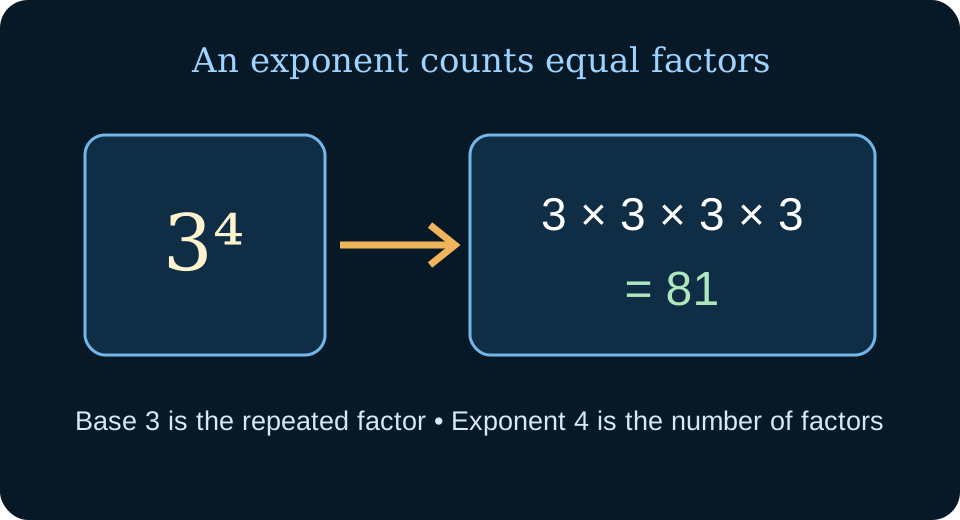
For a positive integer . Connect this statement to what a power means by identifying which operation or notation carries the main mathematical meaning. Rewrite a simple example in expanded form so that the underlying structure can be inspected directly. Compare that example with a nearby nonexample to discover which feature makes the rule valid. Use parentheses and horizontal fraction bars to preserve grouping, especially when a negative sign or reciprocal is involved.
Here is the base and is the exponent. The exponent counts factors; it is not a multiplier. Thus , not . Connect this statement to what a power means by identifying which operation or notation carries the main mathematical meaning. Rewrite a simple example in expanded form so that the underlying structure can be inspected directly.
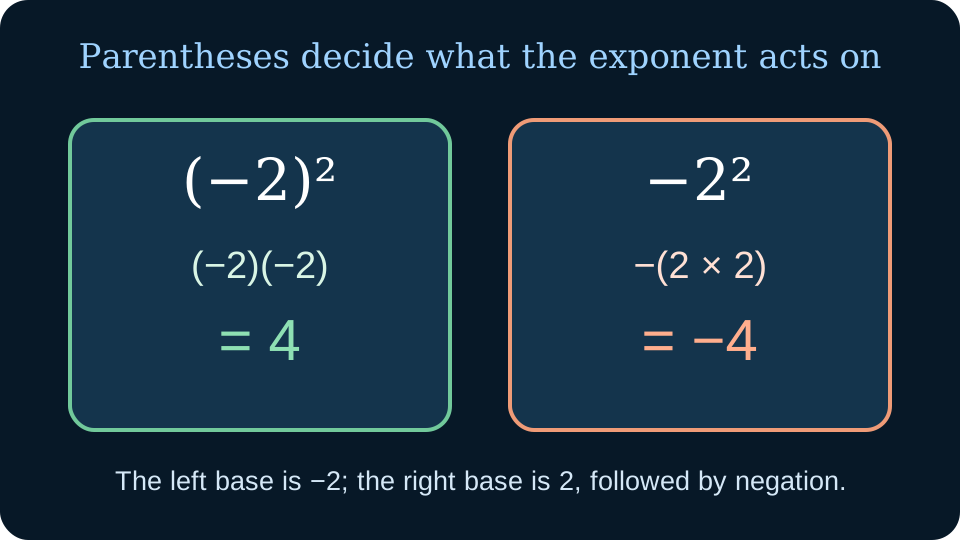
Parentheses determine the base. Connect this statement to what a power means by identifying which operation or notation carries the main mathematical meaning. Rewrite a simple example in expanded form so that the underlying structure can be inspected directly. Compare that example with a nearby nonexample to discover which feature makes the rule valid. Use parentheses and horizontal fraction bars to preserve grouping, especially when a negative sign or reciprocal is involved.
Exponent laws come from structure
 For the same nonzero base. Connect this statement to exponent laws come from structure by identifying which operation or notation carries the main mathematical meaning. Rewrite a simple example in expanded form so that the underlying structure can be inspected directly. Compare that example with a nearby nonexample to discover which feature makes the rule valid. Use parentheses and horizontal fraction bars to preserve grouping, especially when a negative sign or reciprocal is involved.
because the product contains factors of . Similarly. Connect this statement to exponent laws come from structure by identifying which operation or notation carries the main mathematical meaning. Rewrite a simple example in expanded form so that the underlying structure can be inspected directly. Compare that example with a nearby nonexample to discover which feature makes the rule valid.
The power-of-a-power rule follows by repeated grouping. Connect this statement to exponent laws come from structure by identifying which operation or notation carries the main mathematical meaning. Rewrite a simple example in expanded form so that the underlying structure can be inspected directly. Compare that example with a nearby nonexample to discover which feature makes the rule valid. Use parentheses and horizontal fraction bars to preserve grouping, especially when a negative sign or reciprocal is involved.
Products and quotients distribute through a power. Connect this statement to exponent laws come from structure by identifying which operation or notation carries the main mathematical meaning. Rewrite a simple example in expanded form so that the underlying structure can be inspected directly. Compare that example with a nearby nonexample to discover which feature makes the rule valid. Use parentheses and horizontal fraction bars to preserve grouping, especially when a negative sign or reciprocal is involved.
Powers do not distribute over addition: generally, . Name the base, exponent, operation, and grouping symbols before simplifying, because each part controls how the expression must be read. Justify the next step from a definition or exponent law instead of treating an order-of-operations mnemonic as a substitute for reasoning. Check the result with a small numerical example and compare the sign and magnitude with what the original expression suggests. Keep horizontal fraction bars and parentheses visible so that the base and the scope of every exponent remain unambiguous.
Why zero and negative exponents work
 The quotient law must remain consistent. For . Connect this statement to why zero and negative exponents work by identifying which operation or notation carries the main mathematical meaning. Rewrite a simple example in expanded form so that the underlying structure can be inspected directly. Compare that example with a nearby nonexample to discover which feature makes the rule valid.
but the exponent law gives . Therefore. Connect this statement to why zero and negative exponents work by identifying which operation or notation carries the main mathematical meaning. Rewrite a simple example in expanded form so that the underlying structure can be inspected directly. Compare that example with a nearby nonexample to discover which feature makes the rule valid.
Likewise. Connect this statement to why zero and negative exponents work by identifying which operation or notation carries the main mathematical meaning. Rewrite a simple example in expanded form so that the underlying structure can be inspected directly. Compare that example with a nearby nonexample to discover which feature makes the rule valid. Use parentheses and horizontal fraction bars to preserve grouping, especially when a negative sign or reciprocal is involved.
A negative exponent indicates a reciprocal, not a negative value. Connect this statement to why zero and negative exponents work by identifying which operation or notation carries the main mathematical meaning. Rewrite a simple example in expanded form so that the underlying structure can be inspected directly. Compare that example with a nearby nonexample to discover which feature makes the rule valid. Use parentheses and horizontal fraction bars to preserve grouping, especially when a negative sign or reciprocal is involved.
Order of operations is a hierarchy
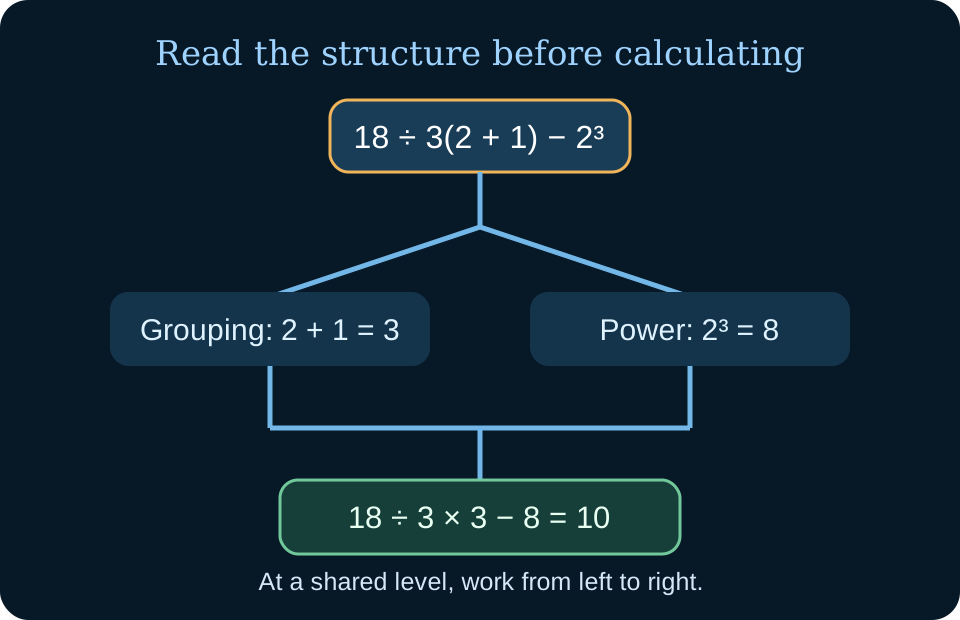
Order of operations describes the tree structure of an expression rather than a race among symbols. Grouping symbols create subexpressions that must be evaluated as units, and exponents act on the bases immediately attached to them. Multiplication and division then share one level, so they are performed from left to right when they occur in the same ungrouped chain. Addition and subtraction likewise share a level and proceed from left to right. Reading the structure in this way explains the hierarchy instead of reducing it to a memorized word. An expression is evaluated according to its structure. Connect this statement to order of operations is a hierarchy by identifying which operation or notation carries the main mathematical meaning. Rewrite a simple example in expanded form so that the underlying structure can be inspected directly. Compare that example with a nearby nonexample to discover which feature makes the rule valid. Use parentheses and horizontal fraction bars to preserve grouping, especially when a negative sign or reciprocal is involved.
- grouping symbols;
- powers and roots;
- multiplication and division from left to right;
- addition and subtraction from left to right.
Multiplication is not universally before division; they share a level. The same is true of addition and subtraction. Connect this statement to order of operations is a hierarchy by identifying which operation or notation carries the main mathematical meaning. Rewrite a simple example in expanded form so that the underlying structure can be inspected directly. Compare that example with a nearby nonexample to discover which feature makes the rule valid.
Scientific notation
Scientific notation writes a nonzero number as. Connect this statement to scientific notation by identifying which operation or notation carries the main mathematical meaning. Rewrite a simple example in expanded form so that the underlying structure can be inspected directly. Compare that example with a nearby nonexample to discover which feature makes the rule valid. Use parentheses and horizontal fraction bars to preserve grouping, especially when a negative sign or reciprocal is involved.
For example. Connect this statement to scientific notation by identifying which operation or notation carries the main mathematical meaning. Rewrite a simple example in expanded form so that the underlying structure can be inspected directly. Compare that example with a nearby nonexample to discover which feature makes the rule valid. Use parentheses and horizontal fraction bars to preserve grouping, especially when a negative sign or reciprocal is involved.
The negative exponent records division by . Connect this statement to scientific notation by identifying which operation or notation carries the main mathematical meaning. Rewrite a simple example in expanded form so that the underlying structure can be inspected directly. Compare that example with a nearby nonexample to discover which feature makes the rule valid. Use parentheses and horizontal fraction bars to preserve grouping, especially when a negative sign or reciprocal is involved.
Common mistakes
- Treating an exponent as multiplication.
- Ignoring parentheses around a negative base.
- Applying exponent rules across addition.
- Reading a negative exponent as a negative number.
- Performing multiplication before an earlier division.
Use common mistakes as a reasoning checkpoint. Read the expression aloud with every grouping symbol and exponent named explicitly. Expand one representative power to expose its repeated factors, then justify the applicable rule from that structure. Test the result with a small permitted value and contrast it with a nonexample that violates a restriction. Preserve each intermediate line so another learner can follow the reasoning without guessing which operation occurred.
Use common mistakes as a reasoning checkpoint. Read the expression aloud with every grouping symbol and exponent named explicitly. Expand one representative power to expose its repeated factors, then justify the applicable rule from that structure. Test the result with a small permitted value and contrast it with a nonexample that violates a restriction. Preserve each intermediate line so another learner can follow the reasoning without guessing which operation occurred.
Use common mistakes as a reasoning checkpoint. Read the expression aloud with every grouping symbol and exponent named explicitly. Expand one representative power to expose its repeated factors, then justify the applicable rule from that structure. Test the result with a small permitted value and contrast it with a nonexample that violates a restriction. Preserve each intermediate line so another learner can follow the reasoning without guessing which operation occurred.
Practice
- Simplify for .
- Evaluate .
- Write in ordinary notation.
- Explain why is not covered by the rule .
Solutions
- .
- .
- .
- The derivation requires a nonzero base because it uses . Division by zero is undefined.
Use practice as a reasoning checkpoint. Read the expression aloud with every grouping symbol and exponent named explicitly. Expand one representative power to expose its repeated factors, then justify the applicable rule from that structure. Test the result with a small permitted value and contrast it with a nonexample that violates a restriction. Preserve each intermediate line so another learner can follow the reasoning without guessing which operation occurred.
Use practice as a reasoning checkpoint. Read the expression aloud with every grouping symbol and exponent named explicitly. Expand one representative power to expose its repeated factors, then justify the applicable rule from that structure. Test the result with a small permitted value and contrast it with a nonexample that violates a restriction. Preserve each intermediate line so another learner can follow the reasoning without guessing which operation occurred.
Use practice as a reasoning checkpoint. Read the expression aloud with every grouping symbol and exponent named explicitly. Expand one representative power to expose its repeated factors, then justify the applicable rule from that structure. Test the result with a small permitted value and contrast it with a nonexample that violates a restriction. Preserve each intermediate line so another learner can follow the reasoning without guessing which operation occurred.
Connection forward
Exponent rules become tools for simplifying algebraic expressions, modeling growth, analyzing scientific scales, and eventually defining logarithms. Connect this statement to connection forward by identifying which operation or notation carries the main mathematical meaning. Rewrite a simple example in expanded form so that the underlying structure can be inspected directly. Compare that example with a nearby nonexample to discover which feature makes the rule valid. Use parentheses and horizontal fraction bars to preserve grouping, especially when a negative sign or reciprocal is involved.
Use connection forward as a reasoning checkpoint. Read the expression aloud with every grouping symbol and exponent named explicitly. Expand one representative power to expose its repeated factors, then justify the applicable rule from that structure. Test the result with a small permitted value and contrast it with a nonexample that violates a restriction. Preserve each intermediate line so another learner can follow the reasoning without guessing which operation occurred.
Use connection forward as a reasoning checkpoint. Read the expression aloud with every grouping symbol and exponent named explicitly. Expand one representative power to expose its repeated factors, then justify the applicable rule from that structure. Test the result with a small permitted value and contrast it with a nonexample that violates a restriction. Preserve each intermediate line so another learner can follow the reasoning without guessing which operation occurred.