
When two varying quantities are multiplied, a change in either factor changes the product. The derivative must therefore include two first-order contributions rather than simply multiply the factor derivatives. A quotient adds the further effect of a changing denominator and preserves every restriction inherited from division. This lesson derives both rules so their terms and signs make sense. It then connects symbolic differentiation to geometry, units, relative rates, strategic simplification, and reliable error checking.
Learning objectives and structural recognition
By the end of this lesson, you will derive the product and quotient rules from established principles. You will apply them to algebraic, exponential, and trigonometric functions. You will interpret each product-rule term as a separate rate contribution. You will preserve quotient domains and choose simplification when it reduces risk. You will also check derivatives numerically, dimensionally, and symbolically.
Structure determines the rule. A sum combines outputs additively, so its derivative is . A product couples each changing factor to the current value of the other. A quotient is a product with a reciprocal but also requires . Reading the outermost operation before differentiating prevents rule confusion.
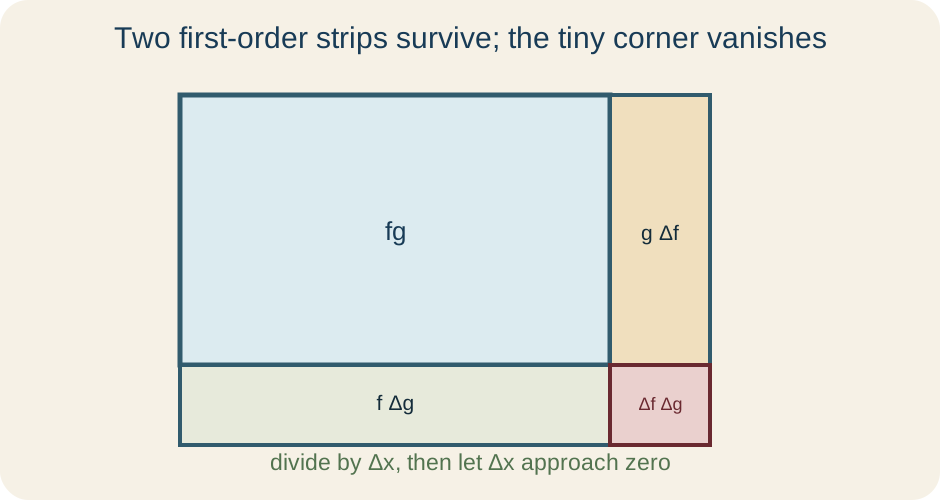
The rules are not arbitrary templates. They summarize what survives when an input increment becomes very small. In a product, the change from both factors changing simultaneously contains a tiny cross-product term, but that term vanishes after the derivative limit. The two first-order changes remain. The diagram below separates these contributions geometrically.
Derive the product rule from a difference quotient
Let . Its derivative begins as . The numerator compares the new product with the old product. It does not initially split into familiar difference quotients. Add and subtract the same intermediate term . This algebraic zero changes form without changing value.
After regrouping, the quotient becomes . Each fraction is now a standard difference quotient. Differentiability gives limits and . Differentiability also implies continuity, so . Therefore , usually written .
Each term changes one factor while weighting it by the other factor’s current value. The term records change in with at its present level. The term records change in with at its present level. Both are required because both factors may vary. Their sum gives the instantaneous product rate.
Understand why multiplying derivatives fails
The tempting shortcut fails even in simple cases. Let , so . The correct derivative is . The false shortcut gives because the derivative of one is zero. A single counterexample disproves the proposed universal rule.
Units reveal another failure. If length and width are measured in meters, area is measured in square meters. The derivative has units . The term has the same area-rate units. But has units , which cannot represent area change per second.
Finite increments make the missing logic visible. The exact product change is . Divide by the input increment. The first two ratios approach the product-rule contributions. The cross term is second order and approaches zero under differentiability.
Apply the product rule systematically
Differentiate . Identify and . Their derivatives are and . The product rule gives . Factoring yields .
A clear layout reduces omitted terms. Write the derivative of the first factor times the unchanged second factor, then add the unchanged first factor times the derivative of the second. Parentheses protect multi-term factors. Simplify only after both contributions are present. Differentiating factors separately before assembling the rule preserves structure.
For three factors, apply the two-factor rule repeatedly. The derivative of is . Each term differentiates exactly one factor while leaving the others unchanged. There are three first-order contributions because any one factor can change. This pattern extends to any finite product.
Interpret changing rectangular area
Let a rectangle have length and width . Its area is . Differentiating gives . The first term is an area strip caused by length change. The second is an area strip caused by width change.
Suppose , , , and . The length contribution is . The width contribution is . Therefore . Every term has the required area-per-time units.
The positive net rate means area is increasing at that instant even though width is decreasing. Competing contributions nearly cancel. Looking only at the sign of one dimension’s rate would give an incomplete conclusion. The product rule quantifies both effects in compatible units. This reasoning generalizes to revenue, mass, energy, and other products of changing quantities.
Derive the quotient rule from the product rule
Let where . Then . Differentiating with the product rule gives . Subtract from both sides. Divide by the nonzero quantity to isolate .
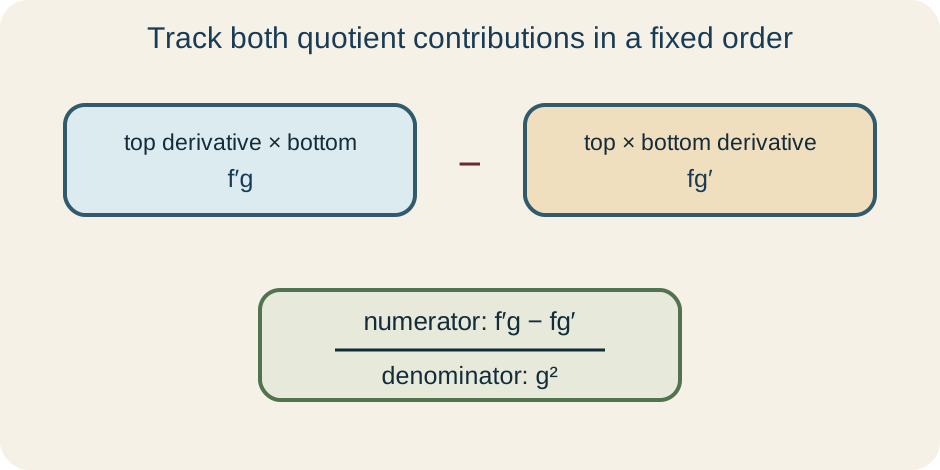
The intermediate result is . Substitute and combine terms over a common denominator. This gives . The denominator is the entire original denominator squared. The numerator order is derivative of top times bottom minus top times derivative of bottom.
The minus sign reflects a changing denominator’s inverse effect. If the numerator stays positive and fixed while the denominator increases, the quotient decreases. Reversing the numerator terms would often predict the wrong sign. The derivation is a stronger memory aid than a rhyme alone. It also makes the restriction unavoidable.
Apply the quotient rule and preserve domains
Let with . The numerator derivative is , and the denominator derivative is one. The rule gives . Simplifying the numerator produces . Therefore for .
Keep parentheses until numerator subtraction is distributed. The minus sign applies to the entire product . A common error changes only its first term. Expand carefully, then combine like terms. Leave the squared denominator factored when that form preserves domain visibility.
The derivative’s domain cannot include points where the original function is undefined. Even if algebra later cancels a factor, an excluded input remains excluded when describing the derivative of that original function. A simplified expression may define a different extension. State inherited restrictions beside the final formula. Domain is part of the answer rather than a footnote.
Simplify strategically before differentiating
Some quotients or products simplify to easier forms. For , . Differentiating the simplified expression gives . This result is valid on the original domain . Simplification does not restore the excluded point.
Expanding polynomial products can also be efficient. Differentiating by first expanding may reduce bookkeeping. By contrast, expanding is impossible because unlike terms do not combine. Choose a representation that makes the derivative structure clearer. Preserve exact equivalence and domain restrictions.
Sometimes a quotient can be rewritten using negative exponents and the product rule. The expression is where . Applying product and chain rules reproduces the quotient rule. This route can be efficient for simple monomial denominators. It does not remove the need to record .
Compare product and quotient relative rates
Where and are nonzero, divide the product rule by . The result is . Each fraction on the right is a relative rate, meaning rate divided by current amount. Relative rates add when quantities multiply. This explains many percentage-growth models.
For a quotient, the analogous identity is . The denominator’s relative rate subtracts. If both numerator and denominator grow at the same relative rate, their quotient has zero instantaneous relative rate. The quotient can be locally constant even while both components change. This interpretation extends beyond symbolic manipulation.
Relative rates must carry reciprocal-input units. If has units of quantity per second and has quantity units, then has inverse-second units. Terms can be added only when their units agree. These identities motivate logarithmic differentiation because the derivative of is . They also clarify percentage changes in products and ratios.
Combine rules with chain structure
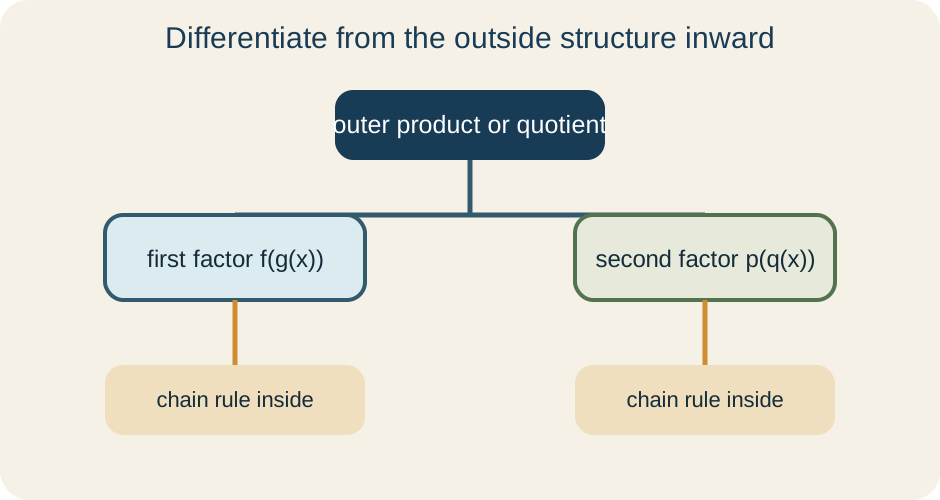
Products and quotients often contain nested functions. Apply the product or quotient rule to the outer structure, then use the chain rule inside each factor derivative. For , the product rule gives . The bracketed derivative includes the inner factor . Simplifying gives .
For , differentiate numerator and denominator separately. The numerator derivative is , and the denominator derivative is . The quotient rule gives . Factoring the numerator may improve interpretation. The denominator never vanishes for real , so the real domain is all numbers.
Rule order follows the expression tree. Identify the outermost operation first. Preserve unchanged factors while differentiating the selected factor completely. Parentheses and brackets show where chain-rule results belong. A structured layout prevents both omitted terms and missing inner derivatives.
Check derivatives from several viewpoints
Symbolic verification can compare two forms. Expand a factored derivative or factor an expanded one until the expressions visibly match. For a simplified original function, differentiate both the original and simplified forms on the shared domain. Agreement strengthens the result. Disagreement identifies an algebraic or rule-application error.
A numerical difference quotient provides an approximate check. At a permitted input , compute for small nonzero and compare it with the formula’s value. Several decreasing values of are better than one. Roundoff eventually limits accuracy. Numerical agreement supports but does not prove the symbolic derivation.
Units and sign provide contextual checks. An area derivative should have area-per-time units. A quotient with fixed positive numerator and increasing positive denominator should decrease. A product of positive increasing factors should increase. These expectations catch impossible answers before detailed recomputation.
Diagnose common mistakes
Writing omits both first-order contributions. Writing only or only assumes one factor is constant without justification. Reversing quotient numerator order changes the sign. Squaring only one term of a multi-term denominator changes the expression. Keep the original structure visible until the rule is complete.
Substituting numerical values too early can turn changing quantities into apparent constants. In related-rate problems, differentiate the relationship before inserting instant-specific measurements. A length equal to five meters at one instant can still have a nonzero derivative. Its current value and its rate are different data. Substitute only after the derivative equation contains all contributions.
Canceling factors before differentiating is allowed only with domain care. The functions and agree for , but only the second is defined at zero. The derivative of the original quotient is one on . Reporting it for every real input incorrectly changes the original function. Preserve exclusions even when the derivative formula looks harmless.
Guided practice and synthesis
Differentiate for . The numerator derivative is , and the denominator derivative is one. The quotient rule gives . The order of numerator terms follows directly from the derivation. The original exclusion remains.
Find the rate of change of when , , , and . Differentiate first to get . Substitution gives . Therefore . The positive sign means area increases at that instant.
For independent synthesis, differentiate and state the inherited domain. Simplify the result and verify it by polynomial division followed by differentiation. Then explain why the two methods must agree on their common domain. Include the meaning of every factor in the quotient-rule numerator. Finish by describing one unit-based or sign-based check that would apply in a contextual version.
Connection forward
The product rule adds separate first-order changes from every varying factor. The quotient rule follows from the product rule and subtracts the denominator contribution over a squared denominator. Both rules preserve the original function’s domain. Units and relative rates explain why the formulas have their particular terms. Differentiation and numerical checks verify the result.
The most reliable workflow begins by identifying outer structure. Simplify only when equivalence and restrictions remain clear. Differentiate each selected factor completely, including inner chain rules. Assemble all contributions before simplifying. Interpret signs and units after obtaining the formula.
The chain rule handles nested functions and completes the basic differentiation toolkit. Related-rate problems combine product, quotient, and chain structures with time-dependent quantities. Logarithmic differentiation turns complicated products and powers into sums of relative rates. Applications of derivatives then use these formulas to analyze motion, optimization, and sensitivity. The structural habits developed here support every one of those topics.