
A two-sided limit asks what a function approaches as the input moves toward a point from both directions. That immediately raises a more basic question: what happens if the behavior on the two sides is different?
One-sided limits isolate those directions. They let us ask separately what the function approaches from values less than the target and from values greater than the target. Once those two behaviors are known, we can determine whether a two-sided limit exists.
Learning objectives
By the end of this lesson, you should be able to:
- interpret left- and right-hand limit notation;
- calculate one-sided limits from formulas and piecewise functions;
- determine when a two-sided limit exists from its one-sided limits;
- distinguish a limit from the value of the function at the point;
- analyze jump discontinuities and domain endpoints;
- distinguish removable from nonremovable discontinuities; and
- explain why a limit fails to exist instead of relying on unexplained shorthand.
Reviewing left and right approach
The previous lesson introduced the idea that an input can approach a value from two directions.
Approaching from the left means using values less than that move progressively closer to it:
Approaching from the right means using values greater than that move progressively closer to it:
For example, if ,
approaches from the left, while
approaches from the right.
A left-hand limit
asks what the outputs approach as approaches using only values with .
A right-hand limit
asks what the outputs approach using only values with .
The superscript minus and plus signs indicate the direction of approach. They do not mean that itself is negative or positive.
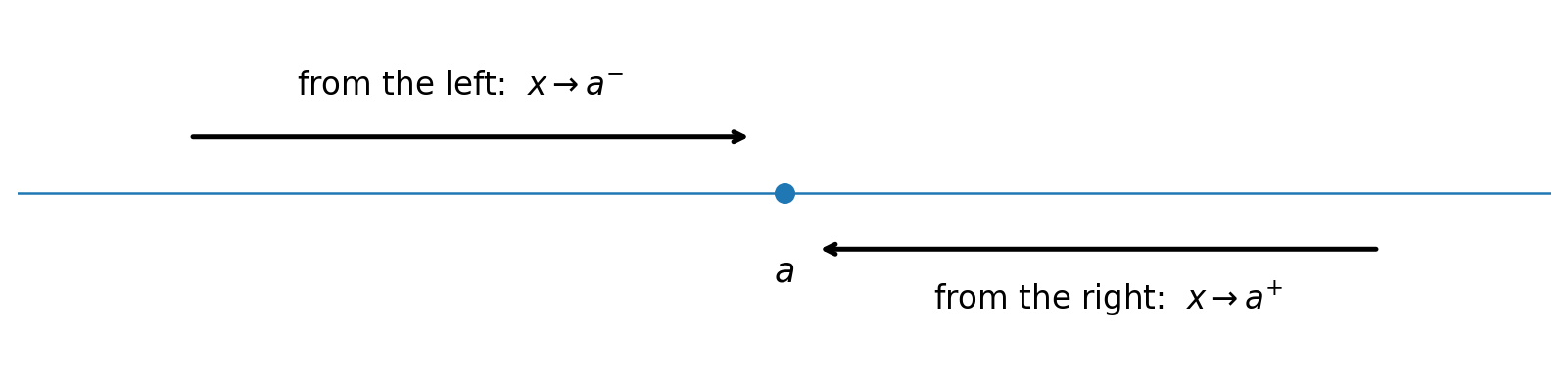
The number-line diagram below makes the direction explicit: moves toward through values less than , while moves toward through values greater than .
The two-sided existence criterion
When the domain contains points arbitrarily close to from both sides, a finite two-sided limit exists only when the two directional limits both exist and agree.
Equivalently,
is the condition that allows us to write
This is not merely a convenient rule. A two-sided limit makes a claim about the function’s behavior from both available directions near the target. If those directions lead to different outputs, there is no single value that describes the behavior of the function near that point.
Piecewise functions
One-sided limits are especially useful for piecewise functions because different formulas may govern the left and right sides of the same point.
Consider
To evaluate the limit as , use the formula that governs each side.
From the left
For ,
Therefore,
From the right
For ,
Therefore,
Because the one-sided limits agree,
The graph below names both pieces explicitly. The blue branch represents for , while the orange branch represents for . Both branches approach , and because the second piece includes equality, the orange point at is filled.
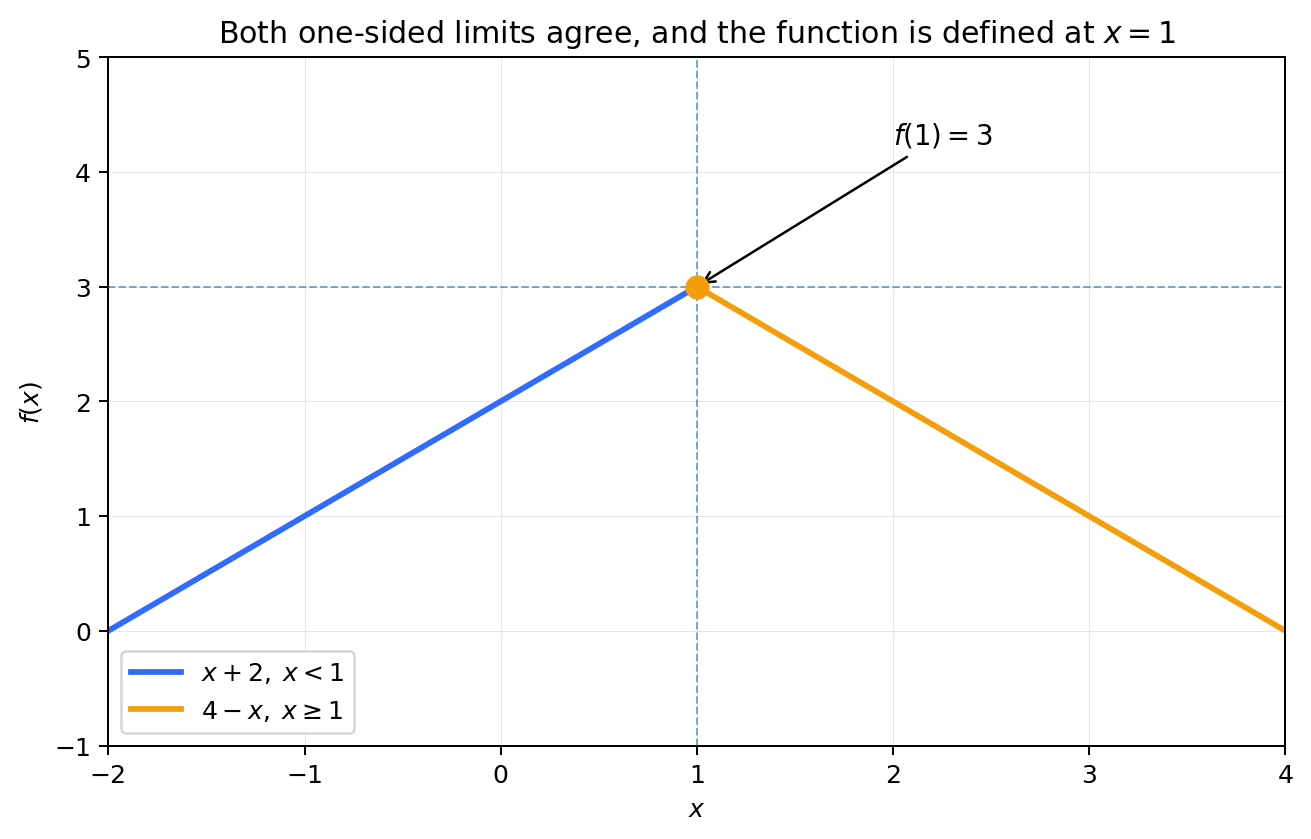
The function value is
That agreement is useful, but it is separate from the limit calculation. The two-sided limit exists because the one-sided limits agree. The filled point tells us that the function is also defined there with the same value.
When the sides disagree: jump discontinuities
Now consider
From the left,
From the right,
Because
there is no single value approached from both directions. Therefore,
The limit does not exist because the left-hand limit is while the right-hand limit is .
The graph below uses the same color convention as the previous piecewise graph: blue for the left-side branch and orange for the right-side branch. It shows the left-hand limit approaching and the right-hand limit approaching .
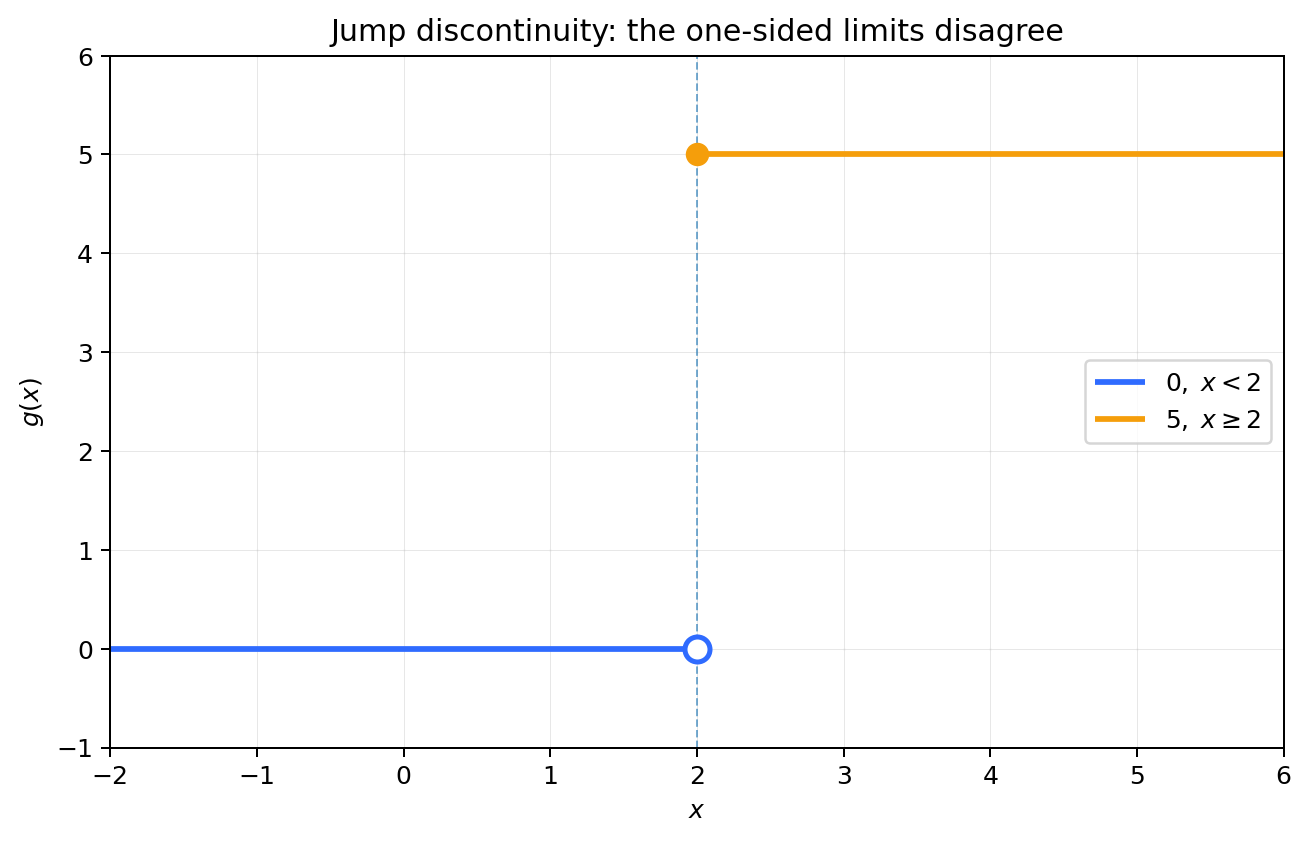
The vertical separation between the two branches is a jump discontinuity. No choice of can make the left- and right-hand limits agree.
A formula-defined jump from an absolute-value ratio
Piecewise notation is not required for one-sided behavior to differ.
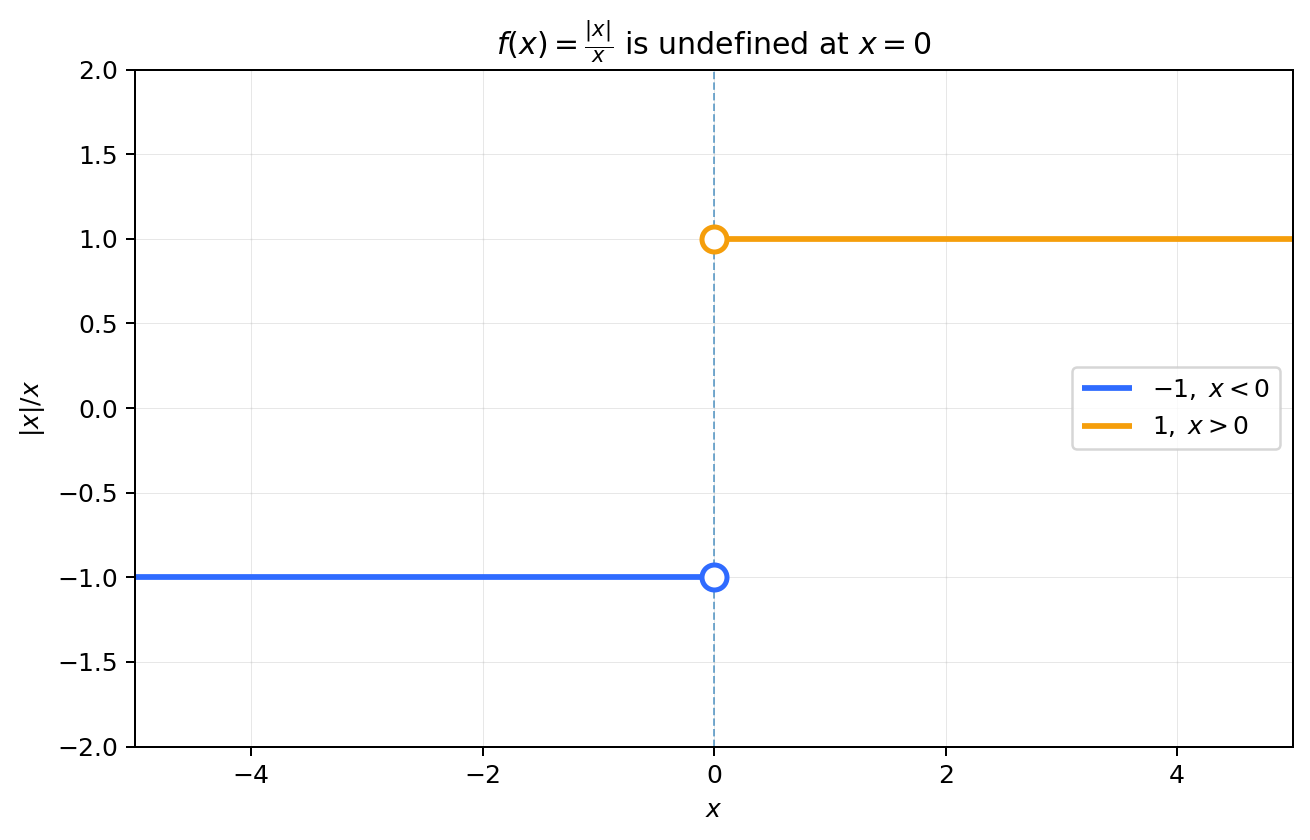
Consider
Direct substitution at gives the form
As discussed in the previous lesson, is an indeterminate form. It does not tell us the value of the limit. Instead, it tells us that direct substitution has not resolved the behavior and that further analysis is required.
In some indeterminate forms, algebraic simplification removes the discontinuity. That happened for
Here, however, the absolute value changes its algebraic form depending on which side of zero we use.
For ,
so
Therefore,
For ,
so
Therefore,
The graph below uses blue for the left-side behavior and orange for the right-side behavior. The function is undefined at , and the two sides approach different values.
Since
there is no value such that
Therefore,
The limit approaching 0 does not exist because the left-hand limit is while the right-hand limit is .
This is why the indeterminate form cannot be resolved by assigning a new value at . The problem is not merely that the function is undefined there; the nearby behavior from the two sides is incompatible.
Endpoints of a domain
Endpoints require a small refinement in how we talk about limits.
Consider
Its real-valued domain is
As approaches through values in the domain, the only possible approach is from the right:
The graph below shows that the function begins at the filled point and approaches that point through domain values with .
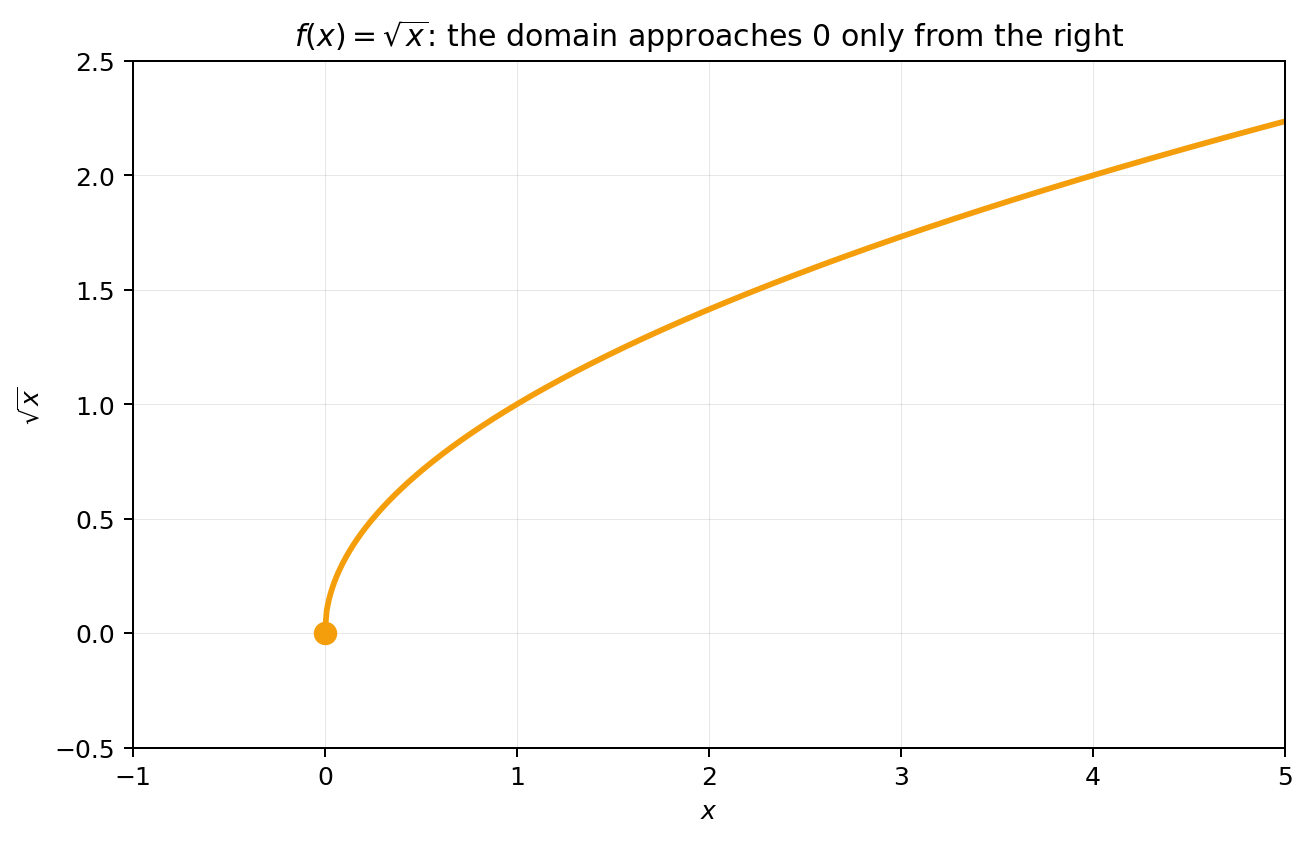
There are no real domain points with , so the real left-hand limit is not defined.
Under the standard definition of a limit for a function whose domain is a subset of the real numbers, the statement
is valid because approaches through points in the domain of the function. In many introductory calculus settings, the right-hand notation
is emphasized at endpoints to make the available direction explicit.
This distinction matters when using the two-sided existence criterion. If is not an endpoint of the domain of and domain values occur arbitrarily close to on both sides, both one-sided limits must agree. At an endpoint such as for , only the right-hand approach is available.
Ways a limit can fail to exist
A limit can fail to exist for several distinct reasons. The mechanism matters.
1. The one-sided limits disagree
This is the jump-discontinuity case:
The examples above involving a piecewise jump and illustrate this mechanism.
2. The function becomes unbounded
Near a vertical asymptote, the function may increase or decrease without bound.
For example,
has
and
The graph below shows the opposite one-sided unbounded behavior. Blue represents the approach from the left and orange represents the approach from the right.
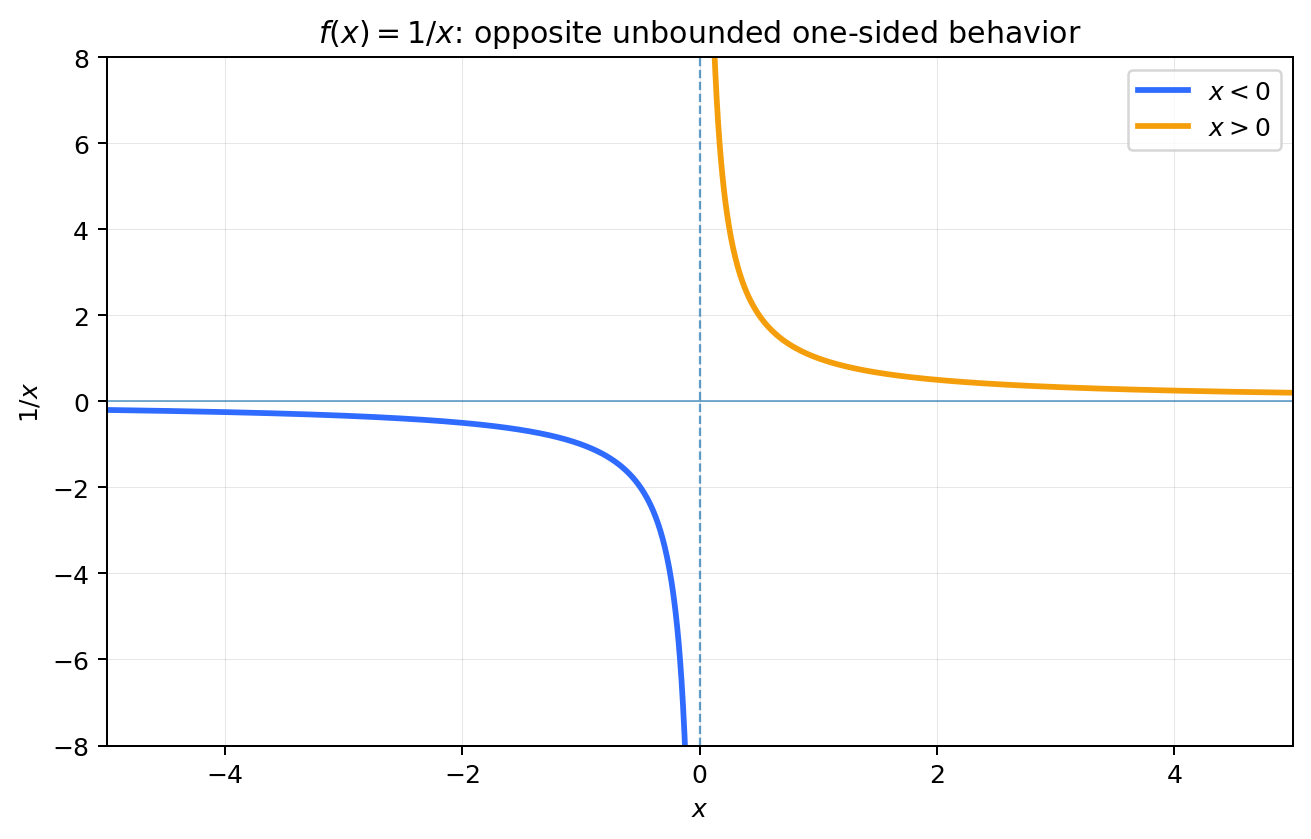
Because the two sides do not approach the same finite real value,
The limit does not exist because the function decreases without bound as and increases without bound as .
A later lesson develops infinite limits and vertical asymptotes in greater detail.
3. The function oscillates without settling
A function may remain bounded but still fail to approach any single output.
A standard example is
as .
The graph below shows the function oscillating increasingly rapidly between and as approaches zero from either side.
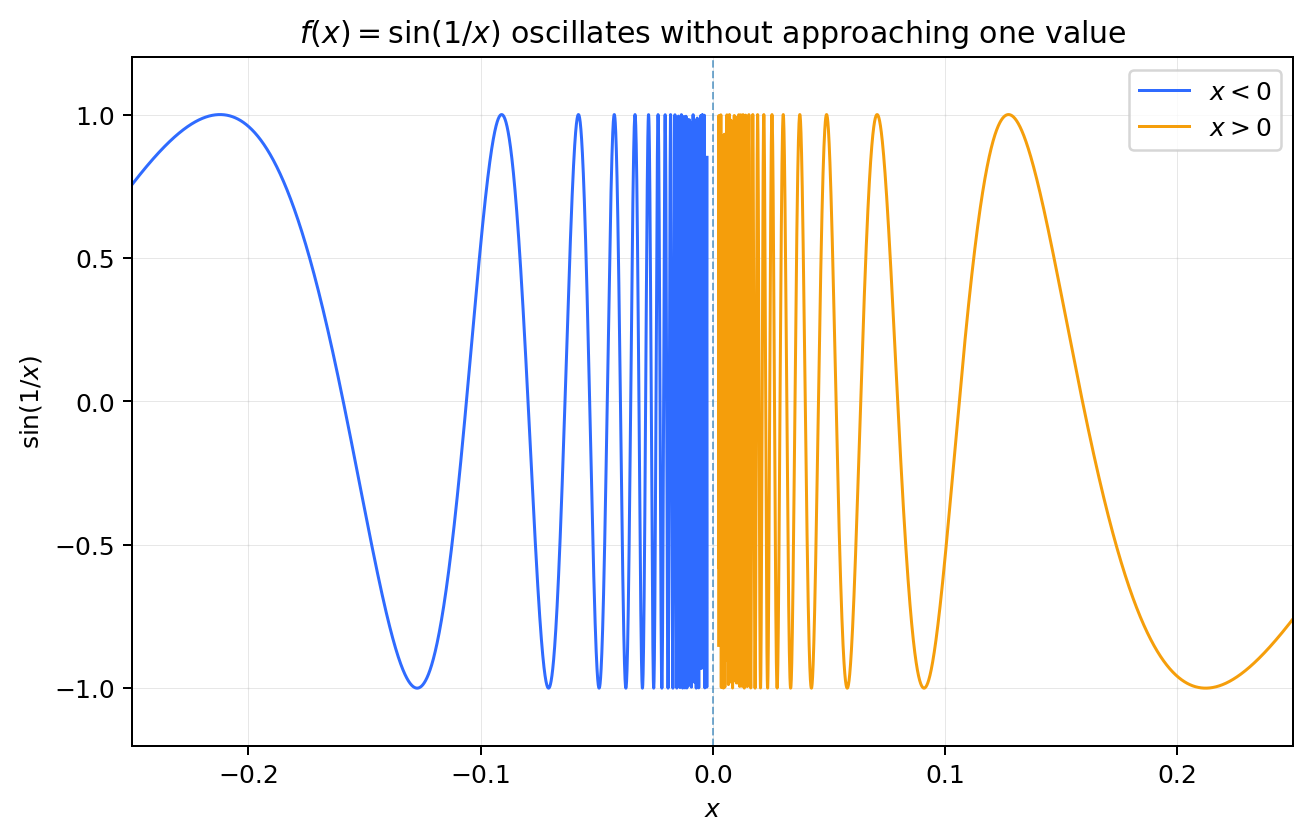
The argument grows without bound in magnitude, causing the sine function to pass through values between and infinitely often near zero. The outputs never settle toward one number.
Therefore,
The limit does not exist because the function oscillates between and infinitely often as approaches without approaching a single value.
4. There are no domain values arbitrarily close to the target
A limit describes behavior arbitrarily close to a target, so there must be domain values arbitrarily close to that target.
This should not be confused with an ordinary domain endpoint such as for . Although there are no real domain values to the left of , there are domain values arbitrarily close to from the right, and the limit through the domain is .
Instead, if the target is isolated from all other domain points, there is no nearby behavior from which to determine a limit in the ordinary introductory sense.
A reliable process
When evaluating a limit at :
-
Determine whether there are domain values arbitrarily close to , and whether they occur on one side or both sides of .
-
If is not an endpoint of the domain and domain values occur arbitrarily close to on both sides, calculate or determine
and
-
Compare the directional behavior.
-
If both sides are available and both approach the same finite value , conclude
-
If only one side is available because is a domain endpoint, evaluate the limit through the available domain values and state the directional limit explicitly when it improves clarity.
-
If the function does not approach a single value, explain the mechanism rather than merely saying the limit does not exist.
Graphs and tables can reveal and support the directional behavior, but when the formula is known and an analytic method is available, the limit should be established by calculation.
Test Your Knowledge
For each problem:
- calculate the relevant one-sided limits;
- determine whether the requested limit exists;
- determine the function value when it is defined; and
- sketch the graph before opening the solution.
1. A jump discontinuity
Let
Determine the left-hand limit, right-hand limit, two-sided limit, and . Then sketch the graph.
Solution
For ,
so
For ,
so
Because the one-sided limits disagree,
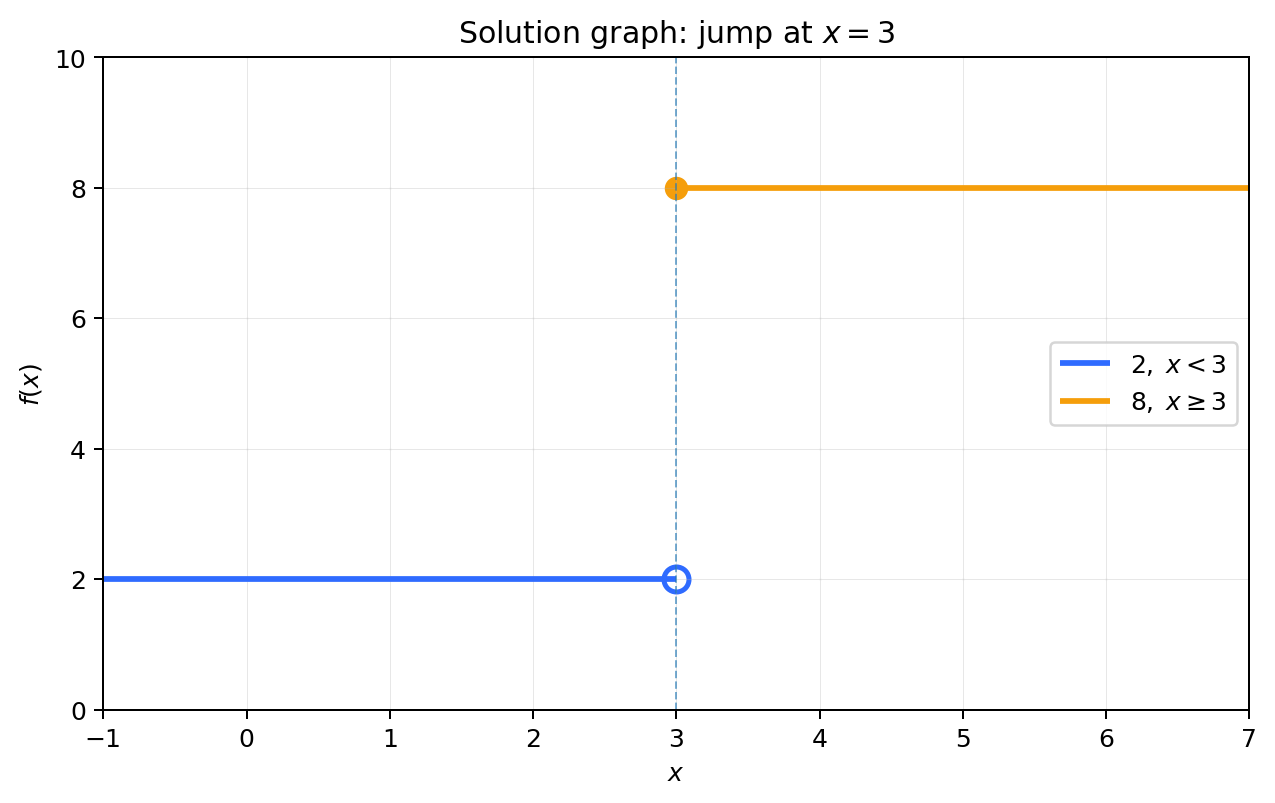
The limit does not exist because the left-hand limit is while the right-hand limit is .
Because the second piece includes equality,
The solution graph below therefore has an open point at , where the left piece is not defined, and a filled orange point at , where the right piece defines the function.
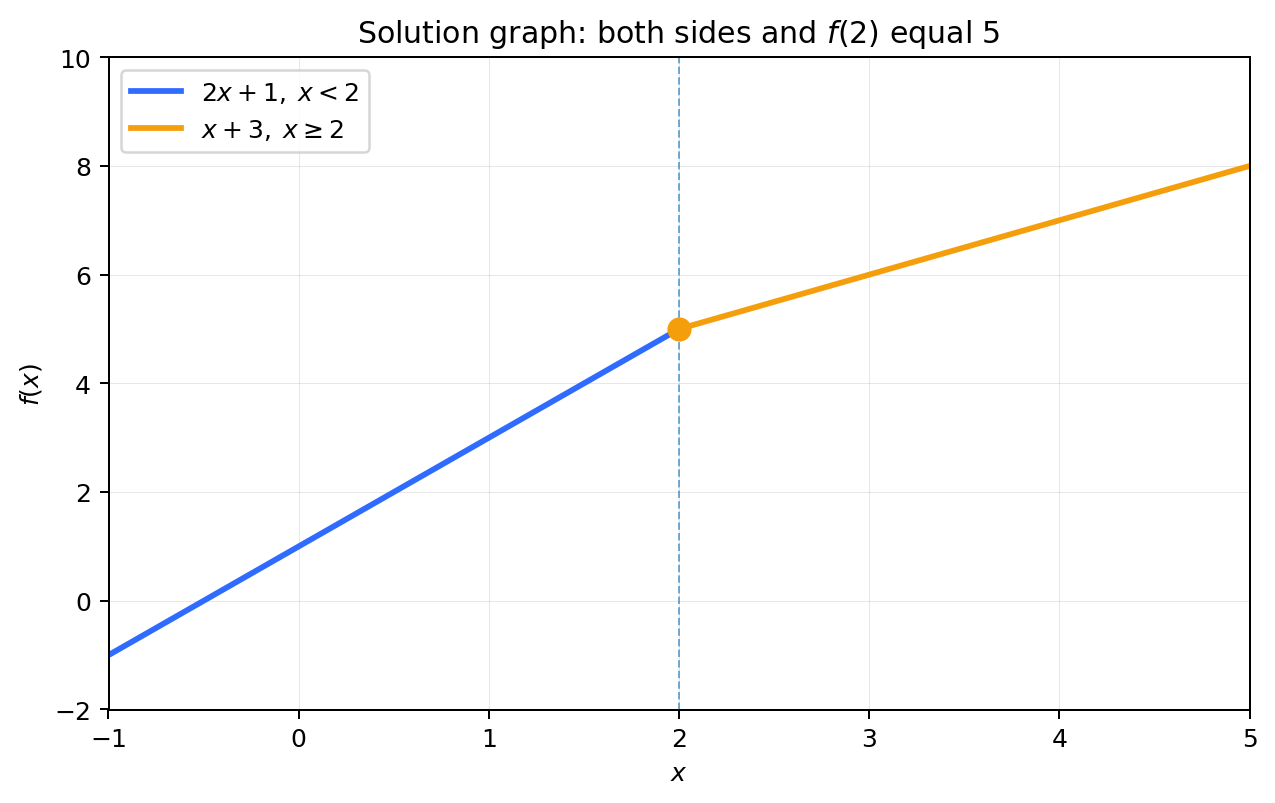
2. Matching one-sided limits
Let
Evaluate the one-sided limits, determine whether
exists, calculate , and sketch the graph.
Solution
From the left,
From the right,
Since the one-sided limits agree,
The second piece defines the function at :
As shown in the solution graph, both branches meet at and the point is filled because the function is defined there.
3. Limit versus function value
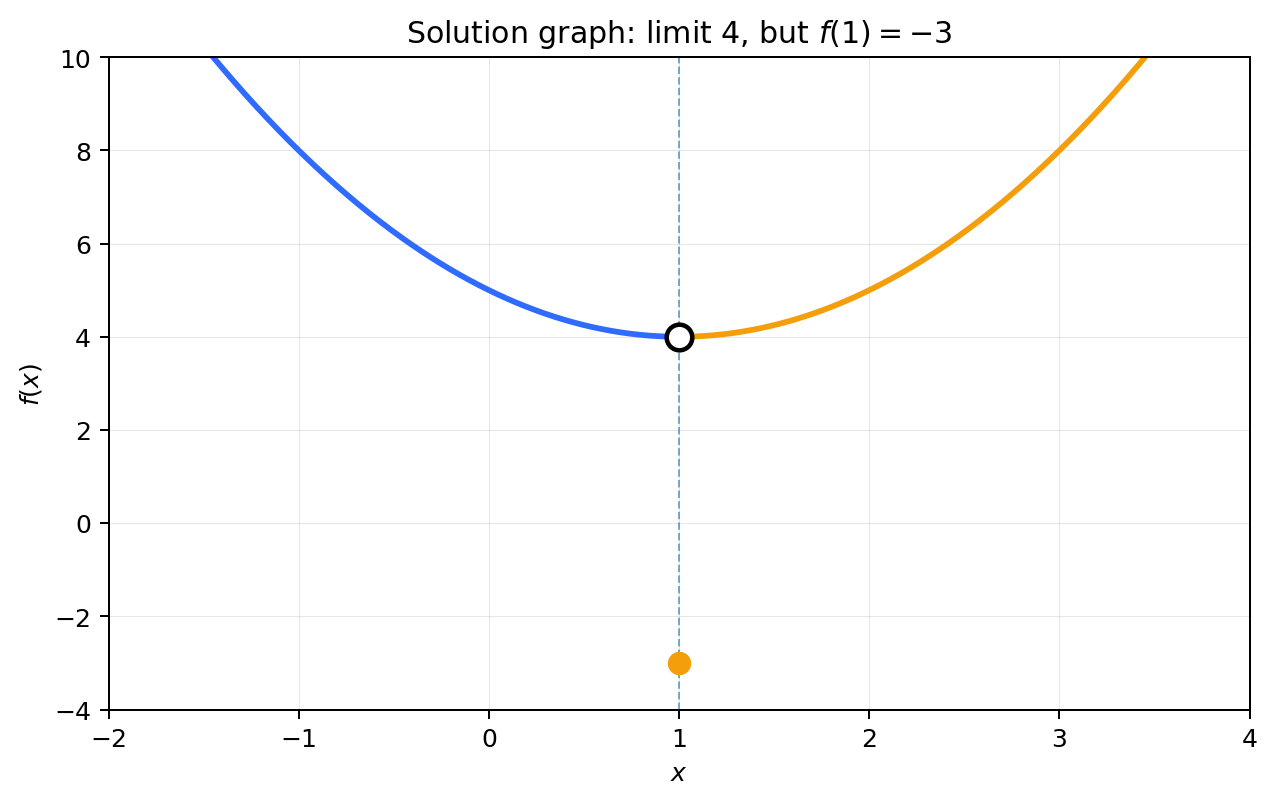
Suppose a function follows
for all , but is separately defined by
Determine
and . Then sketch the graph.
Solution
For nearby values with , the function follows
Therefore,
and
The two-sided limit is
However,
The solution graph below shows an open point at because the nearby formula is not used at , and a filled point at because that is the actual function value.
4. An endpoint
For
evaluate the limit as through the real domain, identify the relevant one-sided limit, and sketch the graph near the origin.
Solution
The domain is
so values in the domain can approach only from the right:
Therefore, as a limit through the domain,
The function is also defined at the endpoint:
The graph below shows a filled point at and no real-valued branch to the left of the origin.
5. An indeterminate form whose one-sided limits disagree
For
evaluate the one-sided limits at , determine whether the two-sided limit exists, and sketch the graph.
Solution
Direct substitution gives , an indeterminate form, so further analysis is required.
For ,
so
For ,
so
Because the one-sided limits disagree,
The limit does not exist because the left-hand limit is while the right-hand limit is .
The function itself is undefined at . The solution graph below therefore uses open points at the two unattained boundary values.
6. Unbounded one-sided behavior
For
describe both one-sided behaviors as , determine whether a finite two-sided limit exists, and sketch the graph.
Solution
As ,
As ,
The two sides do not approach the same finite real value, so
The limit does not exist because the function decreases without bound as and increases without bound as .
The solution graph below shows the vertical asymptote at and the opposite unbounded behavior on the two sides.