
A falling ball can be described through motion or through energy. Kinematics says its velocity changes because gravitational acceleration changes velocity each second. Energy accounting says gravitational potential energy decreases while kinetic energy increases. These statements are not rival explanations, because they encode the same mechanics in different variables. Learning when their predictions coincide reveals both the power and the limits of each description.
The comparison matters beyond textbook problem solving. Scientists often choose a representation according to the question rather than according to a favored formula. A time-sensitive question calls attention to acceleration and velocity, while a state-to-state question may be shorter in energy language. The selected representation can expose one feature while hiding another. A strong solution therefore states what its method can determine and what additional information remains necessary.
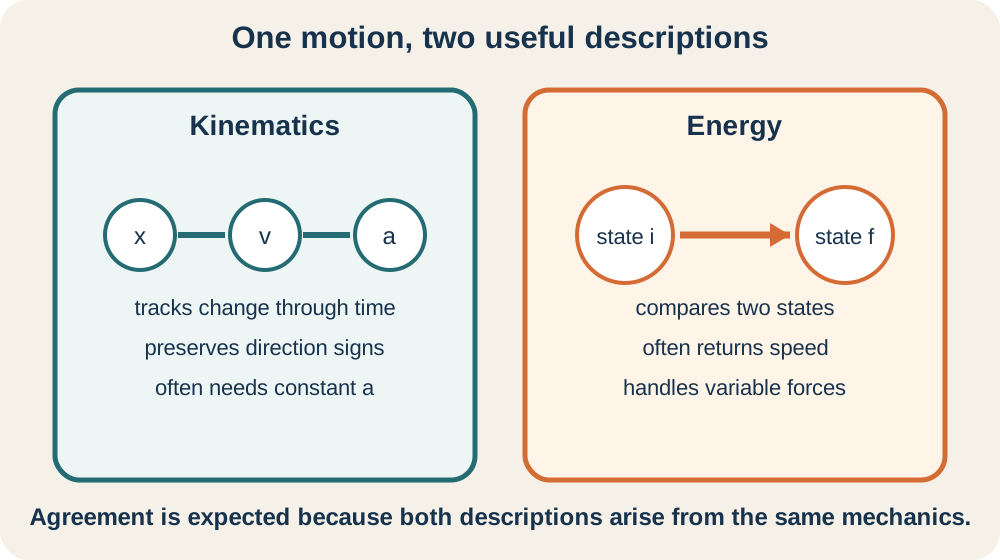
Begin with two descriptions of one motion
Kinematics organizes motion with position , velocity , acceleration , and time . Position identifies location relative to an origin, and velocity is the signed rate at which position changes. Acceleration is the signed rate at which velocity changes. For constant acceleration, these definitions lead to a small family of algebraic equations. Each equation eliminates one variable and is valid only under the assumptions used in its derivation.
Energy organizes the same system using stored energy, energy of motion, and transfers across the system boundary. Translational kinetic energy is , where is mass and is speed. Gravitational potential energy near Earth is , where is vertical position relative to a chosen zero. Work represents energy transferred by a force acting through displacement. The work–energy theorem states that net work equals the change in kinetic energy.
The two descriptions emphasize different information. Kinematics retains signs, time ordering, and detailed evolution when its motion model is known. Energy compares states and often suppresses the path taken between them. Both must predict compatible results when applied to the same physical system with the same assumptions. Disagreement usually signals inconsistent signs, boundaries, forces, or approximations rather than a failure of mechanics.
Derive the shared equation rather than memorize it
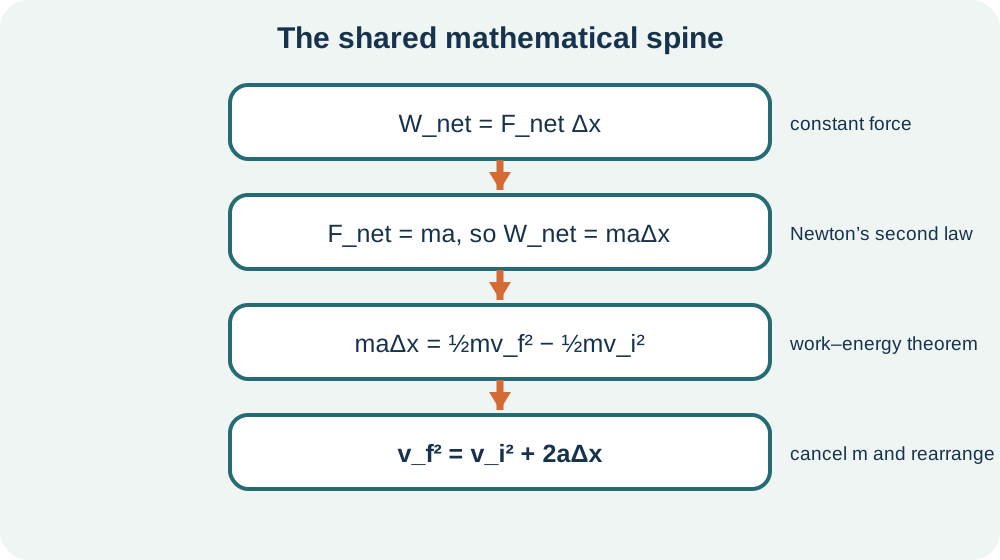
For straight-line motion under a constant net force parallel to displacement, work is . The symbol denotes final position minus initial position. Newton’s second law supplies , where constant force implies constant acceleration for constant mass. Substitution gives . This equation connects force language to motion language.
The work–energy theorem supplies another expression for the same net work. It states . The subscripts and label initial and final states. Equating the two work expressions gives . Every term has energy units of joules, equivalent to kilogram meter squared per second squared.
Cancel the nonzero mass, multiply by two, and rearrange the equation. The result is . This is the familiar constant-acceleration equation that contains no time variable. Its resemblance to an energy equation is not accidental, because it was just derived from the work–energy theorem. The derivation also explains why constant acceleration is required for this simple algebraic form.
Read signs and units as physical information
The term can be positive or negative. It is positive when acceleration and displacement point in the same chosen direction, causing speed to increase in the simple one-dimensional case. It is negative when they point oppositely, allowing speed to decrease. The squared speeds are never negative, but their difference can have either sign. A sign therefore records energy transfer rather than mere algebraic decoration.
Units provide an independent structural check. Acceleration has units , and displacement has units of meters. Their product has units , matching the units of speed squared. Multiplication by mass would produce , which is one joule. If a proposed equation leaves unmatched dimensions, no numerical substitution can make it physically correct.
Coordinate choices remain arbitrary but must stay consistent. Choosing upward as positive makes gravitational acceleration , where near Earth. A downward displacement then has negative , so the product is positive. Choosing downward as positive makes both quantities positive and gives the same final speed. Physics is independent of the coordinate convention when every sign follows that convention.
Compare free-fall solutions step by step
Release an object from rest through a vertical distance while neglecting air resistance. With downward positive, , , and . Kinematics gives , followed by for the downward speed. The positive square root is chosen because speed is a nonnegative magnitude. Direction must be supplied separately as downward.
For the energy solution, define the object and Earth as the system. Choose the final height as the zero of gravitational potential energy. The initial energy is then , while the final energy is . Conservation gives . Canceling mass again yields .
Suppose the vertical drop is . Substitution gives . The result is approximately . The units under the radical are square meters per square second, so the radical has speed units. Both methods agree because they describe the same isolated approximation with the same initial state.
Understand why path shape can disappear
Imagine the object is a cart moving down a frictionless track instead of falling vertically. Energy depends on the vertical height change, not on the track’s shape. The decrease in gravitational potential energy becomes translational kinetic energy if rolling and other stores are absent. Consequently, every frictionless path with the same starting and ending heights gives the same final speed. This conclusion requires no calculation of changing normal forces along the path.
A straight incline illustrates how kinematics hides the same cancellation. Along an incline at angle , the acceleration component is . The distance along the incline for vertical drop is . Substitution gives . The angle cancels because a gentler acceleration acts across a proportionally longer distance.
Equal final speed does not imply equal travel time. Different track shapes distribute acceleration differently and have different path lengths. A steep initial descent can build speed early, changing the time even when the final energy matches. Energy alone usually cannot reveal this temporal history. Kinematics or integration of the motion is needed when elapsed time is the target quantity.
Use energy when acceleration is not constant
The constant-acceleration equations cannot use a single acceleration value when force changes continuously with position. The work–energy theorem remains valid in the integral form . The integral accumulates many small contributions of force times displacement. Its signed area has units of joules. This broader form makes energy useful for springs, curved potentials, and gravitational interactions across large distances.
A spring provides the standard example. Its force is , where is spring stiffness in newtons per meter and is displacement from equilibrium. Because acceleration changes with position, no one constant-acceleration equation describes the full trip. Spring potential energy is . Conservation can connect two positions through .
Rotational motion can also belong in the energy account. A rolling wheel has translational kinetic energy and rotational kinetic energy , where is rotational inertia and is angular speed. Introductory examples sometimes ignore rotation because the object is modeled as a particle or because wheels are assumed negligibly light. That simplification must be stated rather than silently imposed. Including rotation predicts less translational speed for the same available potential-energy decrease.
Recognize what energy alone does not determine
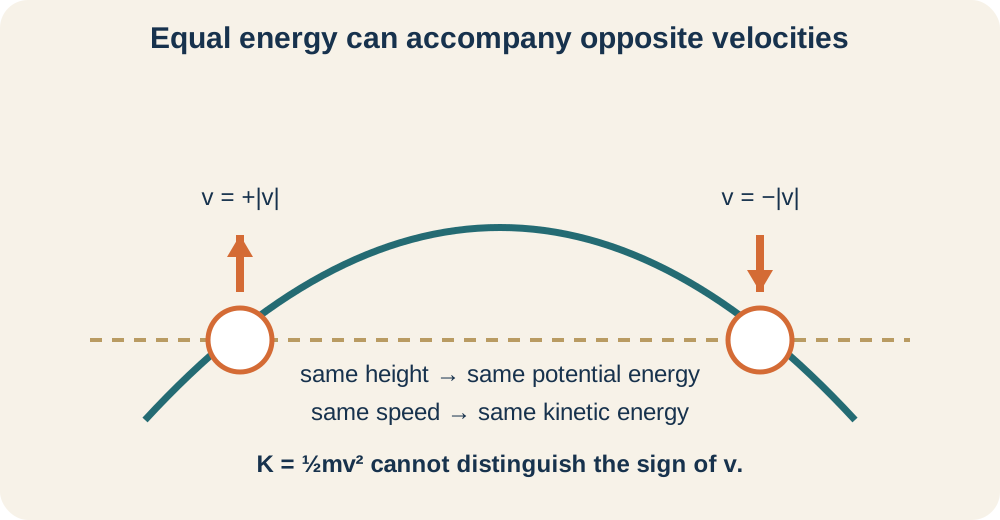
Kinetic energy contains , so it does not distinguish positive from negative velocity. A ball passing a certain height on the way upward can have the same kinetic and potential energies as it has while descending. The speeds match, but the velocities have opposite signs. Energy determines the magnitude in this situation. The motion context or a signed kinematic analysis supplies direction.
Energy also does not ordinarily determine when a state occurs. Knowing that a projectile reaches a certain height does not give its arrival time without additional motion information. Energy can identify a turning height by setting kinetic energy to zero. It cannot by itself distinguish the approach to that height from departure after it. Questions about chronology require a representation that retains time.
Finally, an energy equation does not automatically identify every force. A normal force can redirect velocity without changing speed, so it may do no work while remaining dynamically essential. Centripetal acceleration can likewise be nonzero during constant-speed circular motion. Newton’s second law is needed to find such forces. Energy and force analyses answer related but nonidentical questions.
Include dissipation without claiming energy vanished
Mechanical energy means selected macroscopic kinetic and potential stores. Friction can reduce their total by increasing thermal energy in the system and surroundings. Energy itself is not destroyed. The accounting boundary determines whether the transfer appears as external work or an internal energy conversion. A clear solution names the system before writing its balance.
For a block sliding on a rough horizontal surface, kinetic friction has magnitude . Its work over forward distance is because force opposes displacement. The work–energy equation becomes . Canceling mass and rearranging gives . Kinematics gives the same result from constant acceleration .
Stopping distance exposes the squared-speed relationship. Setting gives for this simplified model. Doubling initial speed multiplies the required distance by four. The energy explanation is that kinetic energy grows with speed squared while the constant friction force removes a fixed energy per meter. Real braking adds reaction time, changing friction, slopes, and tire limits, so the formula is a model rather than a universal guarantee.
Choose a method with a disciplined workflow
Begin by defining the system, coordinate direction, initial state, and final state. List known quantities with units before selecting an equation. Ask whether acceleration is constant and whether time or direction is requested. Identify conservative stores, external work, thermal changes, and rotation where relevant. These questions expose assumptions before algebra conceals them.
Choose kinematics when constant acceleration and temporal detail dominate the question. Choose energy when the desired relationship is state-to-state, when the path is irrelevant, or when force varies with position. Combine methods when energy gives a speed that becomes initial data for a time calculation. Neither method is inherently more correct. The better method is the one whose variables and assumptions align with the requested quantity.
After solving, verify dimensions, signs, limiting behavior, and physical scale. Check that a zero height drop gives no speed increase in the free-fall model. Check that added dissipation lowers rather than raises final mechanical speed. Compare both methods when their shared assumptions make that practical. Agreement then becomes evidence that the physical model and algebra are mutually consistent.
Practice the comparison deliberately
Consider a block released from rest down a frictionless height of . Energy predicts to two significant figures. The mass cancels because both gravitational and kinetic energy are proportional to mass. On a straight incline, kinematics predicts the same value. Explain the cancellation rather than treating it as a numerical coincidence.
Now imagine a solid cylinder rolling without slipping through the same height. Its final energy includes both and . The rolling constraint is , where is radius. Because some energy enters rotation, the translational speed is lower than the sliding-particle prediction. This comparison reveals why omitted energy stores change outcomes even when total energy remains conserved.
For independent study, analyze a thrown ball at equal heights, a spring-launched cart, and a friction-limited stopping problem. For each, state what energy determines directly and what kinematics or force analysis must add. Write units in every numerical substitution and preserve horizontal fraction bars in symbolic work. Sketch the initial and final states before calculating. The goal is to choose representations intentionally and explain why their predictions agree.
Sources and further study
OpenStax University Physics, Volume 1 develops kinematics, work, and energy from a consistent mechanics framework. Its chapters provide extended derivations and additional applications. Compare its system diagrams with the boundaries used here. Re-derive the time-free kinematic equation without looking at the steps above. Retrieval strengthens the connection between the two representations.
The OpenStax College Physics 2e text offers an algebra-based treatment of the same ideas. It is useful for comparing sign conventions and worked examples. Pay attention to when an author writes speed rather than velocity. Check every omitted energy store against the stated model. A source becomes more valuable when its assumptions are actively interrogated.
Further study should connect this article to Newton’s second law, rotational energy, conservative forces, and differential equations of motion. Those topics explain why the methods agree and where simple forms cease to apply. Build a concept map linking force, work, acceleration, kinetic energy, and time. Place the mathematical operation associated with each link beside it. Such a map turns separate formulas into a coherent mechanics system.