
In the cart example from Physical Models, Systems, and Frames, both observers found a distance of 4 m. Each part of that statement matters: distance tells us what was measured, 4 tells us how much, and meters tells us the unit used to measure it. A physical quantity is a measurable property, such as distance, elapsed time, or mass. Its value is expressed with a number and a unit.
Consider “The trip takes 30.” Here we are discussing elapsed time, the interval between departure and arrival. But 30 seconds, 30 minutes, and 30 hours describe very different trips. In the same way, a cart’s mass might be 2 kilograms, a track’s length 3 meters, and a wheel’s diameter 10 centimeters. The quantity names tell us what the numbers describe; the units give those numbers a physical scale.
We now need to carry that meaning into calculations. This lesson explains how to express the same quantity in different units, check whether an equation combines the right kinds of quantities, and estimate whether an answer is plausible.
A quantity stays the same when its unit changes
The lengths 2 m and 200 cm describe the same quantity. A centimeter is one hundredth of a meter, so we need one hundred times as many centimeters to cover the same length. The smaller unit and larger number counterbalance each other: . A unit is a chosen reference quantity; the number tells us how many of those units make up the length. Changing that reference changes the count, while the length itself stays the same.
The SI units used as a basis for introductory mechanics include:
| Quantity | SI unit | Symbol | Dimension symbol |
|---|---|---|---|
| Length | meter | m | |
| Mass | kilogram | kg | |
| Time | second | s |
SI stands for the International System of Units, a shared system that lets people compare measurements. We will use these three base units throughout introductory mechanics. Other units come from combining them. For example, average speed is total distance traveled divided by elapsed time, so its unit can be meters per second, written m/s. We will return to speed in the next unit; here it gives us a useful example of units in a fraction.
Scientific Notation and Metric Prefixes
A track’s length may be convenient to express in meters, while a wheel’s diameter is easier to express in centimeters. To understand how these units relate, first look at powers of ten. The expression means . A negative exponent gives a fraction: and .
Scientific notation writes a positive number as a factor from 1 up to, but less than, 10 multiplied by a power of ten. For example, and . This form makes large and small scales easier to read without changing the quantity.
A metric prefix builds the same powers of ten into a unit’s name and symbol:
| Prefix | Symbol | Multiplier | Length example |
|---|---|---|---|
| kilo | k | 1 km = 1000 m | |
| centi | c | 1 cm = 0.01 m | |
| milli | m | 1 mm = 0.001 m |
Thus a 10 cm wheel diameter is also 0.10 m. These are two ways of reporting the same length. Write a space between a number and its unit, and preserve the case of unit symbols: changing capitalization can change their meaning.
Conversion Factors
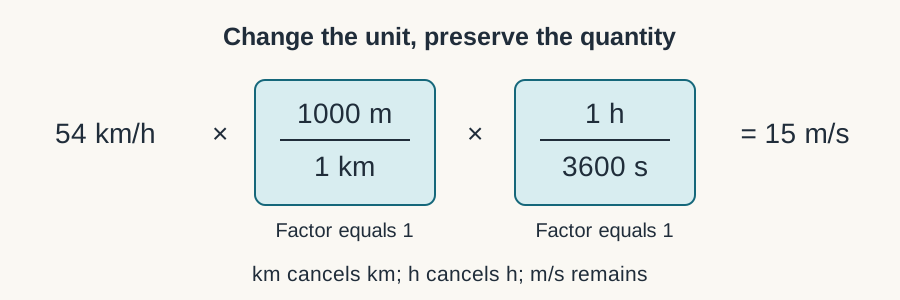
To check the result, convert 15 m/s back: multiply by 3600 s/h and 1 km/1000 m to recover 54 km/h. This reversibility helps expose a factor accidentally put upside down.
Area and Squared Units
Area measures how much surface a flat shape covers. A rectangle’s area is its length multiplied by its width. A square measuring 1 m along each side therefore has an area of , called one square meter. The squared unit records the two lengths we multiplied.
For example, a square tabletop 50 cm long and 50 cm wide has an area of 2500 cm². Each side is 0.50 m, so the same area is . Converting the sides first shows why an area conversion needs two length-conversion factors.
Dimensions check the kind of quantity
The tabletop example changes centimeters to meters, but both units measure length. This shared kind of quantity is called a dimension. Dimensions let us check an equation before choosing particular units or numbers. We write for the dimension of a distance and for the dimension of an elapsed time . The brackets mean “dimension of”; stands for length and for time.
Let represent a constant speed. Because speed divides distance by time, . Multiplying it by elapsed time gives , just as meters per second multiplied by seconds gives meters. Multiplying by time twice instead gives , leaving an extra time factor. That product cannot represent a distance when is a speed.
Quantities added or equated must have matching dimensions. You can add 3 m and 20 cm after expressing them consistently. You cannot add 3 m and 2 s. Multiplication and division can combine different dimensions to form new quantities.
Dimension checks also require a consistent meaning for each symbol. A symbol called could have some other dimension in another problem. Read the definitions before checking an expression.
Estimate a range before calculating precisely
Unit conversions preserve a quantity, and dimension checks help us choose sensible equations. We still need to ask whether the resulting number fits the situation. An estimate uses approximate inputs or a simplified model to find a plausible scale or range. For a trip, an estimate might tell us whether to expect minutes or hours before we attempt a precise prediction.
Here an order-of-magnitude estimate means identifying a factor-of-ten scale. A time near a thousand seconds tells us to plan for minutes rather than hours. Scientific notation makes that scale visible: our single estimate is roughly s. This describes the scale without claiming an exact arrival time.
Check your understanding
- Convert 72 km/h to m/s. What conversion factor would reverse your answer?
- Convert 1800 cm² to m². Explain why dividing by 100 is insufficient.
- A proposed time is , with and . Does it pass a dimension check?
- Under the walking assumptions above, could a 2-hour estimate be reasonable without adding a new condition? Name a condition that could change the conclusion.
- Two expressions and have identical dimensions. Can a dimension check choose between them?
- Write 0.006 m in scientific notation, then express it in millimeters. Has the length changed?
Reveal suggested answers
Suggested answers
- 20 m/s. Multiply by 3600 s/h and 1 km/1000 m to recover km/h.
- 0.18 m². Area contains two length factors, so divide by .
- No: , rather than . The expression would have the dimensions of time, without necessarily describing the journey correctly.
- No: the assumptions give at most 20 minutes. An extended stop, a much longer route, or an average speed below 0.75 m/s could change that.
- No. The physical model, conditions, and measurements must do that work.
- . Both expressions describe the same length.
Connections and references
Measurement and Model Testing explains how much precision a result deserves. Use the Model and Units Checklist in later calculations involving motion, forces, energy, and elasticity.
Reference basis: Halliday, Resnick, and Walker, Fundamentals of Physics, 10th edition, §§1-1–1-3; Serway and Vuille, College Physics, 9th edition, §§1.1, 1.3–1.6; Verma, Concepts of Physics, part 1, §§1.4–1.6. The numerical scenarios and checks are original; no textbook’s example sequence is reproduced.