
Two readings can differ even when both are compatible with the same value. To judge that difference, we need more than the readings’ central numbers: we need justified limits on each measurement. Building on the measurement and significant-figures lessons, this lesson uses intervals to calculate bounds and compare results. It requires arithmetic and fractions, without a formal statistics course.
Give an uncertainty interval a stated meaning
To keep those limitations visible, we will write : a reported value with an allowance on either side. In this lesson, that notation describes the interval from to . When we call it a bound, we assume the measurement procedure justifies treating that interval as enclosing the value. More advanced statistical uses of the same notation have different meanings, so always record how your interval was established.
For example, a justified length bound of cm permits values from 11.8 cm to 12.2 cm. The central value is 12.0 cm; subtracting and adding the allowance gives the endpoints. A range from a few repeated trials describes those trials’ scatter, while an enclosing measurement bound must also account for relevant effects such as calibration and alignment.
Propagate simple positive bounds
Compare measurements with predictions fairly
Having found a range for one result, we can compare ranges from two procedures. Use acceleration—the rate at which speed or direction changes, introduced briefly in the units lesson—as a supplied example quantity. Procedure A reports and procedure B reports . A permits 2.2–2.6 m/s²; B permits 2.4–2.8 m/s². Their shared interval is 2.4–2.6 m/s².
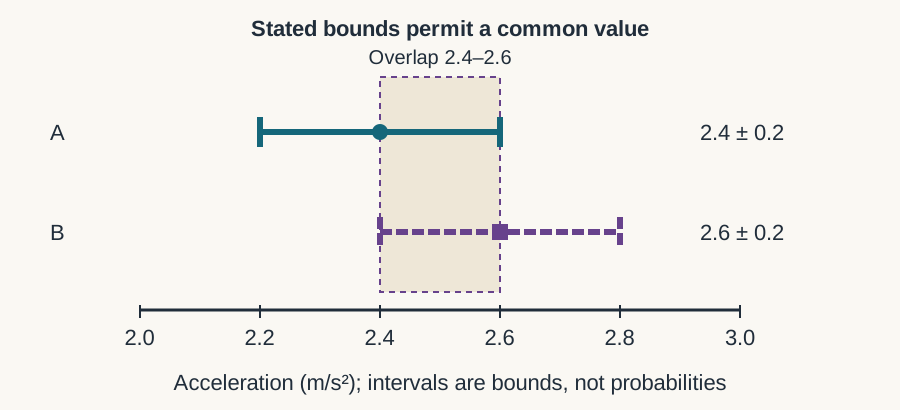
The overlap means a common value is possible under the stated bounds. It does not prove that the true values are equal. If the bounds did not overlap, the two statements could not describe the same value under all their assumptions. You would investigate the procedures, calibration, and model rather than immediately announce that a physical law has failed.
A residual is an observed value minus the model’s predicted value for the same quantity and conditions. For a supplied predicted distance of 0.76 m and a measured distance of 0.80 m, the residual is +0.04 m. Its sign indicates that the measured value is larger; its importance depends on measurement and prediction uncertainty. Repeated residuals with a common sign can suggest an offset or a missing effect, but do not identify the cause by themselves.
Choose a comparison criterion before measuring
Return to the falling-object experiment. Suppose each independently measured arrival time has a justified enclosing bound of ±0.02 s, including relevant timing contributions. Equal arrival times remain possible when the two intervals overlap. A difference greater than 0.04 s separates the intervals and rules out a common time under those assumptions. A smaller difference can leave a common time possible. An unaccounted release delay or calibration error would require reviewing the bounds first.
Decide on this criterion before seeing the result. That makes the comparison depend on a stated measurement procedure rather than on which outcome we hoped to obtain.
Check your understanding
- A rod has a justified length bound of cm. Give its endpoints. Another procedure gives cm. Could both describe the same length under these bounds?
- Recalculate the cart’s central average speed and identify the endpoint choices that maximize it. Why should the upper endpoint not be rounded down to 2.13 m/s?
- Procedures A and B permit 2.2–2.6 m/s² and 2.4–2.8 m/s². What is their shared interval? What does the overlap allow you to conclude?
- Two independently timed drops each have a justified ±0.02 s bound. Their central readings differ by 0.05 s. Can their intervals include the same arrival time under these assumptions?
Reveal suggested answers
Suggested answers
- The intervals are 11.8–12.2 cm and 12.4–12.6 cm. They are separated, so both cannot enclose the same length under their stated assumptions. Investigate the procedures and bounds.
- . The maximum uses 0.81 m and 0.38 s. Their ratio exceeds 2.13 m/s, so rounding the upper endpoint down would exclude an allowed value.
- The shared interval is 2.4–2.6 m/s². A common value is possible, but overlap alone does not establish equal true values.
- No. The combined allowances total 0.04 s, less than the 0.05 s difference. The intervals are separated, provided the stated bounds include all relevant measurement effects.
Connections and references
Use the Mechanics Model and Units Checklist to record the bounds and comparison criterion.
Reference basis: Serway and Vuille, College Physics, 9th edition, §§1.4, 1.6, 1.9; Verma, Concepts of Physics, part 1, §§2.12–2.14; Young and Adams, College Physics, 11th edition, chapter 1, especially §§1.2–1.6. These sources inform the measurement and reporting discussion; no confidence claim is inferred from sample range or standard deviation. All practice data are invented and all numerical examples are original.