
Before calculating how a cart moves, decide what you want the calculation to tell you. The time its center reaches a mark and the orientation of a stripe on its wheel are different questions. A description that answers the first may contain too little information to answer the second.
In this lesson, you will choose a system, a reference frame, and a model; state their assumptions; and identify an observation that could reveal a model’s limits. You need arithmetic and everyday observations, but no previous physics or calculus.
Begin with a question and an observable
A useful question identifies something you could observe: a location, an arrival time, an orientation, or a change in shape. “Explain the cart” is too broad. “Predict when the cart’s center crosses the finish mark” gives a model a definite job.
A model need not begin with an equation. A sketch showing a ball, the ground, and the surrounding air already records choices. Equations later make some predictions quantitative. In both cases, observations must be able to challenge the description.
Choose what belongs to the system
The system is the object or collection of objects selected for study. Everything outside that selection is its environment. A system boundary is an accounting choice; it need not be a physical wall. Interactions can cross it.
Imagine a passenger standing in an elevator. The passenger’s feet press against the floor, the floor supports the passenger, and Earth pulls the passenger downward. All of that happens whether we study the passenger alone or the passenger and elevator together. Choosing a system means deciding which of those objects we will include in our description.
First choose the passenger alone. Picture drawing an outline around the person. The elevator floor lies outside that outline, even though the person’s feet touch it. We describe the floor’s support as an interaction between an object inside our system—the passenger—and an object outside it—the elevator. Earth’s pull also comes from outside the selected system. “Outside” describes our selection; it does not mean that an object is far away or has stopped affecting the passenger.
Now choose the passenger and elevator together. Enlarge the outline to include the cabin, its floor, and the passenger. Both sides of the feet–floor contact are now inside the system, so that contact is an internal interaction. The suspension cable and Earth are still outside this selection: the cable supports the elevator from above, and Earth pulls on the passenger and cabin. These are external interactions, because they involve objects outside the selected system.
The scene has stayed the same; our accounting has changed. Studying the passenger alone helps us focus on how the floor supports the person. Studying the passenger and cabin together helps us describe their motion as one combined system. Later, when we calculate these interactions, making this choice first will help us keep track of which ones belong in the calculation.
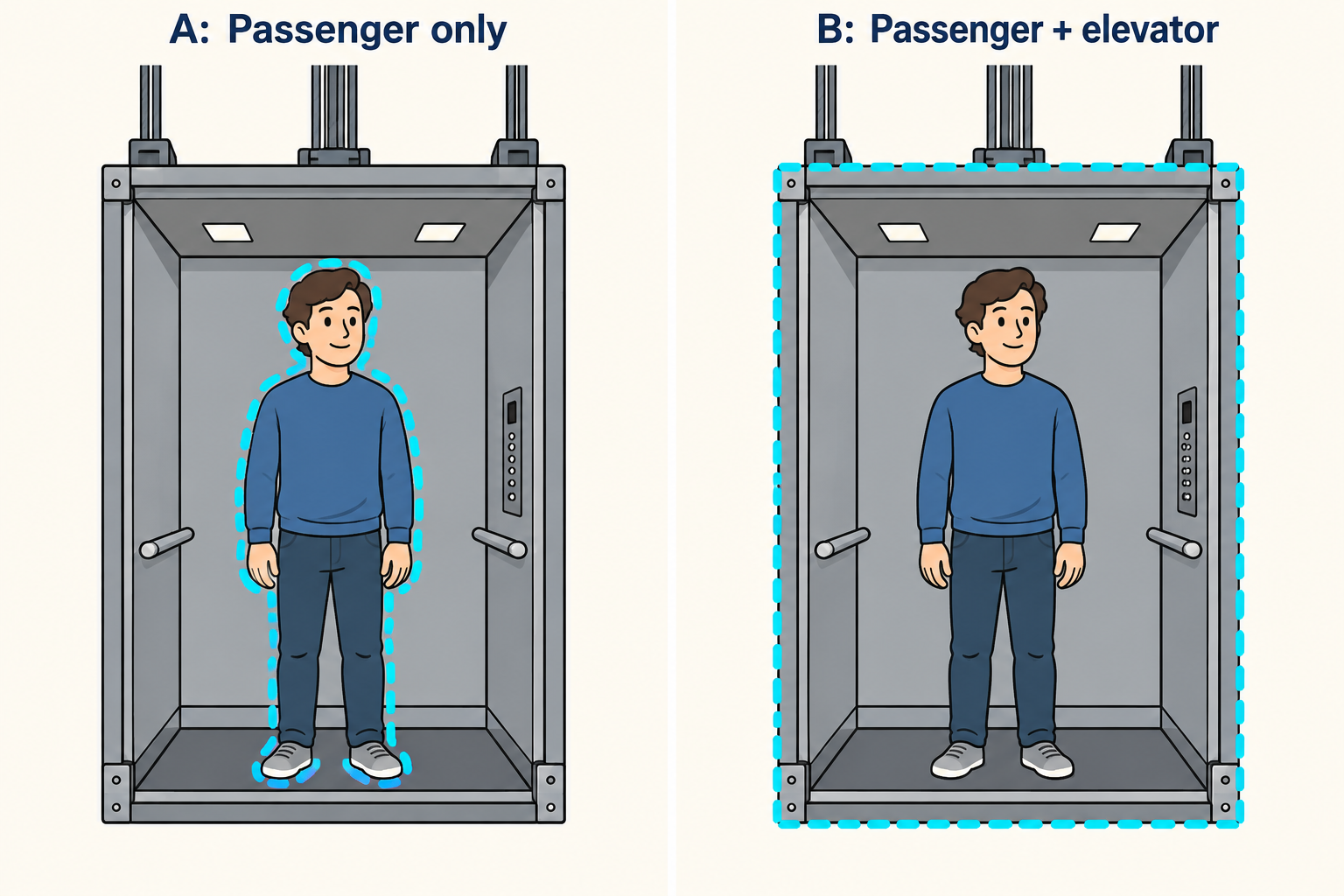
Read the two scenes by looking at the passenger’s feet. In A, the feet are inside the selection and the floor is outside. In B, the feet and floor are both included. The dashed outline is a drawing aid for our choice, not a wall around the objects. Earth is outside both selections and is not shown in the picture.
Specify the reference frame and coordinates
A reference frame supplies the reference objects and clocks relative to which observations are described. A coordinate system assigns numbers to locations in that frame. State the origin, the positive direction, and the unit. When describing motion, also state which event sets the clock to zero.
These choices are related but different. Two people standing in the same building can put their coordinate origins at different doors. They use different coordinates within the same building frame. A person on a moving platform uses a reference that changes location relative to the building.
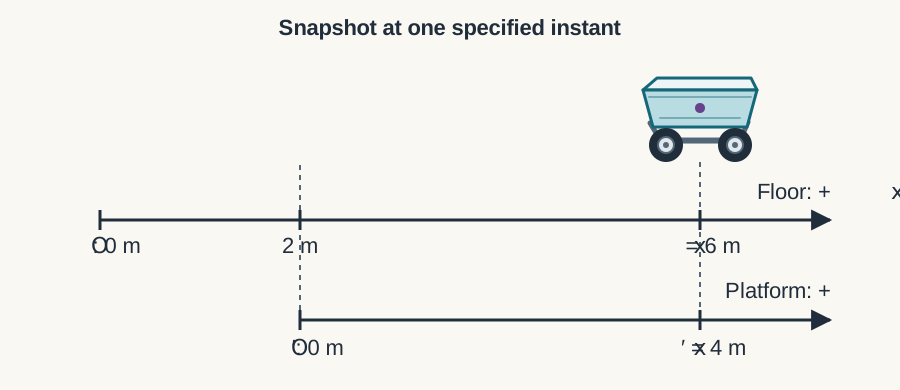
For most classroom experiments, we will use the laboratory as our reference frame. Its floor and walls give us convenient reference points, and over short experiments we can usually neglect the effects of Earth’s rotation. A frame attached to an accelerating or turning vehicle needs more care. We will examine that difference later when we introduce inertial frames and Newton’s laws.
Particle and Rigid-Body Models
The coordinate diagram tracks the cart by a point at its center. That is a particle model: we represent the whole object by one point carrying its mass. This lets us describe its location and motion while setting aside its size, the direction it faces, and changes in its shape. The point represents the cart; the real cart still has all those features.
A rigid-body model also keeps the object’s size and orientation—the direction it faces. It assumes that the distances between its parts stay fixed as it moves or turns. This gives us a way to describe rotation while setting aside bending and stretching. For a cart, we might model the frame and each wheel as separate rigid bodies, because the wheels turn relative to the frame.
Make assumptions testable
The cart examples show how a question guides a model. A falling object gives us a way to check an assumption against observations. Earth pulls objects toward the ground. As an object falls through air, the air can also oppose its motion; this effect is called air resistance.
Suppose we ask, “How long does it take this object to reach the floor?” A simple model includes Earth’s pull and neglects air resistance. A more detailed model includes both. A compact ball dropped over a short distance might be described adequately by the simpler model—the one without air resistance. We would judge “adequately” by whether its prediction is close enough for the timing accuracy our task requires.
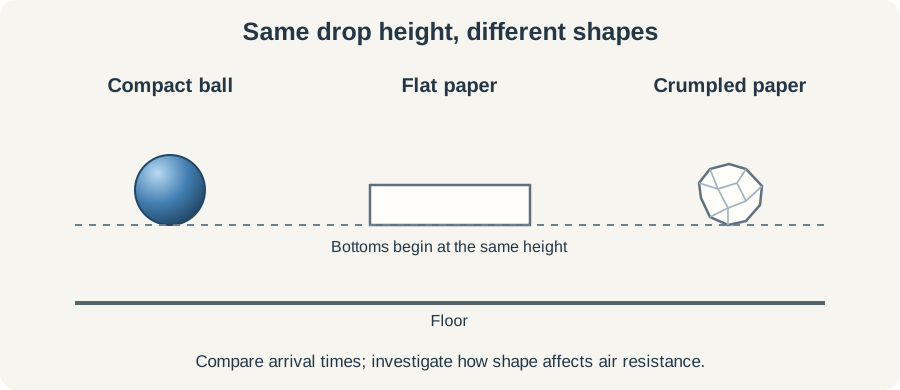
Now consider a flat sheet of paper released from the same height. Its broad surface makes air resistance more important than it usually is for a compact, dense ball over a short drop. The paper may flutter and take longer to reach the floor. If we crumple that same sheet into a tight ball, we change its shape while keeping its mass approximately the same. Comparing the flat and crumpled sheet helps us investigate whether shape—and the interaction with air—matters to the fall.
To make that comparison useful, release the objects without pushing them, match their starting heights, and time the same arrival event. Repeat the trials and allow for delays in releasing or timing. A difference that persists beyond those timing limitations gives us a reason to reconsider the assumption that air resistance can be neglected. The later measurement lesson will show how to make that judgment more carefully.
Check your understanding
- You want to know whether a long cart fits through a narrow opening. What information does a particle model discard that you need?
- A lift passenger is the system. Are the floor and Earth inside or outside it? What changes if the passenger and lift car are selected together?
- The cart rolls straight from the stationary platform origin to the position shown in the diagram. Its floor coordinates change from 2 m to 6 m, and its platform coordinates change from 0 m to 4 m. Calculate its displacement using each set of coordinates. What distance does it travel, and why do both observers agree?
- Propose a comparison between a compact ball and a flat sheet dropped from the same height. State the two models, an observable, and one measurement limitation. What observation would motivate including air resistance?
Reveal suggested answers
Suggested answers
- You need the cart’s dimensions and orientation relative to the opening. A point cannot determine clearance.
- Both are outside the passenger-only system. Floor contact becomes internal to the combined system; Earth’s interaction still crosses its boundary.
- In floor coordinates, . In platform coordinates, . The distance is 4 m because the path is straight and has no reversal. The platform is at rest relative to the floor, so shifting the origin changes both endpoint coordinates by the same amount and leaves their difference unchanged.
- Compare a model neglecting air with one including it; measure arrival time under matched release conditions. Timing resolution or unequal release times could obscure a difference. A reproducible difference larger than justified timing uncertainty would motivate reviewing the air-free model for these objects. It would not, by itself, identify every cause of the difference.
Connections and references
Continue with Units, Dimensions, and Estimation to express predictions consistently, then Measurement and Model Testing to compare them with observations. Later lessons develop position, forces, energy accounting, and the motion of systems using these choices. The Model and Units Checklist is a reusable record of them.
Reference basis: Halliday, Resnick, and Walker, Fundamentals of Physics, 10th edition, §§1-1–1-3; Serway and Vuille, College Physics, 9th edition, §§1.1, 1.7, 1.9; Verma, Concepts of Physics, part 1, §§1.1–1.7. Young and Adams, College Physics, 11th edition, §§1.1–1.2 supplies additional corroboration for idealized models and their domains; §1.7 supports the brief displacement connection. The cart and lift examples and diagrams are original.