
Formula reference. Function operations are valid only where every required intermediate value exists.
Function and composition rules
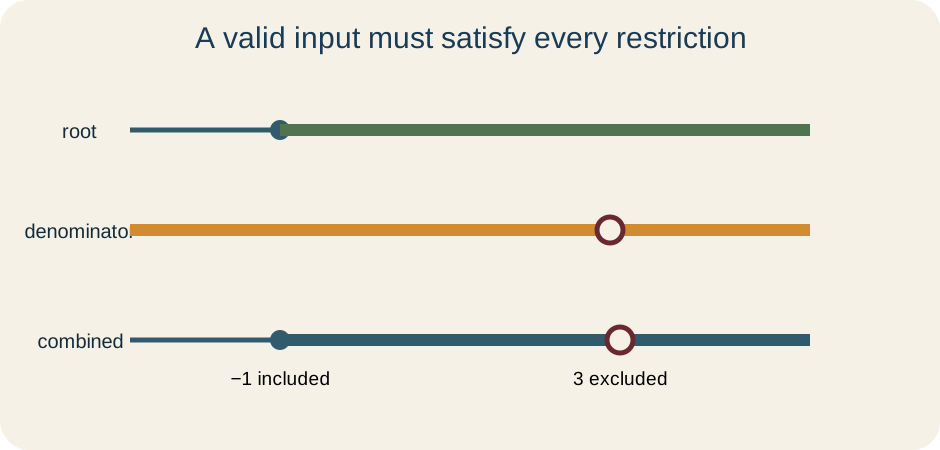
Common real-domain restrictions: denominator ; even-root radicand ; logarithm argument . For composition, evaluate the inner function first.
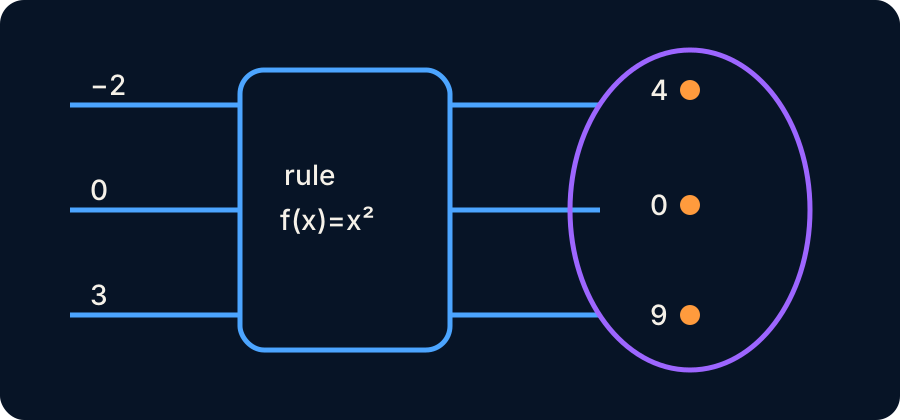
A function is a dependable rule that assigns one output to each allowed input. Function notation does not hide a multiplication: means “the output of function at input .” The parentheses are a container for an input, so means evaluate the same rule at a shifted input. This distinction becomes essential when calculus compares and .
Imagine a weather station that converts time into a temperature reading, then converts temperature into a predicted energy demand. The first relationship is one function; the second is another. A combined model follows the output of the first process into the input of the second. This chained dependency is composition, and it is the conceptual source of the Chain Rule.
Identify input, output, and domain
For , the variable is the input and is the output. In real-number work, the radicand must be nonnegative, so the domain is . A formula by itself is not a complete function description until its allowed inputs are known. The same principle applies to denominators, logarithm arguments, and measured quantities with contextual limits.
The station’s time model might be valid only from sunrise to sunset, even if its formula can be evaluated outside that range. Mathematics distinguishes an algebraic domain from a modeling domain. State both when context supplies meaningful restrictions. A graph can be useful evidence, but it does not replace solving the defining inequality.
Follow a composition one step at a time
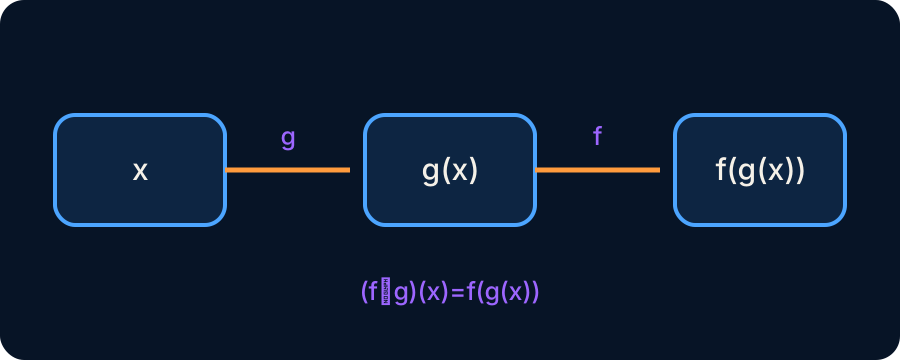
The notation means : first apply , then feed that output into . Order matters. If and , then , whereas . These are usually different functions because they describe different process orders.
Return to the weather station. Let be temperature at time , and let be demand at temperature . The composite answers “what is the predicted demand at time ?” It is clearer to write the intermediate quantity than to view the composition as a mysterious nested expression. That intermediate quantity later supplies the inner function in the Chain Rule.
Connect composition to local change
If temperature changes with time and demand changes with temperature, demand changes with time through both effects. The Chain Rule records this dependency: . The first factor measures demand sensitivity per degree; the second measures degrees per second; their product has demand per second. Units make the multiplication intelligible.
Before differentiating a composite function, name the outer function and the inner function in words. For , the outer function takes a square root and the inner function forms . This verbal step prevents an omitted inner derivative and makes a complex formula manageable as a sequence of familiar operations.
Narrative challenge: predict energy demand
Suppose degrees and demand units. Before opening the solution, write the composite . Then describe, in words, why rather than measures its rate of change.
Show a solution path
Substitution gives . Demand depends on time only through temperature, so the rate must multiply the demand-per-degree sensitivity by the degrees-per-time rate . Adding rates with different units would not describe a coherent quantity.