
Suppose water can move through a pipe in either direction. The amount of water in the tank is a quantity; the flow rate tells how that quantity is changing at an instant. Calculus connects those two ideas. A definite integral turns a changing rate into a signed change over an interval, while an antiderivative gives a function whose derivative is that rate.
Let denote the volume of water in the tank at time . Its derivative, , is the volumetric flow rate; read the dot as “rate of change with respect to time.” In this lesson, rightward flow is positive and leftward flow is negative. The sign convention is simply an accounting choice, but it lets one graph describe both directions without changing variables.
The central question is not merely how to evaluate an integral. It is what the resulting number means. A net volume change can be positive, negative, or zero, whereas total flow is always nonnegative because it counts movement in both directions. Keeping those quantities distinct is the key to using the Fundamental Theorem of Calculus well.
Read direction from a flow-rate graph
A flow-rate graph records direction through its position relative to the horizontal time axis. Above the axis, the chosen positive direction is occurring. Below the axis, the direction has reversed. At a point where the graph meets the axis, the instantaneous flow rate is zero, but the tank may still contain water and may already have experienced substantial change.
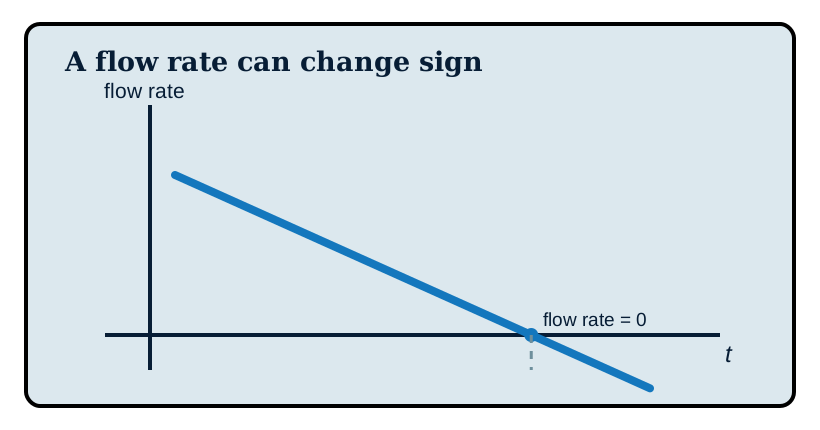
The conceptual graph above asks you to separate motion from net result. What does the portion below the axis say about the direction of flow? If water first moves right and later moves left, does zero net change mean that no water moved? It does not: the two signed contributions may cancel even though water traveled during both portions of the interval.
This distinction produces two useful questions. Net change preserves the sign of each contribution, so it answers how the tank’s volume changed overall. Total flow adds magnitudes, so it answers how much water moved through the pipe in either direction. The graph alone cannot provide exact amounts until a scale or formula is supplied, but it already tells us which contributions must be added and which must be subtracted.
From a rate to a change in volume
If has units of , then multiplying by a small time interval produces a small volume change. Accumulating those small changes from a starting time to an ending time gives the definite integral
The bounds identify the interval over which the change is measured. The differential identifies time as the input being accumulated. The left side is a definite integral, and the right side is the endpoint calculation guaranteed by the Fundamental Theorem of Calculus. Both expressions describe the same net change in volume.
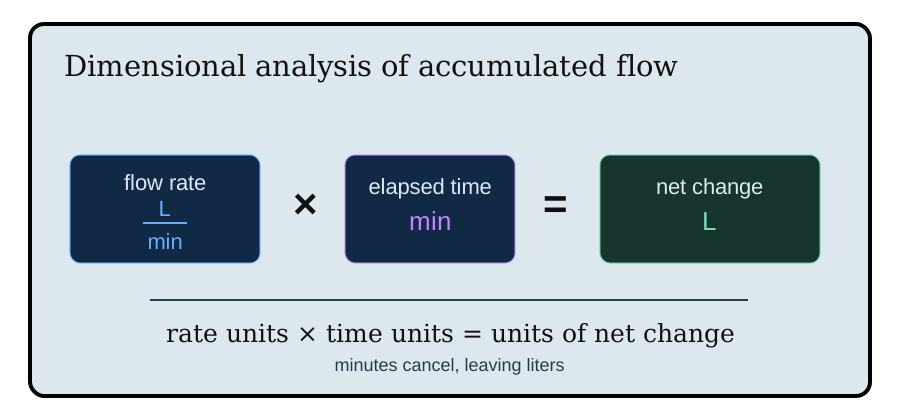
Units provide an immediate check on that interpretation:
The unit diagram below shows why the result is measured in liters. A rate measured per minute is multiplied by time measured in minutes, so the minutes cancel. The remaining unit is volume, not volume per minute. An initial volume can be used afterward to find a final volume, but it is not part of the definite integral itself.
Signed accumulation keeps the physical direction
The sign of a flow rate belongs to the rate itself. A positive region on a graph contributes positively to net change, and a negative region contributes negatively. The detailed graph below makes that accounting visible: the green region lies above the time axis, while the orange region lies below it. A definite integral adds both regions with their signs intact.
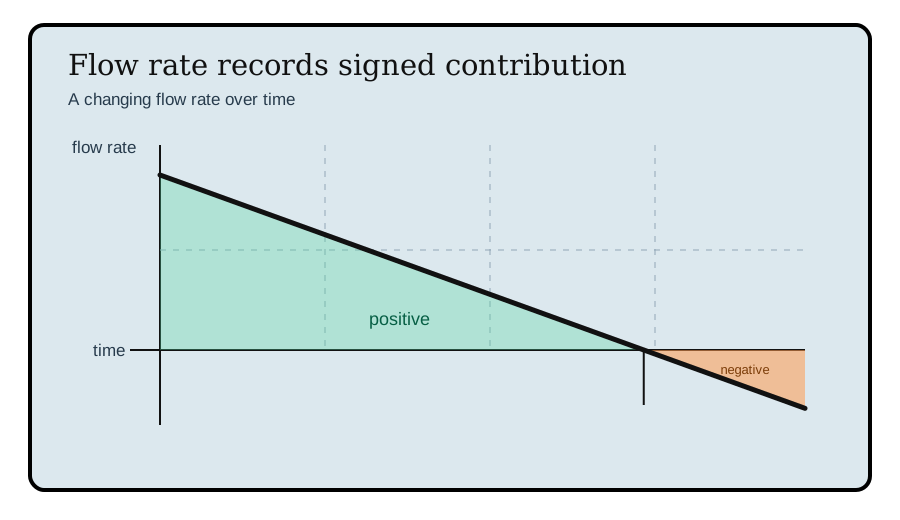
If the two regions had equal magnitudes, their signed sum would be zero. That would mean equal amounts of rightward and leftward flow, not an absence of motion. This is why “area” needs careful language in calculus: ordinary geometric area is nonnegative, but a definite integral records signed accumulation. The two agree only when the graph remains on or above the time axis.
When a problem asks for total amount moved rather than net change, the model changes to . The absolute value does not repair an inconvenient negative answer. Instead, it changes each negative contribution into a positive amount of movement. The correct integral is determined by the physical question, not by a preference for positive numbers.
Calculate the net change over two minutes
Now give the graph a specific rate model:
At , the rate is to the right. Each additional minute reduces the rate by , so the rate reaches zero at . It is negative during the final half-minute, which means the flow is leftward there. The model therefore predicts a positive contribution followed by a smaller negative contribution.
Let be the initial volume. The actual volume function includes that starting amount:
The term sets the initial level of the tank. The terms involving describe the accumulated effect of the flow rate. To find net change, evaluate an antiderivative of the rate alone; do not carry into the definite-integral calculation. The initial volume returns only when the question asks for final volume.
The signed graph below gives the numerical result a geometric explanation. From to , the region above the axis contributes . From to , the region below the axis contributes . Their sum is the net gain calculated above.
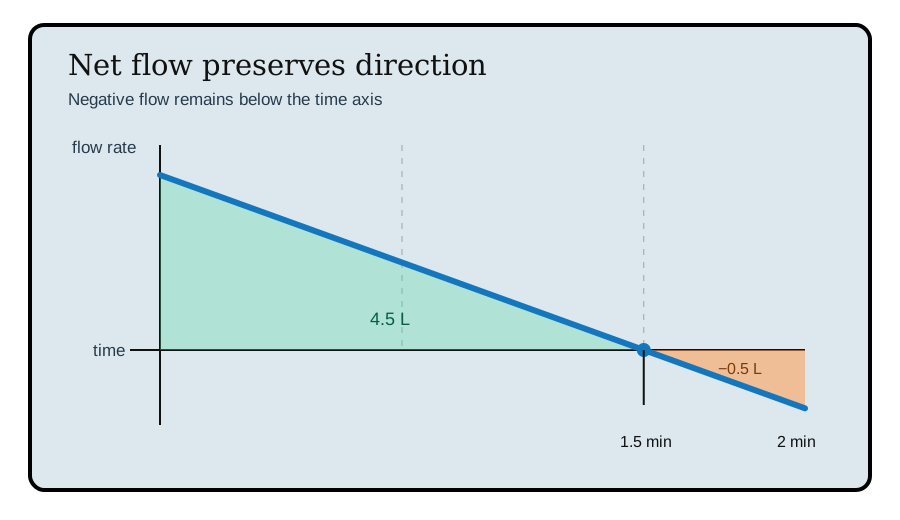
The tank therefore gains overall. That does not mean only moved through the pipe, because the late leftward flow subtracts from the earlier rightward flow. If , then the final volume is . The net change and the final volume are different answers to different questions.
Compare net flow with total flow
The calculation can be checked in two ways. Differentiating the volume model returns the original flow rate, because the derivative of the constant is zero. The graph supplies a second check: its positive region is visibly larger than its negative region, so a positive net change is reasonable. These checks address different errors—one symbolic and one interpretive—and both are worth making.
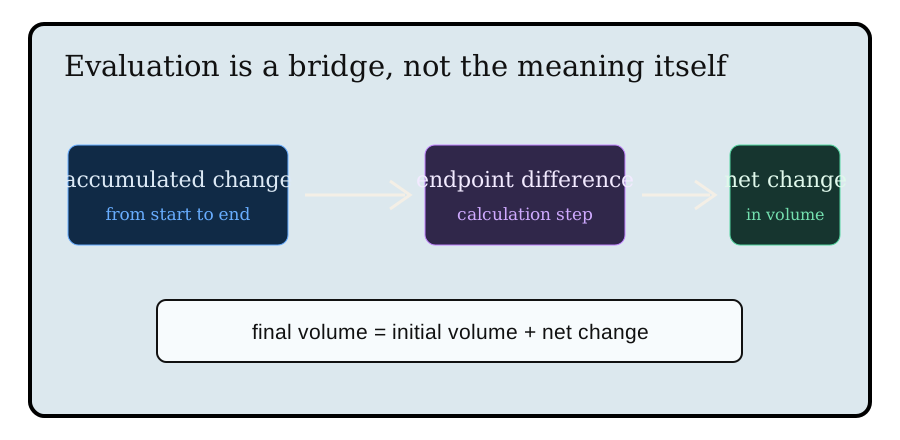
The endpoint diagram below summarizes the relationship among accumulation, endpoint evaluation, and final volume. The definite integral represents signed accumulated change. The endpoint difference calculates that same change efficiently. Adding the initial volume is a separate final step when the problem asks for the amount in the tank rather than the change in the tank.
For total flow, the late negative portion must be counted as movement rather than allowed to cancel. Set the rate equal to zero: , so the sign change occurs at . On the first interval, ; on the second, . The graph of the absolute value reflects the negative portion above the time axis, so both directions count positively toward total flow.
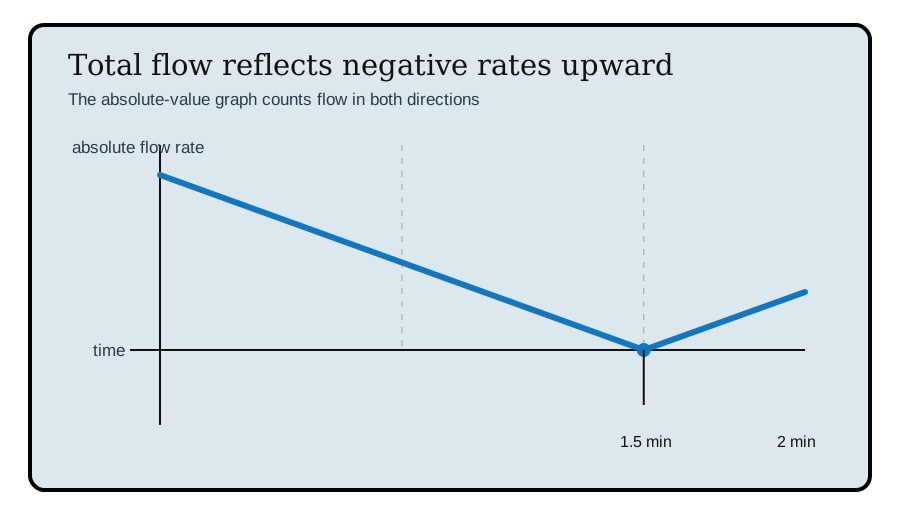
The root at determines where the total-flow integral must be split. Integrating one expression across the entire interval without checking its sign would report net change instead. The piecewise calculation is
The total flow is , while the net change is . The difference is the half liter that moved left during the final part of the interval. It contributes negatively to the tank’s net change but positively to the total amount moved. The same distinction appears in motion: integrating velocity gives displacement, while integrating speed gives total distance traveled.
Stop and check your interpretation
A second tank has initial volume and volumetric flow rate
Find the time at which the flow reverses. Then calculate the net volume change over the full interval and use it to find the final volume. Finally, calculate the total amount of water moved by integrating and splitting the integral at the root. Explain why the net change and total flow do not agree.
Check your reasoning
First factor the rate to find its root:
The relevant root is . The rate is positive before that time and negative afterward. The net change is
The final volume is . For total flow, split at :
The net change is , while the total amount moved is . The leftward contribution reduces the net change but still counts toward total flow.
The next lesson develops substitution as a way to recognize a composite derivative inside an integral. The same discipline will continue to matter: identify the quantity, attend to units and signs, and decide what the calculation is meant to measure.