
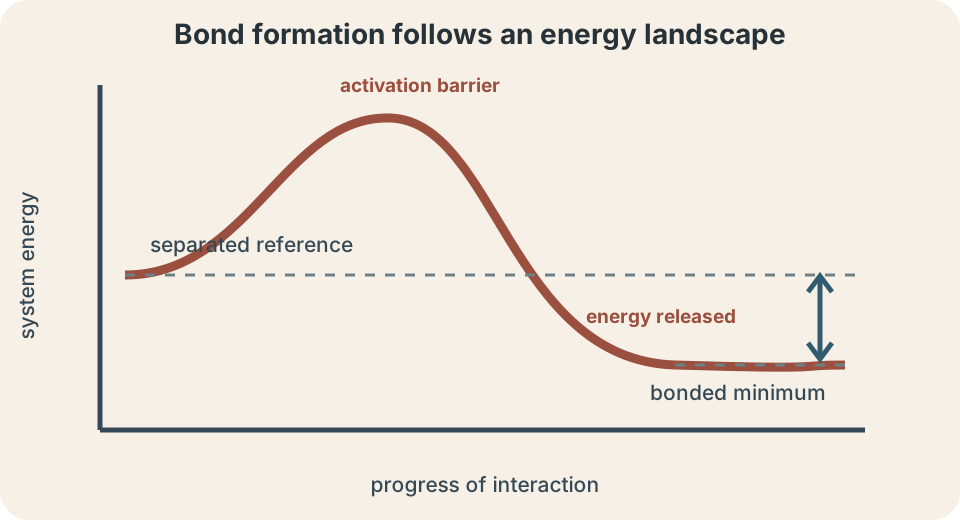
Atoms form chemical bonds when interaction produces a lower-energy arrangement than the relevant separated particles. This statement is more precise than saying atoms “want” complete shells. Atoms do not possess intentions, and a full outer shell is not a force. The measurable causes are electrostatic attraction, electrostatic repulsion, quantum restrictions, and changes in electron distribution. Bonding is therefore an energy story about an entire interacting system.
The system boundary matters whenever energy is discussed. For two approaching atoms, the system includes both nuclei and all of their electrons. Attraction between opposite charges can lower the system’s electric potential energy, while repulsion between like charges can raise it. Electron kinetic energy and quantum-mechanical effects also change as orbitals overlap. A useful explanation must account for all of these contributions rather than selecting only one.
This article builds a model in stages. First, it distinguishes energy from stability and force from potential energy. Next, it interprets the potential-energy curve that defines bond length and bond energy. It then compares covalent, ionic, and metallic descriptions without pretending that nature obeys sharp category boundaries. Finally, it connects microscopic bonding to measurable properties and provides a repeatable reasoning routine.
Stability means lower energy under stated conditions
A stable bonded arrangement occupies a local minimum on an appropriate potential-energy landscape. “Local” means nearby changes in nuclear position raise energy, so small disturbances tend to produce restoring forces. The word does not guarantee that the substance can never react. A diamond, for example, can be kinetically persistent even when another carbon arrangement is thermodynamically favored under given conditions. Stability must always be interpreted with a system, environment, and timescale in mind.
Energy comparisons require a reference state. Chemists often assign the interaction energy of widely separated atoms a value near zero. A bonded pair at negative interaction energy then lies below that reference. The negative sign does not mean the system contains “negative energy” in an absolute sense. It means the chosen bonded state has less energy than the chosen separated state.
Lower energy and slower reaction are different ideas. Thermodynamics compares initial and final states, whereas kinetics studies the pathway and activation barrier between them. A lower-energy product may form imperceptibly slowly if the barrier is large. A higher-energy structure may persist because ordinary thermal collisions cannot reach the transition state. Bond explanations should therefore avoid equating energetic favorability with instantaneous formation.
Electrostatic interactions create both attraction and repulsion
Every atom contains positively charged nuclei and negatively charged electrons. When two atoms approach, each nucleus attracts the other atom’s electrons. At the same time, the nuclei repel one another and the electron clouds repel one another. These four families of interaction act simultaneously. A bond can appear only when the combined energy balance favors a finite separation.
For ideal point charges, electric potential energy has the form . Here is electric potential energy, is Coulomb’s constant, and are the interacting charges, and is their separation. Opposite signs make negative, so attraction lowers relative to infinite separation. Like signs make the product positive, so repulsion raises as separation decreases. The sign of the charge product therefore predicts whether that isolated interaction is attractive or repulsive.
Real atoms are not point charges, so the Coulomb expression alone is not a complete bonding model. Electron charge is distributed through orbitals, nuclei have multiple charges, and electron states must obey quantum rules. Nevertheless, electrostatic reasoning remains indispensable. It explains why electron density between nuclei can stabilize a covalent bond and why oppositely charged ions attract. The more complete quantum model refines this account rather than erasing it.
The potential-energy curve organizes the whole story
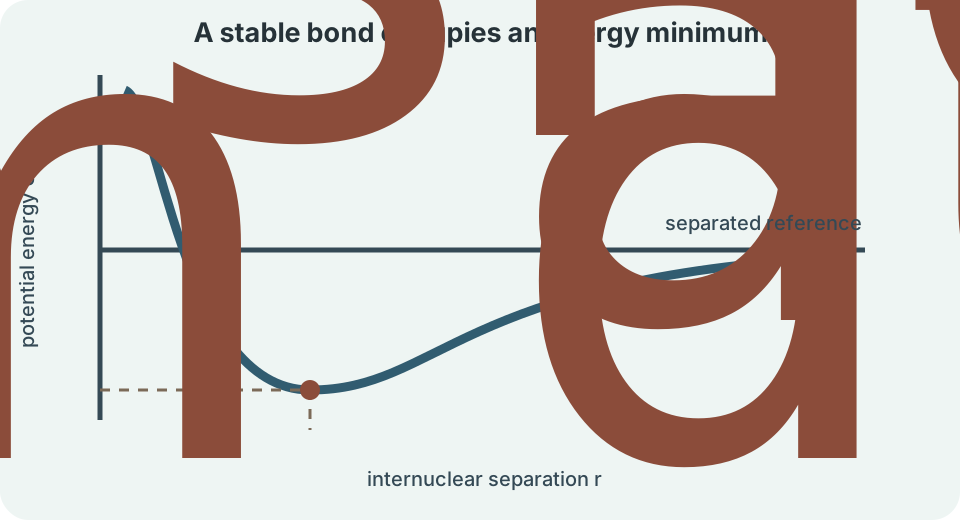
Imagine measuring total interaction energy while the internuclear distance changes. At very large , the atoms interact weakly and the curve approaches the separated-atom reference. As they move closer, favorable attractions can make the energy decrease. At extremely short distance, strong nuclear repulsion and unfavorable electron overlap make the energy rise steeply. The resulting curve commonly contains a well with a minimum.
The horizontal coordinate of the minimum is the equilibrium bond length, often written . The subscript labels the equilibrium value rather than a new variable. At , small stretches or compressions raise potential energy. The system therefore tends to return toward that separation after a small disturbance. A real vibrating molecule moves around the minimum instead of remaining perfectly motionless.
The vertical depth of the well is related to the energy required to separate the atoms. If the separated reference is zero and the minimum is , then is the well depth. The symbol denotes a dissociation-energy scale, and the subscript refers to the minimum of the electronic potential. Measured bond dissociation energies may differ slightly because vibrating molecules retain zero-point energy. The diagram is a model whose labels must be defined before numbers are interpreted.
Force is the slope information in the energy curve
Force and potential energy are related by . The derivative measures how rapidly potential energy changes with separation. The leading negative sign means force points toward decreasing potential energy. At the minimum, the derivative is zero, so the net radial force is zero. Zero net force at one distance does not mean the individual attractions and repulsions disappear.
To the right of the minimum, the curve rises as the atoms separate. Its positive slope gives a negative force under the chosen radial sign convention. That force pulls the atoms toward smaller separation. To the left, the curve falls as increases, so its slope is negative and the force is positive. That force pushes the atoms apart toward the minimum.
Near , the well can often be approximated by . The symbol is an effective bond stiffness, not Coulomb’s constant. The squared displacement makes stretching and compression both increase energy in this local model. Greater curvature corresponds to a stiffer bond and a higher vibrational frequency when masses are comparable. This approximation is local because a real bond eventually breaks rather than stretching like an ideal spring forever.
Electron density can stabilize a covalent bond
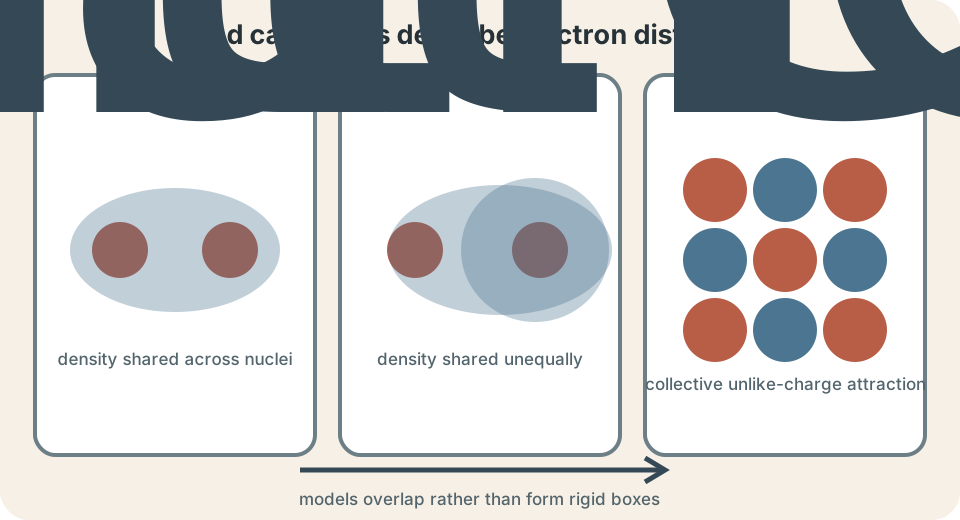
In a covalent description, electrons occupy molecular states distributed across two or more nuclei. Electron density between nuclei is attracted to both positive centers. That shared density can lower electron–nucleus potential energy enough to overcome competing costs. The phrase “shared pair” is a useful bookkeeping image, but the electrons are not tiny balls parked midway between atoms. Their probability distribution is described by a quantum state.
Atomic orbitals combine to form molecular orbitals with different spatial patterns and energies. Constructive combination can produce a bonding orbital with enhanced density between nuclei. Destructive combination can produce an antibonding orbital with a node and reduced density in the internuclear region. Electrons in bonding orbitals generally stabilize the joined system. Electrons in antibonding orbitals oppose that stabilization.
Bond order summarizes the balance between bonding and antibonding occupation in a simple molecular-orbital model. One common definition is . Here is the number of electrons in bonding orbitals, and is the number in antibonding orbitals. A larger positive value often corresponds to a shorter and stronger bond among comparable species. The relationship is a trend, not an excuse to ignore molecular context.
Ionic bonding is collective electrostatic stabilization
An ionic model begins with substantial electron transfer and the formation of cations and anions. A cation has fewer electrons than protons and therefore carries positive net charge. An anion has more electrons than protons and therefore carries negative net charge. Opposite charges attract throughout an ionic solid. The stabilized object is normally an extended lattice rather than an isolated two-particle molecule.
Electron removal requires ionization energy, so forming a cation is not automatically favorable. Adding an electron can release or require energy depending on the atom and electron state. Lattice formation can then release substantial energy as many unlike charges approach in an ordered array. A correct energy account includes all relevant steps. Saying “one atom gives an electron to another” omits the decisive collective lattice contribution.
Ionic and covalent are limiting models rather than perfectly separated boxes. Many bonds have uneven electron density without complete charge transfer. Polar covalent bonding describes an intermediate distribution in which atoms share density unequally. Formal charges and oxidation states provide useful accounting, but they are not direct photographs of electron density. Evidence and purpose determine which model is most helpful.
The octet rule is a pattern, not a cause
Main-group atoms often form arrangements that resemble noble-gas valence-shell counts. This observation supports the octet rule, which predicts eight valence electrons around many atoms. Hydrogen and helium instead follow a two-electron pattern because the first shell contains only the orbital. The rule helps construct Lewis structures and anticipate common formulas. It does not supply the physical force that creates a bond.
The pattern has important exceptions. Electron-deficient compounds can place fewer than eight electrons around boron or beryllium. Odd-electron species cannot give every atom an even octet. Third-period and heavier central atoms are often represented with expanded valence-shell counts in introductory Lewis models. Transition-metal bonding requires additional orbital and ligand-field ideas.
Treating the octet as an energy shortcut improves reasoning. Filled or favorably occupied valence configurations often correlate with lower energy, but the actual cause lies in the energy of the complete electronic state. When the shortcut predicts poorly, the energy model remains the governing framework. This hierarchy prevents a mnemonic from becoming a fictional mechanism. Rules should compress evidence, not replace it.
Bond formation releases energy and bond breaking requires energy
Moving down a bonding potential well releases energy to other degrees of freedom or to the surroundings. The released energy may appear as molecular motion, radiation, or heating of nearby matter. A newly formed isolated bond cannot simply lose energy without some transfer mechanism. Collisions, a third body, or photon emission can carry excess energy away. Conservation of energy applies to the full system plus surroundings.
Breaking a bond requires an energy input because the system must climb out of its well. This remains true even when the overall chemical reaction releases energy. Exothermic reactions usually require breaking some reactant bonds and forming stronger or more numerous product interactions. Energy absorbed during bond breaking is outweighed by energy released during bond formation. The net enthalpy change records the combined accounting.
An approximate gas-phase bond-energy estimate is . The symbol is the reaction enthalpy change. Each represents a positive bond dissociation energy, and the summation symbol means add all indicated terms. Broken bonds enter positively because energy is supplied, while formed bonds are subtracted because energy is released. Average bond energies give estimates rather than exact molecule-specific results.
Bond strength, bond length, and molecular context
Bond strength describes the energy scale associated with separating bonded atoms under specified conditions. Bond length describes the average internuclear separation in a particular molecular environment. Stronger comparable bonds are often shorter because their potential wells are deeper and their equilibrium separations smaller. The word “comparable” matters because atomic size, charge, bond order, and surrounding structure all change the relationship. No single trend should be applied without identifying the comparison set.
Multiple bonds commonly have greater electron density between the same two nuclei than single bonds. Carbon–carbon double bonds are therefore generally shorter and stronger than carbon–carbon single bonds. Triple bonds are commonly shorter and stronger still. Resonance can distribute bonding across several positions and create intermediate bond lengths. Measured structure reveals delocalization that one localized drawing may hide.
Temperature does not usually change a substance into a different bond category, but it changes vibrational populations and observed averages. Molecules occupy vibrational states within an anharmonic potential well. Because the well is not perfectly symmetric, larger vibrations can increase average separation. Spectroscopy probes energy spacings and therefore provides evidence about stiffness. Structural and energetic measurements must be interpreted together.
Bonding models predict macroscopic properties
Microscopic bonding helps explain melting point, electrical conductivity, hardness, solubility, and mechanical response. Ionic lattices often have high melting points because separating ions disrupts many electrostatic interactions. They may conduct when molten or dissolved because charged particles can move. In the solid state, the ions remain localized and ordinarily do not carry current freely. These are trends with material-specific exceptions.
Molecular covalent substances can melt at relatively low temperatures because melting often separates molecules without breaking their internal covalent bonds. Their intermolecular attractions determine much of the phase-change energy. Network covalent solids behave differently because covalent connections extend through the material. Diamond is hard and has a very high sublimation temperature because deformation disrupts a three-dimensional network. The label “covalent” alone therefore does not determine a property.
Metals contain delocalized electronic states extending across many atomic centers. Mobile charge carriers help explain electrical and thermal conductivity. Nondirectional collective bonding helps many metals deform without immediately fracturing. Alloying changes electronic structure and lattice geometry, so mechanical properties can change dramatically. Bonding models become useful when they generate testable property predictions.
A disciplined method for explaining any bond
Begin by defining the particles and the reference state. Identify the nuclei, electrons, ions, or molecular fragments included in the system. State whether the comparison uses isolated gas-phase species, a lattice, a solution, or another environment. List the important attractive and repulsive interactions. This boundary prevents omitted energy terms from deciding the answer invisibly.
Next, describe how electron density changes as the particles interact. Decide whether a covalent, ionic, metallic, or mixed model captures the dominant pattern. Use an energy curve or energy cycle to show why a finite arrangement is favored. Define every symbol before manipulating an equation. Check that the verbal mechanism agrees with the mathematical sign of the energy change.
Finally, connect the model to evidence. Bond lengths can come from diffraction, energy differences from spectroscopy or thermochemistry, and electron distribution from several experimental and computational methods. State where the model is approximate and what observation could reveal failure. Avoid anthropomorphic phrases unless they are immediately translated into energy language. A strong explanation moves from interaction, to energy, to structure, to measurable consequence.
Retrieval practice and synthesis
Explain why two attracting atoms do not collapse until their nuclei touch. Your answer should mention both the attractive region and the steep short-range repulsive region of the potential-energy curve. Then explain why the equilibrium distance corresponds to zero net force but not zero interaction. Use and define the derivative in words. A complete answer connects the graph’s slope to force direction on both sides of the minimum.
Compare the statements “breaking bonds releases energy” and “burning fuel releases energy.” The first statement is incorrect for an isolated bond because climbing from the potential well requires input. Combustion can nevertheless release energy because forming product bonds and interactions releases more energy than reactant bond breaking absorbs. Write the approximate bond-energy equation and explain the sign of each sum. Identify the system boundary before assigning any energy transfer. This contrast is a useful test of whether energy accounting has replaced memorized slogans.
Predict which evidence would distinguish a purely ionic picture from a polar covalent picture. Consider bond length, electron-density distribution, conductivity, lattice structure, and response to solvents. No single observation always settles the classification because bonding exists on a continuum. Choose a model that explains the largest relevant set of measurements with the fewest unsupported assumptions. The next lessons develop ionic bonding, covalent bonding, polarity, and molecular structure from this energy foundation.