
Two atoms can have nearly the same mass yet behave completely differently because chemical behavior depends strongly on electron arrangement. The nucleus establishes elemental identity through proton count, but electrons determine how an atom interacts with light, electric fields, and neighboring atoms. Outer electrons are especially influential because they are the first electronic region encountered when atoms approach. Their arrangements repeat across the periodic table and create recurring patterns of reactivity. Chemistry becomes more coherent when those patterns are explained through charge, energy, distance, shielding, and quantum constraints.
Learning objectives and the structure-to-behavior chain
By the end of this article, you will distinguish classical orbit pictures from quantum orbitals and explain shells, subshells, and electron configurations. You will apply Aufbau ordering, Pauli exclusion, and Hund’s rule at an introductory level. You will connect valence electrons and effective nuclear charge to periodic trends, ion formation, and reactivity. You will interpret line spectra using energy differences and the relation . You will also explain why simplified models are useful while recognizing where they stop being literal.
The central chain is nuclear charge and quantum constraints lead to electron arrangement, which shapes energy and spatial availability, which then shapes chemical behavior. Every arrow in this chain needs reasoning. Saying an atom reacts “because it wants an octet” replaces mechanism with a slogan. A better explanation identifies the attractive forces, accessible states, and energy change of the combined system. The goal is causal structure rather than trend memorization.
Several models appear in introductory chemistry because no single picture answers every question simply. Shell diagrams show valence counts, orbital diagrams show occupancy and spin, electron configurations compress notation, and probability clouds show spatial character. A model should be judged by what it explains. It should not be mistaken for a photograph of an atom. Moving among models is a reasoning skill rather than an admission that one picture failed.
Begin with charge and electrostatic attraction
Protons carry positive elementary charge, while electrons carry equal-magnitude negative charge. Opposite charges attract and like charges repel. In a hydrogen-like picture, the electrostatic potential energy becomes more negative as an electron is brought closer to the nucleus. A lower energy often corresponds to a more strongly bound state. Electron behavior nevertheless cannot be predicted by electrostatics alone because quantum mechanics restricts allowed states.
Coulomb interaction magnitude between point charges has the form . The symbol is the electrostatic constant, and are charges, and is separation. The horizontal fraction shows inverse-square distance dependence. Atomic electrons are not classical point particles traveling on fixed paths, so the formula supplies interaction logic rather than a complete atomic orbit model. Charge and distance remain essential ingredients.
Electron-electron repulsion also matters. Each electron is attracted to the nucleus while repelling every other electron. Multi-electron atoms therefore require a many-body quantum description. Approximate models summarize the competing interactions through shielding, effective nuclear charge, and orbitals. Periodic trends emerge from this competition rather than one force acting alone.
Replace planetary orbits with quantum states
Electrons in atoms do not circle the nucleus along definite planetary trajectories. Quantum mechanics describes an electron through a wavefunction whose squared magnitude determines probability density. An orbital is an allowed one-electron state with a characteristic energy and spatial pattern within an atomic model. Probability density indicates where an electron is likely to be detected across repeated measurements. It does not trace a hidden classical path.
Quantum numbers label orbital properties. Principal quantum number is associated with shell and typical size or energy. Angular-momentum quantum number distinguishes subshell types commonly labeled and . Magnetic quantum number distinguishes orbitals within a subshell. Spin quantum number describes a two-valued intrinsic electron property.
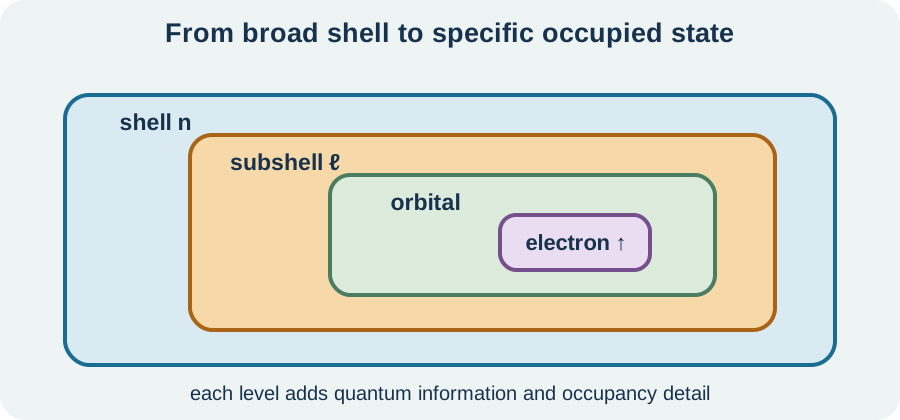
Orbital drawings usually enclose a chosen percentage of probability density. Their boundaries are visualization conventions rather than hard walls. An orbital is spherically symmetric, while orbitals have directional lobes separated by a node. More complex orbitals contain additional angular and radial nodes. Shape influences overlap and bonding, but a two-dimensional sketch compresses three-dimensional probability.
Organize shells, subshells, and orbital capacity
A shell with principal number contains subshells with allowed values from zero through . Thus contains only , while contains and . An subshell contains one orbital, contains three, contains five, and contains seven. Each orbital can hold at most two electrons. Therefore subshell capacities are two, six, ten, and fourteen electrons.
The notation identifies shell two, subshell, and four electrons in that subshell. The superscript is an electron count rather than an exponent used for arithmetic. A complete configuration lists occupied subshells. Total superscript count equals the number of electrons represented. For a neutral atom, that total equals proton count.
Shell labels do not imply all orbitals within a shell have identical energy in multi-electron atoms. Penetration and shielding split subshell energies. A orbital can be occupied before in the common building order, yet ionization and detailed energies introduce further nuance. Ordering diagrams are empirical-quantum summaries. They should not be interpreted as universal unchanging ladders.
Apply the three occupancy constraints
The Aufbau principle says a ground-state configuration is built by occupying lower-energy available orbitals before higher-energy ones under the chosen approximation. Aufbau means building up. It is a guideline based on orbital energy ordering. Known exceptions occur, especially among transition elements. Observed configurations take priority over an oversimplified mnemonic.
The Pauli exclusion principle states that no two electrons in one atom share all four quantum numbers. Consequently, one orbital can hold at most two electrons, and those electrons have opposite spin labels in an orbital diagram. Pauli exclusion is a fundamental fermion property rather than electrostatic repulsion alone. Pairing notation with opposite arrows represents the two allowed spin projections. Arrows are symbols, not miniature rotating particles.
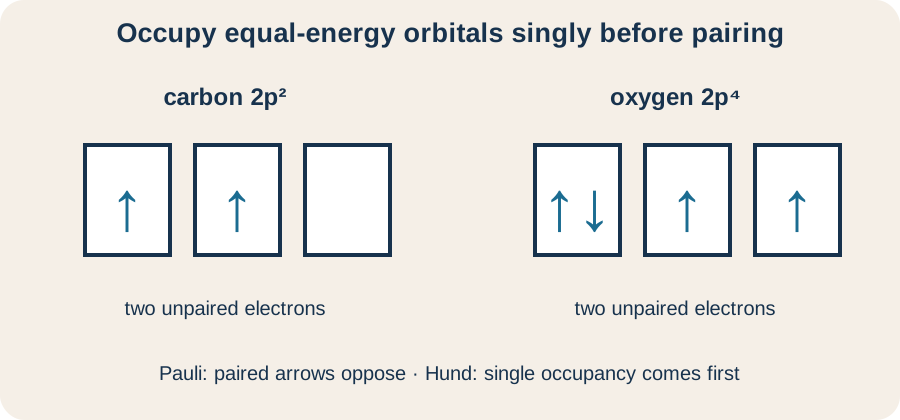
Hund’s rule says electrons occupy equal-energy orbitals singly with parallel spin labels before pairing in the ground-state arrangement. For three orbitals, two electrons occupy two separate orbitals before sharing one. This pattern lowers energy through quantum-mechanical exchange and reduced pairing effects in the model. It also predicts unpaired electrons and magnetic behavior. Hund’s rule applies among degenerate orbitals, not across arbitrary different energies.
Build configurations and orbital diagrams
Carbon has atomic number six, so a neutral carbon atom has six electrons. Its ground-state configuration is . The first and second orbitals are filled with paired electrons. The two electrons occupy separate orbitals with parallel spin labels under Hund’s rule. This leaves two unpaired electrons in the elementary isolated-atom picture.
Oxygen has eight electrons and configuration . In the three orbitals, place one electron in each before pairing the fourth. The resulting diagram has two unpaired electrons. Filling one orbital completely before using the others would violate Hund’s rule. Orbital diagrams expose information compressed by configuration notation.
Noble-gas shorthand replaces inner completed subshells with a bracketed noble-gas symbol. Sodium can be written . The bracket does not mean multiplication; it represents neon’s complete electron configuration as a core. Shorthand highlights outer electrons while preserving total accounting. Verify total electrons whenever constructing or reading it.
Distinguish core and valence electrons
Core electrons occupy inner filled regions and are usually less directly involved in ordinary bonding. Valence electrons occupy outer or chemically active orbitals and participate most directly in reactions. For main-group elements, valence count often corresponds to group patterns. Sodium’s displays one valence electron beyond a neon-like core. Chlorine’s displays seven.
The phrase “outer shell” works best for main-group introductions but becomes more complicated for transition metals. Electrons in nearby and orbitals can both participate in bonding and ion formation. Simple group-number rules have exceptions and limited domains. State whether the discussion concerns main-group atoms. Chemistry rewards models used within their scope.
Valence electrons matter because their orbitals extend farther and overlap when atoms approach. They are also shielded by core electrons and often require less energy to rearrange or remove. Core electrons still influence effective nuclear charge, polarizability, spectroscopy, and high-energy processes. “Less directly reactive” does not mean irrelevant. The division is functional rather than absolute.
Explain shielding and effective nuclear charge
An outer electron is attracted by every proton but repelled by other electrons. Inner electrons partially shield it from the full nuclear attraction. Effective nuclear charge is often summarized qualitatively as , where is proton count and is a shielding estimate. The equation is a model, not exact subtraction of integer charges. Different orbitals experience different penetration and shielding.
An orbital with more probability density near the nucleus penetrates inner electron regions more strongly. Within one shell, orbitals generally penetrate more than , which penetrate more than in introductory comparisons. Greater penetration exposes an electron to stronger nuclear attraction. This helps explain subshell energy ordering. Shielding is not a physical wall that completely blocks force.
Across a period, increases while added valence electrons enter the same principal shell. Shielding increases less than nuclear charge in the broad trend, so effective attraction generally strengthens. Down a group, new shells increase distance and core shielding. These competing effects drive many periodic patterns. A trend explanation should name which factors change and which dominates.
Derive atomic-radius trends
Across a main-group period from left to right, atomic radius generally decreases. Proton count increases while valence electrons occupy roughly the same shell. Increasing effective nuclear attraction pulls electron density inward. Electron-electron repulsion partly opposes the contraction but usually does not dominate the broad trend. The result is a pattern with local exceptions and definition dependence.
Down a group, atomic radius generally increases. Each step introduces an additional occupied shell, placing valence density farther from the nucleus. Increased shielding reduces how strongly outer electrons experience the added protons. The new shell effect dominates the broad comparison. Distance and shielding must both appear in the explanation.
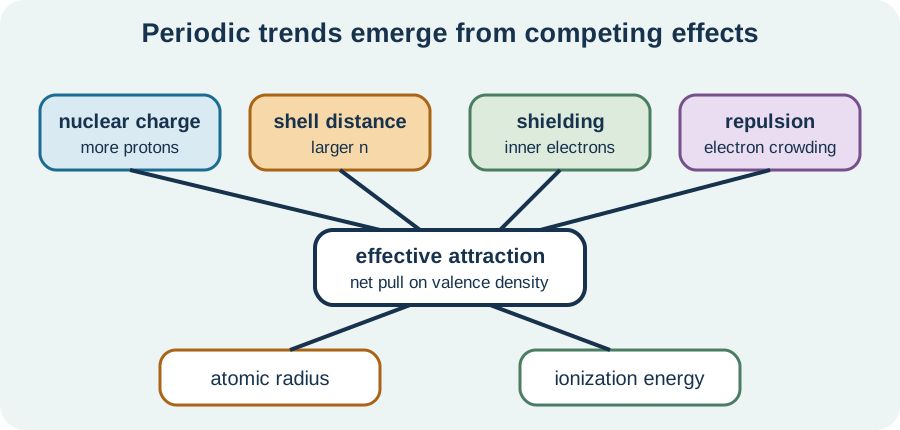
Atomic radius is not a single sharply bounded property because electron density fades gradually. Covalent, metallic, and van der Waals radii use different operational definitions. Comparisons should use consistent definitions and chemical environments. Trend arrows are summaries rather than exact universal inequalities. Data remain necessary for close cases.
Connect ionization energy to electron binding
First ionization energy is the energy required to remove one electron from a gaseous neutral atom in its ground state. A general process is . Energy must be supplied, so ionization energy is positive under this convention. Stronger attraction and smaller radius generally increase the required energy. Greater shielding and distance generally reduce it.
Across a period, first ionization energy generally increases as effective nuclear attraction strengthens. Down a group, it generally decreases because outer electrons occupy larger, more shielded shells. Subshell structure and electron pairing create exceptions. For example, removing an electron from a higher-energy or paired orbital can be easier than a simple monotonic rule predicts. Configuration explains deviations from the broad trend.
Successive ionization energies remove additional electrons from an increasingly positive ion. They therefore generally rise. A very large jump appears when removal begins from a stable inner core after valence electrons are gone. This pattern can reveal valence count for main-group elements. It does not imply atoms literally decide to stop; it records energy costs.
Connect electron affinity and electronegativity cautiously
Electron affinity describes the energy change when a gaseous atom gains an electron under a defined convention. Sign conventions vary across sources, so state whether a positive number means energy released or required. The process probes attraction for an added electron and electron-electron repulsion. Broad periodic patterns contain important exceptions. A single arrow mnemonic is unreliable without a convention.
Electronegativity describes an atom’s tendency to attract shared electron density within a bond. It is a relative, model-dependent scale rather than a directly isolated atomic energy. Values depend on chemical environment and scale definition. Electronegativity generally increases across a period and decreases down a group. Effective nuclear attraction and distance provide the causal picture.
Electron affinity, ionization energy, and electronegativity are related but not interchangeable. One concerns adding an electron to a gaseous atom, one removing an electron, and one sharing density in a bond. Their units and definitions differ. Trend similarities arise from shared electronic causes. Precise vocabulary prevents false equivalence.
Form ions through electron accounting
An ion has unequal proton and electron counts. Charge in elementary-charge units is proton count minus electron count. Losing electrons produces a positive cation, while gaining electrons produces a negative anion. The nucleus does not change during ordinary ion formation. Changing proton count would change the element.
Sodium with eleven protons and eleven electrons has configuration . Removing the electron produces with ten electrons and a neon-like configuration. Chlorine gains one electron to fill its subshell and form . These configurations help explain common ion charges. Energy of the entire chemical process, not configuration aesthetics alone, determines whether ion formation is favorable.
Cations are usually smaller than their neutral atoms because electron loss reduces repulsion and may remove an entire outer shell. Anions are usually larger because added electron density increases repulsion within the same nuclear charge. Isoelectronic species have equal electron counts but different proton counts. Within such a series, more protons generally pull the shared electron configuration tighter. Electron counting plus nuclear charge explains the ordering.
Explain why spectra contain discrete lines
Atomic electron energies are quantized, so only particular state energies are allowed. A transition between initial and final states involves energy difference . Absorption requires incoming energy matching a positive upward difference. Emission releases energy when an electron moves to a lower state. The photon magnitude obeys .
The constant is Planck’s constant and is photon frequency in inverse seconds, also called hertz. Photon energy can also be written , where is light speed and is wavelength. Higher frequency means higher energy, while longer wavelength means lower energy. Units must be consistent before numerical calculation. The horizontal fraction expresses inverse wavelength dependence.
Because only certain energy differences occur, isolated atoms produce discrete absorption and emission lines. Each element’s set of lines acts as a spectroscopic fingerprint under stated conditions. Astronomers identify elements in stars by comparing observed wavelengths with laboratory spectra. Spectral intensity and line shape contain additional information beyond identity. Quantization makes remote chemical analysis possible.
Connect valence structure to bonding
When atoms approach, their nuclei and electron distributions interact. The total energy includes electron-nucleus attractions, electron-electron repulsions, nucleus-nucleus repulsion, and quantum kinetic contributions. A stable bond corresponds to a lower-energy arrangement at a finite separation relative to separated atoms under the specified conditions. No single attractive pair explains the whole balance. Bond length occurs where competing energy effects produce a minimum.
Ionic models emphasize electron transfer and attraction between resulting charges. Covalent models emphasize shared electron density and orbital combination. Metallic models emphasize delocalized electrons across many atomic centers. Real bonding often combines these idealized characters. Valence configuration helps predict which interactions are accessible.
The octet rule summarizes many main-group patterns but is not a universal cause. Hydrogen follows a duet pattern, electron-deficient compounds exist, odd-electron species exist, and expanded valence descriptions appear in common models. A better explanation asks whether the molecular electron arrangement lowers total energy and satisfies quantum constraints. Rules are compressed observations with domains. Exceptions reveal the underlying physics rather than breaking chemistry.
Relate unpaired electrons to magnetism
An atom or species with one or more unpaired electrons is paramagnetic in the elementary model and is attracted into a magnetic field. A species with all electrons paired is diamagnetic and responds differently. Orbital diagrams make unpaired counts visible. Configuration notation alone may require expansion into boxes. Magnetic measurements can test electronic models.
Oxygen atoms with have two unpaired electrons under Hund’s rule. Molecular oxygen also displays paramagnetism, though explaining it correctly requires molecular orbital theory rather than simply combining atomic diagrams. This famous evidence shows why bonding models must extend atomic orbitals. Observation constrains model choice. A Lewis structure alone does not capture every electronic property.
Spin terminology should not be interpreted as literal balls rotating in space. Spin is an intrinsic quantum property with measurable angular-momentum and magnetic effects. Arrow diagrams encode allowed projections and occupancy relationships. They are bookkeeping tools grounded in quantum rules. Literalizing the icon creates misconceptions.
Understand excited states and chemical energy
The ground state is the lowest-energy allowed electron arrangement under specified conditions. An excited state has one or more electrons in higher-energy allowed states. Absorbing light, electrical energy, or collision energy can create excitation. Excited states often have finite lifetimes. Relaxation can release photons or transfer energy nonradiatively.
Chemical reactions rearrange electrons among molecular states, not merely isolated atomic shells. Bonds break and form as the total electronic structure evolves with nuclear positions. Activation energy describes a barrier along a reaction pathway. Products can be lower in energy even when the reaction requires an initial input. Atomic configuration trends prepare this reasoning but do not replace molecular energy analysis.
Energy units include joules per photon, electronvolts per particle, and kilojoules per mole. Conversions must state the counting scale. Multiplying one-particle energy by Avogadro’s constant gives energy per mole. A wavelength calculation produces photon energy, not automatically reaction enthalpy. Units identify what is being counted.
Use periodic trends as causal predictions
A trend problem should begin by identifying the compared species and electronic changes. Ask whether they lie across a period, down a group, or in an isoelectronic series. Then compare nuclear charge, occupied shell, shielding, penetration, and repulsion. State which effect dominates the broad expectation. Check for subshell or charge complications.
For neutral sodium and chlorine in the same period, chlorine has greater nuclear charge while valence electrons remain in shell three. Effective attraction is stronger, so chlorine’s atomic radius is generally smaller. For sodium and potassium in the same group, potassium adds shell four and has more shielding. Potassium is generally larger and its first valence electron is easier to remove. These explanations transfer better than memorized arrows.
For , , , and , each species has ten electrons. Proton counts increase from eight through eleven. Greater nuclear charge pulls the same electron count inward more strongly. Radius therefore generally decreases in that order. Isoelectronic comparison isolates nuclear-charge effect clearly.
Recognize the limits of simplified electron models
Shell diagrams suggest electrons occupy circular layers, which helps count valence electrons but misrepresents probability distributions. Orbital box diagrams capture occupancy and spin but hide spatial shape. Hydrogen-like orbital images neglect electron correlation and environment. Effective nuclear charge compresses a complex many-electron problem. Every model trades detail for usability.
Electron configurations of isolated gaseous atoms do not fully describe atoms in molecules, solids, solutions, or excited states. Orbitals can hybridize or combine into molecular and band states. Oxidation states are formal electron-accounting devices, not direct maps of complete charge transfer. Partial charges depend on definitions and environment. Use the model matched to the question.
Computational chemistry uses approximate wavefunctions or electron densities with stated methods and basis sets. More elaborate calculations do not eliminate modeling choices. Experimental spectroscopy, magnetism, structure, and thermochemistry test predictions. Scientific understanding grows through agreement and productive disagreement between models and observations. Introductory rules belong within that evidence cycle.
Verify configurations and trend explanations
Begin with atomic number, charge, and electron count. For ions, use electrons equal protons minus signed positive charge or plus the magnitude of negative charge. Build the configuration in an accepted energy order and check total superscripts. Expand valence orbitals into a diagram when spin or unpaired count matters. State known exceptions rather than forcing a mnemonic.
For a trend, identify the compared electron shells and charges. Explain nuclear attraction, distance, shielding, penetration, and repulsion in words. Avoid using the trend itself as its explanation. Check whether the comparison involves neutral atoms, ions, or isoelectronic species. Use experimental data when close exceptions matter.
For spectra, define initial and final energies, sign convention, photon relation, and units. For bonding, discuss total-energy change rather than declaring atoms want a configuration. Compare the model’s prediction with observation. A rigorous answer links symbols, physical mechanism, and evidence. Electron reasoning should remain explicit.
Diagnose common mistakes
One mistake draws fixed planetary paths and calls them orbitals. Replace paths with allowed quantum states and probability patterns. Another fills one degenerate orbital completely before occupying others. Apply Hund’s rule and Pauli exclusion together. Count electrons after every configuration.
Trend mistakes often cite shielding across a period as though it exactly cancels added protons. Added electrons enter the same broad shell, and effective attraction generally increases. Down a group, new shells and shielding dominate. State competing effects and direction. Memorized arrows without mechanisms fail on ions and exceptions.
Bonding mistakes treat the octet rule as a force or conscious goal. Stability concerns total energy under quantum and electrostatic constraints. Spectral mistakes assume an electron can emit any color while changing energy continuously. Quantized differences restrict photon energies. Words should match the physical model.
Practice configuration, trends, and spectra
Write ground-state configurations and valence counts for carbon, oxygen, sodium, and chlorine. Draw orbital diagrams for the electrons of carbon and oxygen. Count unpaired electrons. Explain each placement using Pauli exclusion and Hund’s rule. Identify the limitation of treating isolated-atom diagrams as molecular bonding diagrams.
Rank atomic radius for sodium, magnesium, and chlorine and explain the broad order. Then rank , , , and by radius. State which electronic factor changes in each comparison. Avoid citing trend arrows alone. Distinguish neutral-period and isoelectronic reasoning.
An atom emits a photon of frequency . Using , calculate photon energy. Explain what the sign of atomic energy change would be during emission. State why only certain frequencies appear for an isolated atom. Attach units at every step.
Solutions and reasoning
Carbon is with four main-group valence electrons and two unpaired electrons. Oxygen is with six valence electrons and two unpaired electrons. Sodium is with one valence electron. Chlorine is with seven. Pauli limits two opposite-spin electrons per orbital, while Hund distributes electrons singly before pairing.
Across period three, broad radius order is because effective nuclear attraction increases within the same valence shell. The ten-electron isoelectronic series is . Proton count increases across that series while electron count stays fixed. Greater nuclear charge contracts the electron distribution. The reasoning differs from merely moving across neutral atoms.
Photon energy is . Seconds cancel, leaving joules per photon. During emission, the atom moves to lower energy, so under final-minus-initial convention. The emitted photon carries positive energy magnitude . Quantized state differences allow only certain frequencies.
Carry electron structure into bonding and materials
Electron arrangement explains why periodic patterns repeat, why atoms form characteristic ions, why spectra contain lines, and why valence structures guide bonding. The explanation begins with charge and quantum constraints rather than slogans. Shell distance, shielding, penetration, repulsion, and nuclear charge interact. No one factor governs every comparison. Trends are causal summaries with exceptions.
The next step is to study how atomic orbitals and electron counts reorganize when atoms combine. Lewis structures, valence-bond models, molecular orbital theory, and band theory answer different levels of that question. Spectroscopy and magnetic behavior test those models. Materials design uses electronic structure to tune conductivity, color, reactivity, and strength. Atomic electron ideas become tools for understanding collective matter.
When explaining chemical behavior, name the species, charge, configuration, relevant electrons, energy change, and model limits. Use units in spectral and energetic calculations. Connect claims to observable trends or measurements. That practice turns electron diagrams into a reasoned account of chemistry rather than a set of boxes to fill. The explanation is complete only when structure is connected to observable behavior.